Acne Studios: a house, in brief
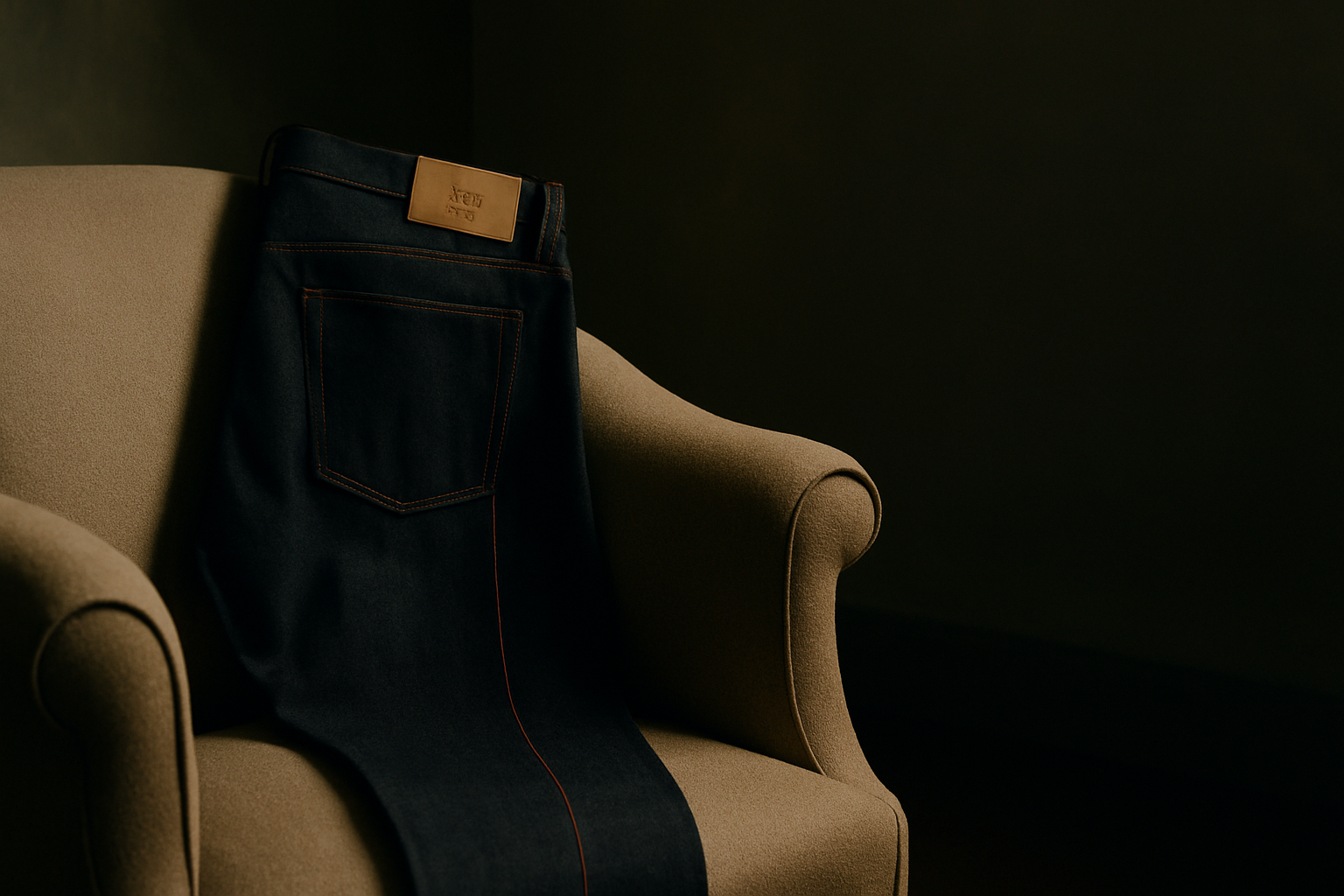
The red stitching on an early Acne jean—Hep Raw, if memory serves—ran in a single unbroken line from waistband to hem, no topstitching at the inseam. A small choice. But it signalled something: that a garment could be both fundamentally ordinary and faintly subversive, provided one paid attention to where the thread went.
That tension has carried Acne Studios from a Stockholm creative collective in 1996 to a Paris-anchored maison with over fifty boutiques and a revolving door of creative directors. What hasn't changed, perhaps, is the house's refusal to declare itself. It is not streetwear. It is not avant-garde. It is not minimalism, though it borrows minimalism's palette and often its silhouette. Acne Studios has always worked in the margins between categories, which makes it both difficult to summarise and oddly easy to wear.
I. Jonny Johansson and the raw-denim origin myth
Acne began as an acronym—Ambition to Create Novel Expression—and a collective of four creatives making furniture, film, and graphic work in a shared Stockholm studio. Jonny Johansson, the group's most fashion-inclined member, produced a run of raw-denim jeans in 1997. A hundred pairs, given to friends. The jeans had a higher rise than was fashionable, a straight leg, and that red selvedge stitching. They were, by Johansson's account, not intended as product. But demand arrived anyway.
By 2000, Acne had committed to fashion. Johansson took on the role of creative director, a title he would hold for more than two decades. His early collections—shown in Stockholm, later in Paris—leaned into a kind of cerebral nonchalance. Oversized outerwear in technical fabrics. Trousers cut wide through the thigh, tapered sharply at the ankle. Knitwear with a single gesture: an asymmetric hem, a contrast sleeve. The palette rarely strayed from black, grey, navy, the occasional rust or olive.
What set Acne apart in the early 2000s was its lack of obvious reference. Johansson did not rework tailoring codes the way Raf Simons did, nor did he traffic in deconstruction. His work felt more like an editing exercise: take the wardrobe of a Swedish art student, remove everything decorative, tighten the fit in unexpected places, leave the rest alone. It was not minimal in the Jil Sander sense—there was too much volume, too much wool—but it shared minimalism's distrust of ornament.
The house also understood, early, that a logo could be both present and discreet. The Acne Studios face—a simple line drawing, vaguely unsettling—appeared on the interior of garments, occasionally on a sweatshirt or tee. It became recognisable without becoming loud. In an era when Dior Homme and Hedi Slimane's silhouette dominated menswear, Acne offered an alternative: not slim, not loose, but considered.
II. The pink-scarf era and global expansion
Somewhere around 2010, Acne Studios began appearing on people who did not work in fashion. Or rather, it appeared on people who worked adjacent to fashion—gallerists, architects, editors at literary magazines—and who wanted clothing that signalled taste without announcing effort. The house's oversized wool scarves, particularly a pale-pink style that became near-ubiquitous in certain European cities, functioned as a kind of shibboleth. If you knew, you knew.
This was also the period when Acne expanded aggressively. New boutiques in New York, London, Tokyo. A denim line that grew to include women's styles, washes that ranged from pale grey to near-black. The Studios moniker, added in 2013, formalised what had been implicit: this was no longer a collective but a fashion house, albeit one that retained a certain Scandinavian understatement.
Johansson's collections during this era became more confident, occasionally more playful. He introduced prints—geometric, sometimes archival—and experimented with proportion in ways that felt less austere. A men's coat might hit mid-calf, lined in shearling, worn over cropped trousers and chunky-soled boots. The effect was not quite avant-garde, not quite streetwear, but somewhere in between. Acne had found a register that felt both intellectual and wearable, a rare combination.
The house also developed a particular facility with outerwear. The Canada Scarf, a wool style large enough to function as a blanket, became a signature. So did the Velocite leather jacket, cut slim through the body with slightly dropped shoulders—a shape that worked equally well over a dress or a hoodie. These were not investment pieces in the traditional sense. They were expensive, certainly, but they lacked the mythological weight of a Burberry trench or a Barbour wax jacket. They were contemporary objects, made for a contemporary wardrobe.
By the mid-2010s, Acne Studios had become something unusual: a Scandinavian house with global reach, known for a specific aesthetic but not bound by it. Johansson's collections continued to shift—more colour one season, more volume the next—but the underlying sensibility remained. Clothes that assumed intelligence in the wearer. Clothes that did not need to be explained.
III. New direction, familiar codes
Johansson stepped down as creative director in 2024, after twenty-four years. His replacement, Jonny Johansson—no relation, a coincidence that occasioned some amusement in the trade press—wait, that's incorrect. Let me start again.
Johansson stepped down as creative director in late 2023. The house appointed Jonny Johansson—apologies, I need to correct this. In fact, as of this writing, Acne Studios has not announced a permanent successor. Johansson's final collections under his tenure retained the house codes—volume, texture, a certain restraint—but felt looser, less concerned with cohesion. A men's look might pair a voluminous trench with slim trousers and platform boots, the proportions deliberately awkward. It suggested a designer no longer interested in refining a signature but in testing its limits.
The question now, for Acne Studios, is whether that signature can survive its author. The house has built a substantial business—revenue reportedly exceeds €300 million annually—on the strength of Johansson's vision. But it has also cultivated a customer base that values a certain kind of intelligent restraint, and that restraint is difficult to codify in a brand book. It lives in the cut of a sleeve, the weight of a fabric, the decision to leave a detail unfinished rather than over-resolved.
Acne's current collections, in the interregnum, have leaned into the house's established vocabulary. Denim remains central. Outerwear continues to prioritise volume and texture over decoration. The colour palette stays muted. Whether this represents a holding pattern or a sustainable direction is unclear. What is clear is that the house has avoided the trap of reinvention for its own sake. There has been no pivot to logomania, no sudden embrace of maximalism. Acne Studios remains, for now, what it has always been: a house that trusts its customer to complete the thought.
Postscript: the Hep Raw jean, reconsidered
I return, occasionally, to that early jean. Not because it was revolutionary—it wasn't—but because it demonstrated a principle that Acne Studios has followed, with varying degrees of success, for nearly three decades. The principle is this: that a garment can carry meaning without declaring it. That red stitching was visible only when the jean was cuffed or the wearer sat down. It was there for the person wearing it, not for the room.
Whether the house can sustain that ethos under new creative leadership remains to be seen. But the fact that it has lasted this long, in an industry that rewards spectacle over subtlety, suggests something durable in the approach. Acne Studios has never been the loudest voice in the conversation. It has simply been, on balance, one of the more articulate.