Alexander McQueen's overlooked codes
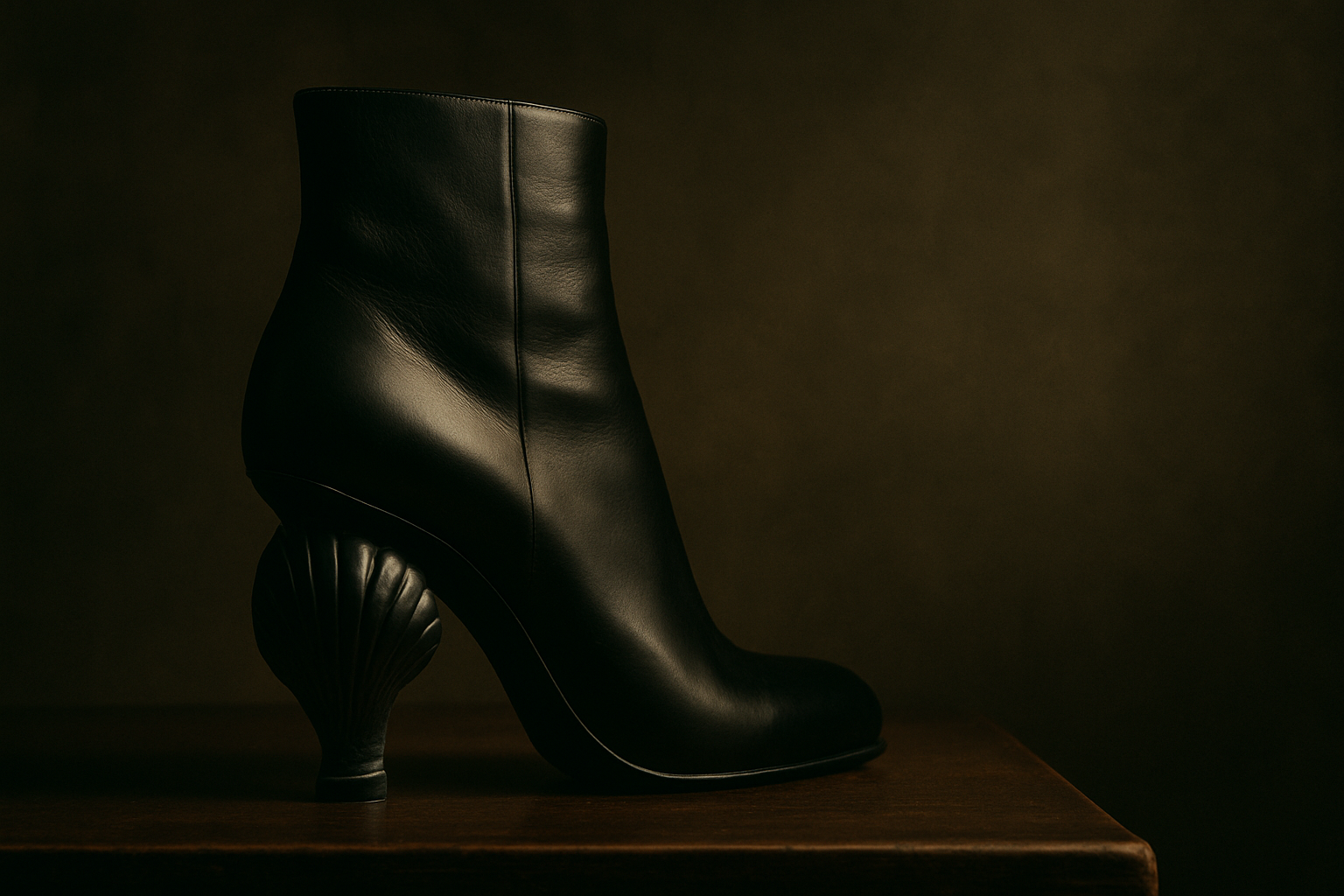
The first time you notice the scallop shell carved into the heel of an Alexander McQueen boot, it feels like a private joke. Not the armadillo shoe, not the bumster trouser, not the skull—just a small, precise detail that disappears the moment you put the boot on. It's there because Lee McQueen put it there in 1998, a nod to the Venus myth he'd been reading about, and because Sarah Burton kept it there twenty years later when no one was asking her to.
This is the part of Alexander McQueen that doesn't photograph well. The house built its reputation on spectacle—the spray-paint robots, the hologram of Kate Moss, the antlers, the ice palace—but underneath that was a tailor who learned his trade on Savile Row at sixteen and never stopped thinking about how cloth should move. The codes everyone knows are loud. The ones that matter are not.
The Foundational Years
Lee Alexander McQueen left school at fifteen, spent two years at Anderson & Sheppard learning to cut a sleeve, then moved to Gieves & Hawkes where he worked on military jackets and learned how to make a shoulder hold its shape under gold braid. By the time he enrolled at Central Saint Martins in 1990, he could already do what most graduates couldn't: make a pattern that accounted for the body underneath.
His graduate collection in 1992, bought in full by Isabella Blow, was called Jack the Ripper Stalks His Victims. The silhouette was Victorian, the construction was Edwardian, and the lining of one coat was printed with his own hair. This wasn't fashion as costume. It was fashion as autopsy—pulling apart the codes of British tailoring and putting them back together with the seams on the outside.
What followed were the bumsters, yes, but also the three-button jacket with a nipped waist that became the house's default tailoring shape. The low-slung trouser that exposed the base of the spine. The bias-cut dress that moved like liquid but held its line because McQueen had engineered the pattern to do exactly that. These weren't trends. They were structural decisions that became signatures.
The scallop shell appeared in the Spring/Summer 1998 collection, Untitled (Joan). McQueen had been reading about Joan of Arc and about Botticelli's Birth of Venus, and he carved the shell into the wooden heel of a boot because it connected both. It showed up again in 2001, in 2005, in 2010. By the time Burton took over in 2010, it was a house code that had never been marketed as one.
The Burton Era
Sarah Burton joined Alexander McQueen in 1996, worked her way up through womenswear, and became head of the atelier in 2000. When McQueen died in 2010, she was the obvious choice to succeed him—not because she could replicate his vision, but because she already understood the part of it that wasn't about vision at all. She knew how the patterns worked.
Burton's first collection for the house, Spring/Summer 2011, opened with a white dress covered in hand-painted feathers. It was delicate, it was beautiful, it was everything McQueen's work was not supposed to be. But the construction underneath was pure McQueen: a corset built into the bodice, a skirt cut on the bias, a hem that moved in a way that required the pattern to account for weight distribution across four panels. The surface was Burton. The engineering was the house.
She kept the scallop shell. She kept the three-button jacket. She kept the low-rise trouser, though she raised it slightly because the market had moved on. What she added was a new kind of embroidery—not the machine-applied crystals that had become standard in luxury fashion, but hand-worked florals that took the atelier six weeks to complete. The Duchess of Cambridge wore one of these dresses in 2011. It became the most famous dress Burton ever made, and it buried the fact that the bodice was a feat of structural tailoring that most houses couldn't have executed.
The Harness bag, introduced in 2015, was Burton's first major accessory success. It wasn't a logo bag. It didn't have a name that referenced a founder or a city or a year. It had a leather harness that wrapped around the body, and it sold because it looked like nothing else on the market. This was the McQueen approach to product: make the construction the signature.
Burton's tenure lasted thirteen years. In that time, she turned Alexander McQueen into a house that could do two things at once—maintain the theatrical language McQueen had invented, and run a business that sold tailoring, dresses, and bags at a scale that required four collections a year. The scallop shell stayed in the heel. The atelier stayed in London. The house stayed strange.
The Current Codes
Seán McGirr took over as creative director in October 2023. His first collection for Alexander McQueen, shown in March 2024, opened with a black leather jacket worn over a pleated skirt. The jacket had the three-button silhouette. The skirt had the bias cut. The look was McGirr's, but the codes were still there.
What McGirr has done—and it's too early to say if it will hold—is lean into the part of McQueen's work that was about Irishness and Britishness as parallel traditions. McQueen was born in Lewisham to a Scottish mother and an English father, and his work always carried the tension between the two. McGirr is from Meath. His first collection included Aran knit patterns, tartan, and a leather trench that referenced both the IRA and the British military. It was provocative in the way McQueen's work was provocative, which is to say it was specific.
The scallop shell is still there. So is the three-button jacket. So is the low-rise trouser, now cut slightly higher because the market has moved again. The house's tailoring is still constructed the way McQueen learned to construct it on Savile Row—with a canvas interlining, a pad-stitched lapel, and a sleeve that sets into the shoulder without a single pucker. This is not the part of Alexander McQueen that gets written about, but it is the part that makes everything else possible.
The Harness bag is still in production. So is the Curve bag, introduced by Burton in 2020, which has a sculptural shape that requires the leather to be moulded over a wooden form before it's stitched. These are not logo bags. They do not have hardware that announces the house. They are recognisable because of their construction, which is the same reason a McQueen jacket is recognisable even when the label is cut out.
The Overlooked Part
There is a photograph of McQueen from 1997, taken backstage after the It's a Jungle Out There show. He is holding a pair of scissors, and he is cutting a seam out of a jacket that didn't sit right on the model. The show is over. The jacket will never be worn again. He is fixing it anyway.
This is the part of Alexander McQueen that doesn't make it into the retrospectives. The house is known for the spectacle, for the runway shows that were performance art, for the skull scarf that became a logo even though McQueen never intended it as one. But underneath all of that was a tailor who believed that construction was the only signature that mattered. The scallop shell is still carved into the heel because Burton understood that, and because McGirr understands it now.
The house is not what it was when McQueen was alive. It is quieter, more commercial, less willing to stage a show that will alienate half the audience. But the codes are still there. The three-button jacket still nips at the waist. The bias-cut skirt still moves the way it should. The atelier still pad-stitches the lapels by hand. You can buy a logo bag if you want one, but the house doesn't need you to. The construction will tell you what you're holding.