Brunello Cucinelli: a house, in brief
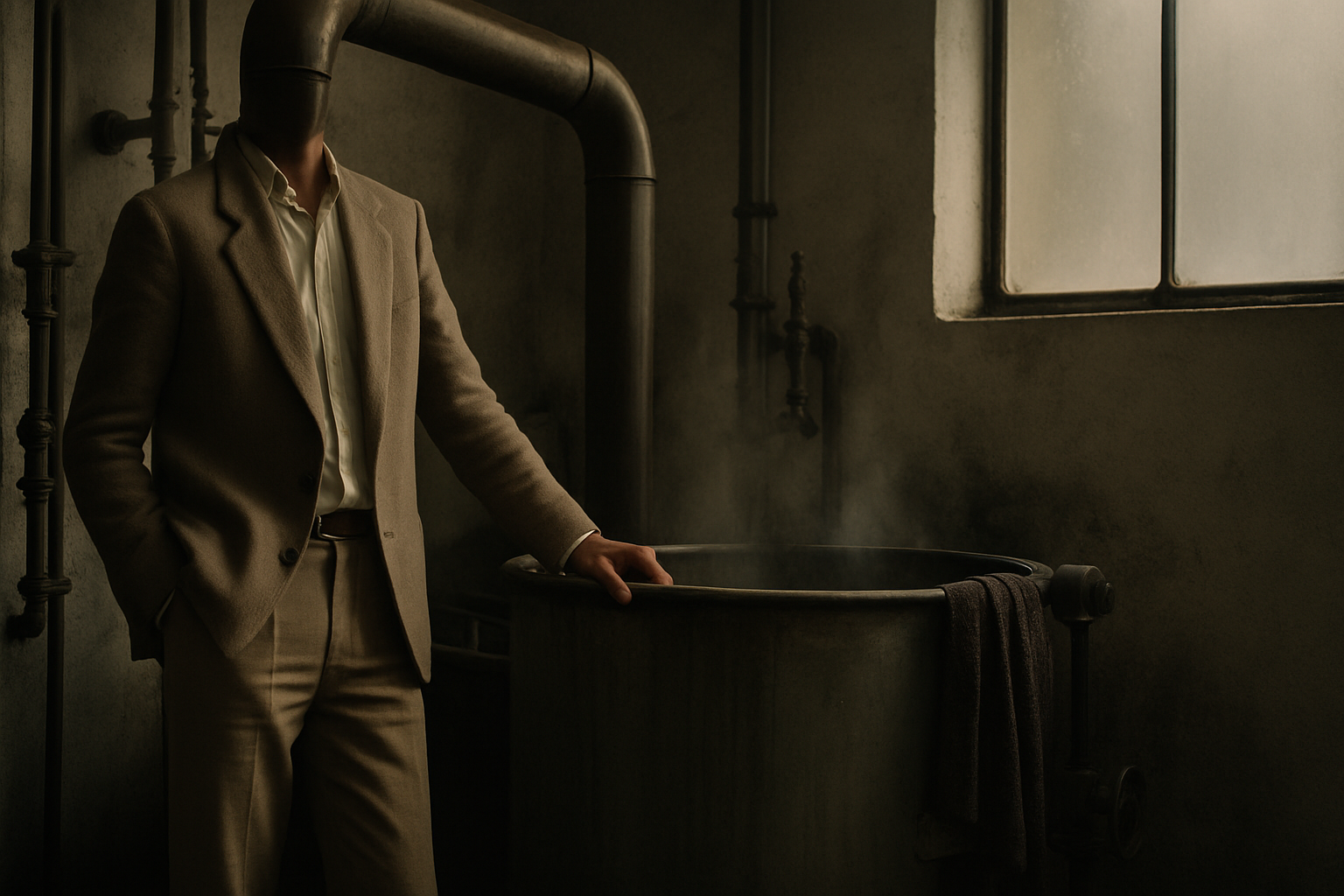
There is a photograph from 1985, not widely circulated, of Brunello Cucinelli standing beside a dye vat in a rented workshop outside Perugia. He is thirty-two. His hands rest on a bolt of cashmere, undyed, still the colour of wet sand. The caption, when it appears in Italian trade journals, notes that he has just placed an order for natural pigments — no synthetics — and that his first collection will consist of sweaters in twenty-eight shades, all derived from minerals and plants. One suspects he did not yet know he was founding a house. He thought he was solving a problem: how to make knitwear worth the price of the fibre.
That problem, and the way Cucinelli answered it, would define the next four decades.
The Solomeo Years: 1985–2000
Cucinelli did not begin with a manifesto. He began with cashmere, which in the mid-eighties was still a luxury material trapped in dowdy silhouettes. His insight was structural, not aesthetic. If you paid artisans fairly, gave them time, and used the best raw fibre available — Mongolian goat, combed by hand, spun to a fine gauge — you could charge accordingly. The product would justify the margin.
He set up in Solomeo, a fourteenth-century hamlet an hour from Perugia, population four hundred. The choice was both romantic and tactical. Rent was low. The surrounding region had a deep bench of knitwear specialists, many of whom had worked for larger houses and were willing to freelance. Cucinelli offered them year-round contracts and profit-sharing. In return, he asked for a level of finish — seams that lay flat, hems that rolled without puckering — that took time.
The early collections were narrow: crewnecks, cardigans, a few turtlenecks. Colours stayed close to the earth. Camel, taupe, a grey the house called pietra, stone. He sold through multi-brand boutiques in Milan and Florence, then into a handful of doors in New York and Tokyo. Growth was linear, not exponential. By 1995, revenue had reached twenty million dollars. Cucinelli owned the company outright.
What he did next is harder to parse. He bought the rest of Solomeo — the castello, the church, the piazza — and began a restoration that would take fifteen years. He built a theatre. He planted an amphitheatre. He established a foundation to teach Kant and Aristotle to local students. The line between corporate strategy and personal philosophy blurred, then disappeared. Cucinelli began speaking in public about humanistic capitalism, a term he never quite defined but which seemed to mean: pay people well, treat craft as sacred, resist the tyranny of the quarterly report.
Critics called it paternalism. Admirers called it a model. Either way, it worked. The house grew.
The Expansion: 2000–2012
Cashmere alone cannot sustain a maison. Cucinelli understood this earlier than most. In 2000, he introduced tailoring — unstructured blazers, trousers with a drawstring waist, shirts cut from linen so fine it felt like cotton. The palette stayed muted. The silhouette stayed soft. But the offer widened.
He was not inventing a new language. He was extending an existing one. The Cucinelli customer, by this point, was legible: a man or woman who worked in finance or law or medicine, who travelled frequently, who valued discretion over display. The house gave them a wardrobe that signalled taste without announcing wealth. A grey flannel suit, unlined. A suede bomber in the colour of wet clay. Loafers with a crepe sole, no hardware.
The tailoring succeeded because it felt inevitable. Of course a house that made the world's best cashmere would also make trousers. Of course those trousers would be cut with the same attention to hand-feel, the same refusal to rush. The logic was airtight.
In 2012, Cucinelli took the company public. The IPO raised a hundred million euros. He retained control — sixty percent of shares — and used the capital to expand retail. Standalone boutiques opened in Paris, London, New York, Hong Kong. Each store was designed to feel like a private library: oak shelving, linen upholstery, no music. The aesthetic was consistent to the point of rigidity. You could walk into a Cucinelli boutique in Seoul or Miami and know, within three seconds, where you were.
The house was no longer a knitwear specialist. It was a full-spectrum luxury brand, with handbags and shoes and a small but growing women's business. Revenue in 2012 topped three hundred million euros. Cucinelli, now fifty-nine, began appearing on lists of Italy's most admired CEOs. He did not seem to enjoy the attention.
The Present: 2012–Now
What has changed in the past decade is less the product than the context. Cucinelli still makes the same cashmere crewneck he made in 1985, still dyes it with natural pigments, still finishes the seams by hand. But the market around him has shifted. Quiet luxury, once a niche preference, is now a widely recognized category. Brands that spent the 2010s chasing logo-driven hype have pivoted toward restraint. Cucinelli, who never pivoted, finds himself at the centre of a conversation he did not start.
The house has responded by doing less, not more. Collections are smaller. Seasonal variation is minimal. A blazer introduced in 2015 is still in production, unchanged except for the occasional adjustment to shoulder width. This is not laziness. It is strategy. Cucinelli has argued, in interviews and shareholder letters, that fashion's obsession with newness is both economically wasteful and spiritually corrosive. Better to make fewer things, make them well, and let them persist.
The argument is easier to make when you control the company. Cucinelli answers to shareholders, but he does not answer to them in the way most public CEOs do. He has capped annual growth at ten percent. He has refused to open outlet stores. He has kept production in Italy, even as competitors have moved to Eastern Europe or Asia. These decisions cost margin. They also protect the house from the volatility that has destabilized larger groups.
Revenue in 2023 reached just over one billion euros. The house employs two thousand people, most of them in or near Solomeo. Cucinelli, now seventy-one, has not named a successor. One assumes he will not retire so much as fade into the background, the way certain patriarchs do, present but no longer central.
What Remains
There is another photograph, this one from 2022, of a Cucinelli atelier in Solomeo. A woman in her fifties sits at a wooden table, linking the sleeve of a cashmere cardigan by hand. The process takes forty minutes. She has been with the house for thirty years. Behind her, through a window, you can see the castello and the hills beyond it, green in summer, brown in winter, unchanging.
The photograph was taken for a corporate report. It was not meant to be poetic. But it captures something the house has spent four decades trying to articulate: that luxury, at its most durable, is not about scarcity or status. It is about time. Time to source the right fibre. Time to train the right hands. Time to let a seam settle before you press it. Cucinelli built a company on that premise. Whether the premise survives him is a question the market will answer, in time.