Fendi: a house, in brief
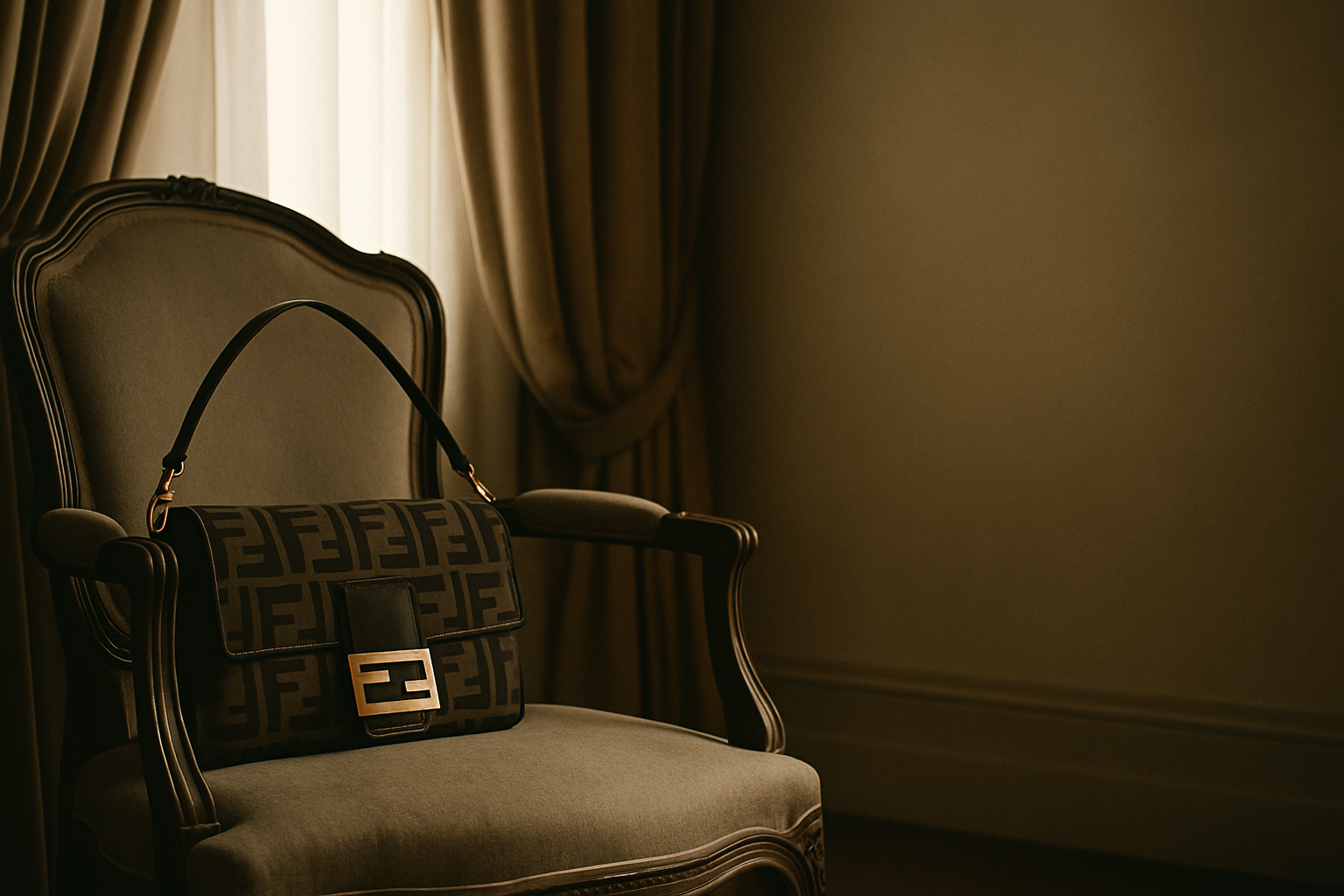
The Baguette came back in 2019 not because anyone asked for it but because Silvia Venturini Fendi knew it had never really left certain closets. The reissue wasn't marked by fanfare—just quiet restocks in colours the original run never touched. Fifteen years after Sex and the City turned a compact shoulder bag into shorthand for a certain kind of want, Fendi had the rare luxury of reviving something that still felt like theirs.
That confidence is structural. Most houses that span a century do so by shedding skin every decade. Fendi's trick has been to keep the same bones and let three distinct eras write over them without erasing what came before.
The fur and the sisters
Karl Lagerfeld arrived at Fendi in 1965, twenty-four years old and already bored of playing tasteful. The five Fendi sisters—Paola, Anna, Franca, Carla, Alda—had inherited their parents' fur and leather atelier on Via del Plebiscito and wanted to do more than line coats for Roman signore. Lagerfeld gave them more. He treated fur like fabric, not trophy. Sheared it, dyed it implausible colours, intarsia'd it with leather, reversed it so the pelt faced inward. The work was technical and unserious in equal measure, which is harder to sustain than it sounds.
By the seventies, Fendi wasn't just a fur house—it was the fur house that made fur feel like a choice rather than an inheritance. The double-F logo, which Lagerfeld sketched in an afternoon, became less a monogram than a signal: this is what happens when craft stops apologising for itself. The logo worked because it didn't need to. It sat on bags and buckles and the silk linings of coats that cost what a Fiat cost, and it never tried to explain.
What that era said about Fendi's intentions: we can make the most rarefied thing in the world and treat it like wool.
Venturini and the bag that bent the market
Silvia Venturini Fendi, third generation, took over accessories in 1994. Three years later she designed the Baguette—a small, short-strapped shoulder bag that arrived just as the late-nineties market was trying to figure out what women wanted now that logomania had curdled into self-parody. The answer, it turned out, was a bag that could be ornamental and functional in the same gesture. The Baguette wasn't minimal. It came in a hundred permutations: beaded, embroidered, shearling-trimmed, done in needlepoint that referenced Baroque upholstery or in sequins that referenced nothing at all. But it was scaled to fit under your arm like bread, and that physical fact made the decoration feel considered instead of compensatory.
Fendi produced the Baguette in limited runs, which back then wasn't standard practice—it was leaving money on the table. But it also meant the bag never became ubiquitous enough to become invisible. You saw one and registered it as a specific choice. The Peekaboo, which Venturini designed in 2008, worked on similar logic: structured, double-sided, engineered so the interior was as resolved as the exterior. It presumed the buyer would care about what happened when the bag was open on a desk or a restaurant banquette, which is a bet most accessories don't make.
What that era said: Fendi understood that a bag could be both an object and a system, and that women would pay for a system that worked.
Piccioli and the question of scale
Kim Jones arrived as artistic director of womenswear in 2020, but the more telling shift came a year earlier when Silvia Venturini Fendi handed day-to-day accessories oversight to a broader design team while remaining in a supervisory role. Jones brought streetwear fluency and a Rolodex that includes every collaborator who matters in the current market. His first collection featured shearling bombers and Baguettes reworked in monogram canvas, a material Fendi had used sparingly until then. The move was legible: bring in a younger customer without alienating the client who still buys a fur-lined coat every third winter.
It's working, in the sense that revenues are up and the Peekaboo remains in production alongside newer, more accessible styles. But there's a tonal shift. Where Lagerfeld's Fendi felt like it was made for women who didn't need to be convinced of anything, and Venturini's Fendi felt like it was made for women who knew exactly what they needed, Jones's Fendi feels like it's made for a customer who's still deciding. The clothes are polished, the collaborations are clever, the bags come in colourways that photograph well. But the house no longer feels like it's setting the terms.
Part of that is structural. LVMH, which took full control of Fendi in 2001, runs the maison the way it runs most of its portfolio: with an eye on quarterly growth and geographic expansion. The atelier is still in Rome, but the decisions get made in Paris. Fendi has opened flagships in Shanghai and Seoul and Miami, and those stores stock a product mix calibrated for customers who may not know the Baguette's history and don't need to. The bags work on their own.
What this era says: Fendi knows how to scale, and scaling means you stop speaking only to the people who were already listening.
What remains
There's a sample sale every January in a warehouse off Via Cristoforo Colombo. Employees and friends of employees line up in the cold for first access to last season's overstock: Peekaboos with interior colourways that didn't move, shearling coats in sizes no one ordered, scarves in prints that tested poorly in Asia. The sale is chaotic and slightly grim, which is true of all sample sales, but it's also one of the few places you can still see the full range of what Fendi makes. Not just the hits, but the misses. Not just the bags that end up on Instagram, but the bags that sit in the archive because they were too strange or too specific or too expensive even by Fendi's standards.
That range is what the house still has that most of its peers don't. Fendi can do a ₤6,000 intarsia fur coat and a ₤1,200 nylon Baguette and have both feel like they came from the same place, because they did. The question isn't whether Fendi can hold that range—it already does. The question is whether the market will keep rewarding a house that refuses to simplify itself into a single idea.
For now, the answer seems to be yes. The Peekaboo is in its seventeenth year of production. The Baguette is on its second or third revival, depending on how you count. And somewhere in the Rome atelier, someone is still shearing fur by hand, not because anyone under forty will buy it, but because that's what the house knows how to do.