Gucci: a house, in brief
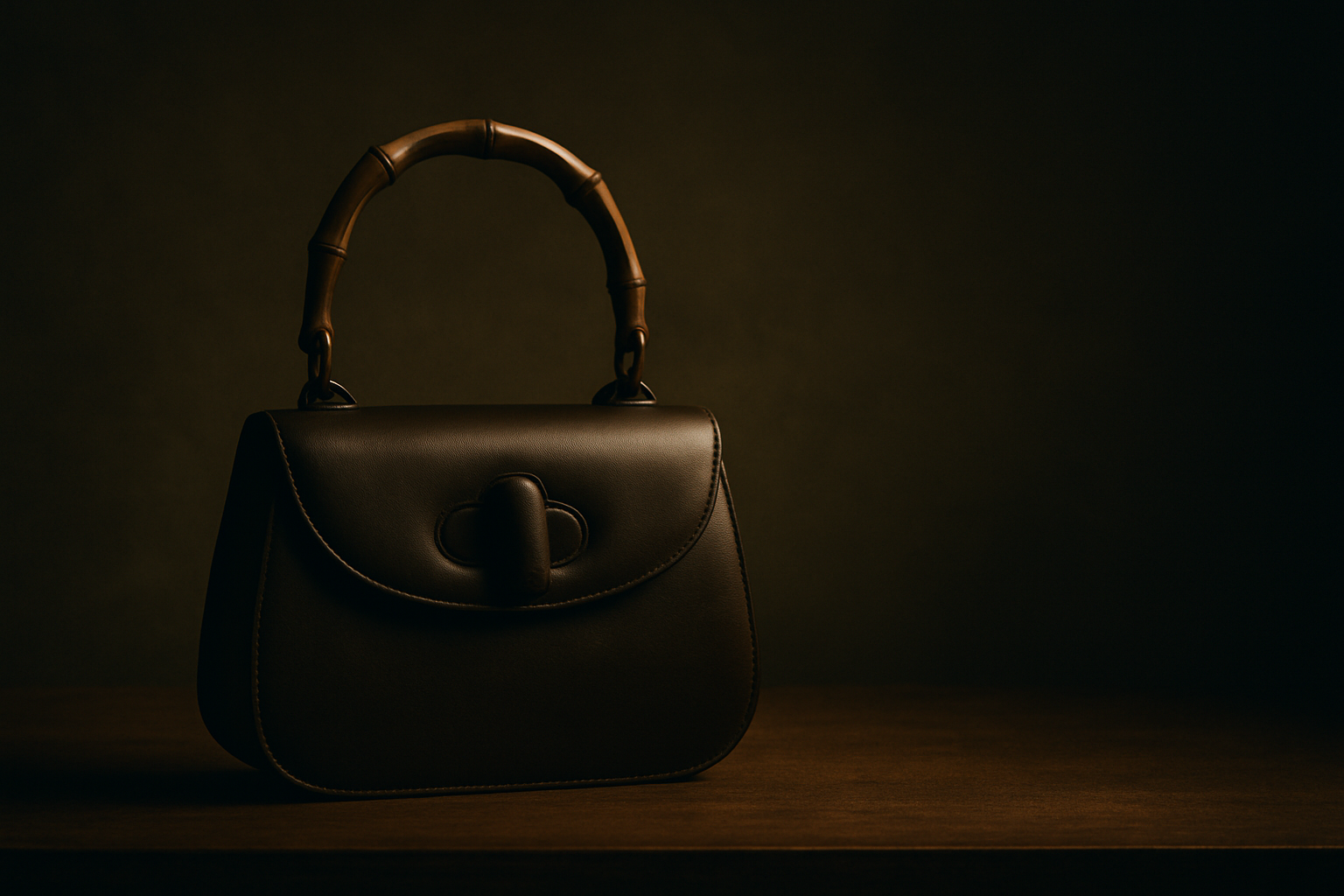
The bamboo handle on a 1947 top-handle bag — war-rationed leather, ingenuity in place of hardware — still curves the same way in the archive as it does in the current collection. One can trace a line from that first improvisation to nearly everything that followed. Not a straight line, certainly. But a line nonetheless.
Gucci has been many things over eight decades. A saddlery. A status marker. A logo run amok. A punchline, then a resurrection, then another resurrection. What it has never been, not for long, is static.
Guccio and the artisan proposition
Guccio Gucci opened his first shop in Florence in 1921, selling leather goods to the equestrian set and the occasional tourist. The origin story — that he worked at the Savoy in London and returned to Italy determined to replicate the luggage he'd seen in grand hotel lobbies — is tidy enough to be suspect. But the work itself was not theoretical. Gucci hired Florentine artisans who knew saddle construction, and the house applied that technique to handbags and small leather goods. The horsebit, the green-red-green stripe, the interlocking Gs: all came later, between the thirties and sixties, as the business expanded and required shorthand.
By the time Aldo Gucci, Guccio's son, took the reins in the fifties, the maison had moved decisively into accessories for a jet-set clientele. The bamboo bag became a signature, not because bamboo was precious but because it was available during material shortages and could be steam-bent into a handle. That pragmatism — finding a solution, then making it elegant — defined the house in its first few decades. Grace Kelly carried a flora-print scarf. Jacqueline Kennedy carried a shoulder bag that the house later renamed in her honour. Gucci was, by the seventies, the sort of name one dropped to signal arrival.
It also became, by the eighties, overextended. Licensing deals proliferated. The double-G logo appeared on keychains, lighters, toilet seats. Family infighting turned operatic. The brand that had once signified Florentine craft now signified something closer to airport duty-free. By 1993, Maurizio Gucci — Guccio's grandson, the last family member to control the company — had been forced out. He was murdered two years later. The maison, by then, had already begun the work of rebuilding.
Tom Ford and the body as canvas
When Tom Ford became creative director in 1994, Gucci was in receivership and losing cultural ground to Prada and Helmut Lang. Ford, a Texan who had studied architecture and worked under Cathy Hardwick and Perry Ellis, did not arrive with a thesis about Florentine heritage. He arrived with a point of view about sex.
The spring 1996 collection — low-slung velvet trousers, a satin shirt unbuttoned to the navel, a model in a g-string and a Gucci blazer — was not subtle. It was not trying to be. Ford understood that Gucci's logo had been devalued by overuse, and that the way back was not through handbags but through desire. He made clothes for women who wanted to be looked at, and he made them in jewel tones and bias-cut silk and liquid jersey that required a certain confidence to wear. The ads, shot by Mario Testino, were unapologetic. A model's pubic hair shaved into a G. Another model, naked, straddling a man in a suit. The images were calculated to provoke, and they did.
Ford also grasped that accessories could anchor a wardrobe if they carried erotic charge. The Gucci loafer, which had been around since the fifties, was re-proportioned: narrower, sleeker, with a stacked heel that changed the wearer's gait. The bamboo bag was revived, but smaller, worn cross-body, treated as an evening piece rather than a carryall. By 1999, Gucci's revenue had increased nearly tenfold. Ford had made the house relevant again, not by invoking its past but by making the present feel urgent.
When Ford and CEO Domenico De Sole left in 2004, the question was whether Gucci could sustain momentum without them. The answer, over the next decade, was: more or less. Frida Giannini, who took over in 2006, leaned into archive codes — the horsebit, the flora print, the bamboo handle — and produced work that was competent, commercial, and largely forgettable. The accessories sold. The ready-to-wear did not make headlines. By 2014, the house was stable but stalled.
Alessandro Michele and maximalist pastiche
Alessandro Michele's first Gucci show, in February 2015, arrived with less than a week's notice. He had been promoted from accessories design after his predecessor was dismissed, and the collection he presented — ruffled blouses, embroidered bombers, clashing florals, men in pussy-bow shirts — looked like nothing else on a runway that season. It also looked like several things at once: seventies glam, Victorian portraiture, secondhand-shop serendipity, a cabinet of curiosities given a Milanese budget.
Michele's Gucci was not interested in restraint. It was interested in accumulation. A loafer might have a horsebit, a backless mule construction, and an embroidered tiger. A handbag might combine bamboo, python, a chain strap, and a charm shaped like a bee. The effect was either enchanting or overwhelming, depending on one's threshold for ornament. What it was not, at any point, was minimal.
The strategy worked, commercially and culturally, for nearly seven years. Michele understood that Instagram rewarded visual density, and that younger clients — particularly in Asia and the United States — were less interested in quiet luxury than in pieces that announced themselves. Gucci's revenue nearly doubled under his tenure. The house became the most-searched luxury brand online. Celebrities wore the clothes not because they were elegant but because they were conversation pieces.
By 2022, though, the formula had begun to feel repetitive. Michele's collections, which once seemed like a reaction against minimalism, now felt like their own kind of orthodoxy. In November of that year, Kering — Gucci's parent company — announced his departure. The decision was framed as mutual. The timing suggested otherwise.
Sabato De Sarno and the return to codes
Sabato De Sarno, who took over in January 2023, came from Valentino and brought with him a different sensibility. His first collection, shown that September, stripped away much of Michele's baroque excess. The palette was softer: rosso ancora, a particular shade of red that De Sarno described as foundational to the archive, appeared on everything from leather jackets to evening gowns. The silhouettes were cleaner. The logo, when it appeared, was smaller.
The reaction was mixed. Some critics welcomed the recalibration. Others found the work too cautious, too concerned with not alienating Michele's audience while also courting a new one. The accessories — a new iteration of the Jackie, a bamboo-handle tote called the Gucci Bamboo 1947 — sold well enough. The ready-to-wear has yet to establish a clear identity. De Sarno has spoken about wanting to return Gucci to its roots as a leather-goods house, to emphasise craft over spectacle. Whether that approach will prove commercially viable in an era when spectacle drives social engagement remains to be seen.
The house, at present, is in a familiar position: between chapters. Not in crisis, but not yet settled. Revenue has softened. The cultural conversation has moved elsewhere. De Sarno has time — Kering is not known for impatience with its creative directors — but not infinite time.
What remains
Stand in the Gucci archive in Florence, and you will see the bamboo bag from 1947 next to a Tom Ford-era satin shirt next to one of Michele's embroidered bombers. The objects do not cohere into a single aesthetic. They cohere into a single fact: that Gucci has survived by refusing to be one thing for very long.
Whether that is a strength or a liability depends, in the end, on what one wants from a fashion house. Consistency, or adaptability. A clear point of view, or the ability to reinvent when the moment demands it. Gucci has chosen the latter, again and again. The bamboo handle curves the same way it did in 1947. Everything else is negotiable.