Gucci: a house, in brief
There is a photograph, not often reproduced, of Guccio Gucci standing in the doorway of his first shop on Via della Vigna Nuova in 1921. He wears a three-piece suit. Behind him, visible through the glass, are a half-dozen saddlebags and a single steamer trunk. The shop is narrow. The light is poor. One suspects he knew exactly what he was doing: taking the vocabulary of Florentine leather craft — centuries old, guild-regulated, built for horses and harness — and redirecting it toward the traveller. Not the aristocrat, necessarily, but the person who moved between cities and needed their belongings to arrive intact.
That redirection, modest as it appears in the photograph, is the hinge on which a century of Gucci turns.
The founding logic, 1921–1953
Guccio had worked at the Savoy in London. He understood luggage not as a category but as a series of problems: weight, closure, wear at the corners, what happens to vachetta leather when it meets rain. His first pieces — trunks, valises, hat boxes — addressed those problems using techniques borrowed from saddle-making. The result was a house style that felt, even then, like an argument: that rigour and portability could coexist, that one need not choose between craft and function.
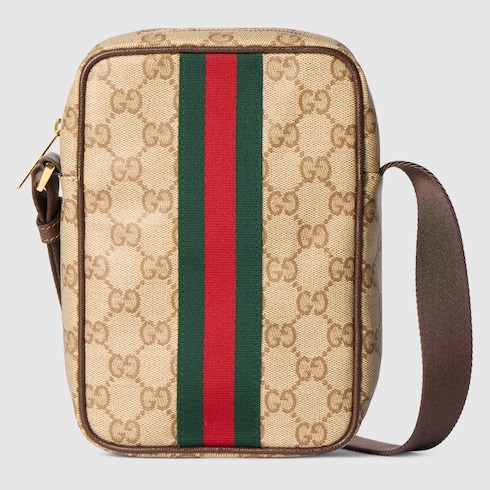
By the thirties, the atelier had introduced cotton canvas with a double-G weave, a response to wartime leather shortages but also a recognition that not every surface needs to be hide. The bamboo-handle bag appeared in 1947 — bamboo because steel was rationed, yes, but also because the material could be heat-curved into a grip that distributed weight across the palm rather than pinching at two points. These were not gestures toward novelty. They were solutions, and they carried a Florentine suspicion of excess.
What Guccio built, in other words, was a house predicated on movement. His clients were not sitting in salons. They were boarding trains.
Tom Ford's provocation, 1994–2004
By the early nineties, Gucci had become the sort of brand one inherits and does not open. Overextended licensing. Stores in secondary markets selling double-G key fobs and nylon duffels. The atelier work — what remained of it — had been smothered under accessible price points and a logo that no longer signified much beyond its own ubiquity.
Tom Ford, hired in 1990 as chief womenswear designer and promoted to creative director in '94, did not restore the archive. He interrogated it. The velvet suit he showed in his first major collection, autumn/winter 1995, was cut narrow through the shoulder and flared sharply at the hip. It looked, on the runway, like something between armour and provocation. The fabric was Milanese, the construction was Savile Row by way of Studio 54, and the effect was to ask a question the house had not posed in decades: what if luxury were not about restraint but about control?
Ford's Gucci was unapologetic in its sexuality, which is to say unapologetic in its understanding of the body as both subject and object. The satin shirt unbuttoned to the sternum. The python-skin pant. The ad campaigns shot by Mario Testino, in which models appeared less dressed than upholstered. This was not, strictly speaking, Florentine. But it was coherent. Ford had identified a vocabulary — sensuality, precision, a kind of mercenary glamour — and pursued it without hedging.
He also understood product. The Jackie bag, reissued in 1999, was not a replica of the 1961 original but a tightening of its proportions: smaller, sharper, engineered for the shoulder rather than the crook of the arm. The horsebit loafer, already in production since 1953, became a signature again, this time sold in jewel-toned suede and worn, often, without socks. Ford's genius was not in invention but in editorial judgement. He knew which pieces to revive, which to retire, and which to leave alone.
By the time he departed in 2004, Gucci's revenue had increased roughly tenfold. The house was, once again, a position.
Alessandro Michele's archive fever, 2015–2022
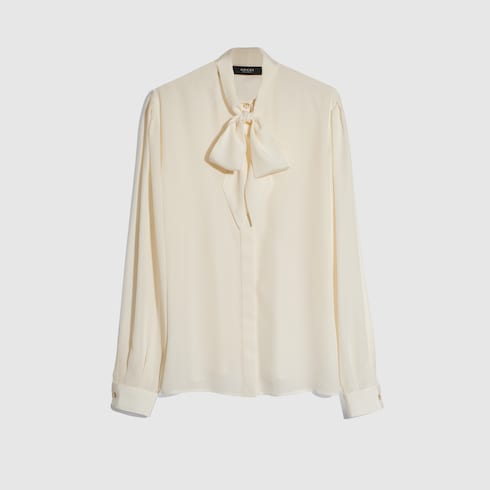
Alessandro Michele arrived without fanfare. He had spent twelve years in Gucci's accessories division, a side door into the creative director's office if ever there was one. His first collection, menswear for autumn/winter 2015, appeared six days after his appointment. The models wore pussy-bow blouses, embroidered cardigans, floral brocade suits, and eyeglasses that looked borrowed from a Milanese librarian circa 1973. The show notes referenced neither Ford nor Guccio. They did not need to. Michele had bypassed both.
What he proposed instead was a kind of magpie maximalism: Gucci as a house with access to a century's worth of references, all of which could be recombined, layered, and worn simultaneously. A dionysus bag with a tiger-head closure, named for the Greek god but styled like something out of a Roman sarcophagus. A loafer backless and lined in shearling. Suits in sky blue, salmon, canary yellow. If Ford had pursued control, Michele pursued abundance.
The strategy worked, commercially and culturally, for the better part of a decade. Gucci became the house one wore to signal fluency in a particular kind of referential play — not just fashion literacy but a willingness to treat the archive as a costume box rather than a canon. Michele's campaigns, art-directed in collaboration with photographer Glen Luchford and later others, leaned into surrealism, anachronism, and a studied disregard for the idea that a brand should have a single point of view.
By 2021, Gucci's annual revenue had reached nearly €10 billion. But the aesthetic had begun to curdle. What had felt, in 2015, like liberation from good taste now felt like a refusal to edit. The references piled up. The maximalism became rote. When Michele departed in November 2022, the announcement was framed as mutual, which in the trade usually means one thing.
Sabato De Sarno and the return to form
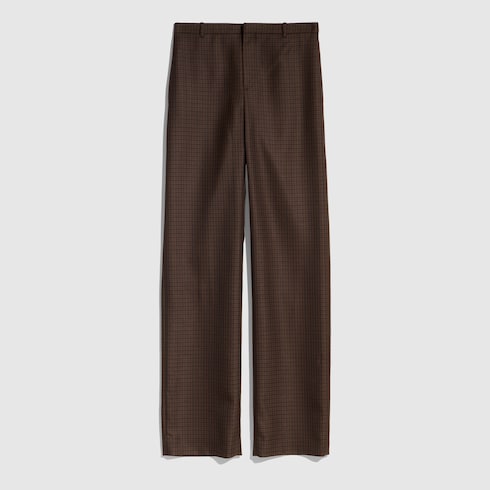
Sabato De Sarno, formerly design director at Valentino, took the role in January 2023. His first collection, shown that September, opened with a red shearling coat worn over a ribbed knit and tobacco-brown leather trousers. No embroidery. No tiger heads. The palette — rust, cream, charcoal, a lipstick red that recurred on bags and outerwear — felt less like a statement than a breath.
De Sarno has spoken, in interviews, about facture: the idea that a garment's value resides not in its references but in its construction. His Gucci is quieter than Michele's, more concerned with proportion and hand than with semiotics. The Blondie bag, introduced in his debut collection, features a round interlocking-G clasp in gold-tone metal, but the bag itself is soft, unstructured, made to slump rather than stand. It is, in that sense, a return to Guccio's first principle: solve the problem, then refine the solution.
Whether this approach will hold commercially is an open question. Kering, Gucci's parent company, has reported declining sales in recent quarters, a function of softening demand in China and the broader luxury slowdown. De Sarno's work is considered, intentional, and — this is not a criticism — still forming. One does not reverse a decade of aesthetic direction in eighteen months.
What remains
There is another photograph, this one from 2003, of Tom Ford standing in the Gucci atelier in Florence. He is holding a length of python skin, examining the scales near the tail. Behind him, a craftsman is hand-stitching the gusset of a bag, six stitches per inch, the thread waxed and pulled taut. Ford is wearing a black suit. The light, again, is poor.
What strikes you, looking at the image now, is not the contrast between the two men but the continuity. The atelier is the same room Guccio worked in eighty years prior. The tools have not changed. The python will become a bag, the bag will be sold, and someone will carry it onto a train. Gucci has always been, at its best, a house that understands this: that luxury is not about transcendence but about the thing in your hand, and whether it works.