Gucci's overlooked codes
The first thing you notice in the Gucci archive — if you're ever allowed close enough — isn't bamboo or horsebit or webbing. It's the piping. Narrow, tonal, sometimes in a contrasting grain direction. It runs along the edge of a 1964 shoulder bag in cognac calf, doubles back on itself at the gusset, and disappears into the lining seam. Nobody photographs piping. Nobody writes about piping. But it's there, doing the work of holding a silhouette taut without adding visible structure.
Gucci's recognisable codes — the ones that move product, that get memed, that land on mood boards — are well-established. We know the bamboo handle, the horsebit, the red-green-red stripe, the interlocking Gs. These are the house's calling cards, and they've been leveraged, archived, revived, and recontextualised across decades. But underneath that apparatus, quieter signatures have been running since Guccio Gucci opened the first Florence shop in 1921. They don't announce themselves. They accumulate.
Cotton canvas and the postwar shortcut
Gucci didn't start with leather. It started with hemp canvas, then shifted to cotton when material shortages during the Second World War made cowhide scarce and expensive. The canvas wasn't a luxury move — it was a pragmatic one. But Guccio Gucci, who'd spent time as a porter at the Savoy in London, understood that wealthy clients didn't want their luggage to look like deprivation. So the canvas was dense, tight-woven, finished with a subtle sheen that caught light like polished wood.
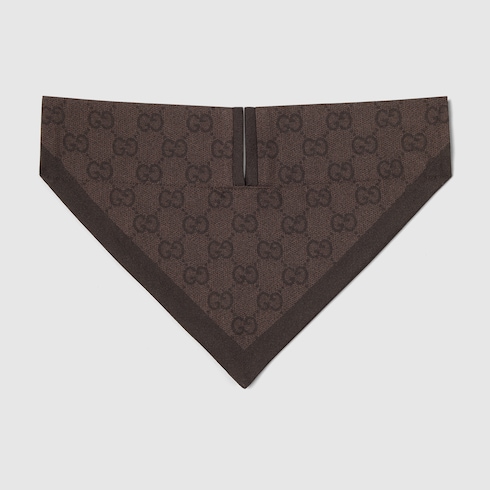
That canvas became the substrate for almost everything the house produced through the fifties. It's still in use now, though it's been rebranded as "GG Supreme" and treated with various coatings to meet contemporary durability standards. The pattern itself — the interlocking Gs in a diagonal grid — arrived in the early sixties, but the base cloth predates it by decades. What's notable isn't the logo. It's the hand: slightly stiff, resistant to slouch, engineered to hold a shape without internal reinforcement. You can feel it in a current Ophidia or Dionysus. The canvas does structural work that leather would require boning or layered construction to achieve.
Most houses that use coated canvas now do so as a cost play. Gucci's use has a different origin. It was necessity first, then identity, then — only later — economy.
The loafer that wasn't for walking
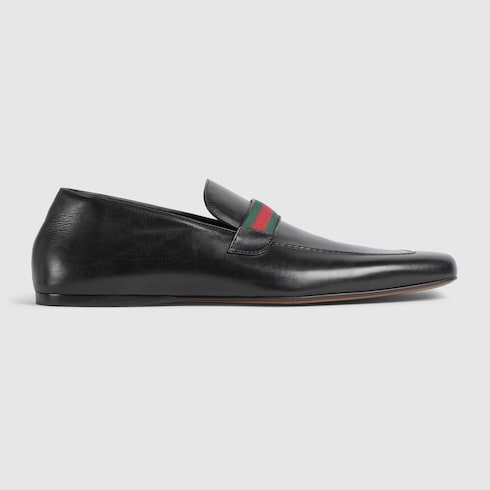
The Gucci loafer entered production in 1953. It's been written about extensively, mostly in the context of the horsebit detail or its adoption by various actors and musicians. What gets less attention is the last shape and the heel pitch.
The original loafer wasn't designed for pavement. It was designed for the kind of walking you do between a car and a restaurant, or across a yacht deck, or through a hotel lobby. The vamp is cut low, the topline sits below the ankle bone, and the heel — at roughly two centimetres — provides just enough lift to shift your weight forward without requiring a stride adjustment. It's a shoe for standing and for being seen standing.
That's a different design brief than, say, a Church's oxford or a Paraboot derby. Those are shoes for distance, for weather, for the Tube. The Gucci loafer is for controlled environments. And that distinction — luxury as a buffer against the elements, not an engagement with them — runs through much of the house's output. The bags aren't weatherproof. The shoes aren't orthotic. The clothing doesn't pack well. Gucci's historical customer wasn't solving for function. She was solving for visibility within a narrow set of social circumstances.
That's less true now, of course. Sabato De Sarno's first collections have included nylon outerwear, flat sneakers, and tote bags with reinforced bases. But the loafer remains, and it remains exactly as impractical as it was in 1953.
Silk twill and the scarf problem
Gucci produced its first printed silk scarves in the late fifties, around the same time Hermès was consolidating its own scarf program. The comparison is inevitable, and Gucci doesn't win it. Hermès scarves are denser, more saturated, printed with more passes and deeper mordanting. They're also twice the price.
But Gucci's scarves occupy a different position. They were never meant to be collected. They were meant to be bought at the last minute, in the Milan flagship or the Rome boutique, as a gesture or a cover for having forgotten something else. The prints were bold, the colour palettes were wide, and the twill was lighter than Hermès — easier to knot, easier to drape, easier to shove into a handbag without creating bulk.
What's interesting is how those scarves fed back into the house's leather program. By the mid-sixties, Gucci was printing the same motifs — flora, fauna, interlocking Gs, equestrian bridles — onto coated canvas and using them as bag bodies. The scarf became a print library. That's backwards from how most houses work. Usually the leather goods come first, and the scarves are an accessory line spun off later. Gucci's scarves were R&D.
You see this approach now in the way De Sarno uses prints. The Blondie bag, for instance, doesn't rely on a signature clasp or a recognisable shape. It relies on a jacquard treatment that was tested first in silk, then translated into a woven textile, then applied to leather. The print does the work of identification. The structure is almost neutral.
Where the house is now
Sabato De Sarno took over as creative director in January 2023, following Alessandro Michele's eight-year tenure. Michele had turned Gucci into a magpie operation — historical reference stacked on historical reference, irony layered over sincerity, gender collapsed into a kind of theatrical abundance. It worked commercially. It also exhausted the archive.
De Sarno's first moves were subtractive. He pulled back on logo density, simplified silhouettes, and recentred the house on tailoring and leather goods. The Blondie bag and the Rosso Ancora red — a specific, dark, slightly brownish red that he's positioned as a new house signature — are attempts to create codes that don't rely on the existing icon set.
It's too early to say whether those codes will stick. The Blondie has sold, but it hasn't become a street fixture the way the Dionysus or the Marmont did. Rosso Ancora is distinct, but it's also the kind of colour that requires a certain commitment from the customer. You can't wear it halfway.
What's more interesting is what De Sarno hasn't touched. The loafer is still in production, unchanged. The canvas is still the same weight and weave. The piping is still there, running along the edge of every structured bag, doing its quiet work. Those elements aren't marketable in the way a monogram is marketable. But they're what make a Gucci bag feel like a Gucci bag when you're not looking at it — when you're just carrying it, and the weight is familiar, and the handle sits in your hand at exactly the angle you expect.
That's the part of the house that doesn't need a creative director. It just needs to keep running.