Hermès: a house, in brief
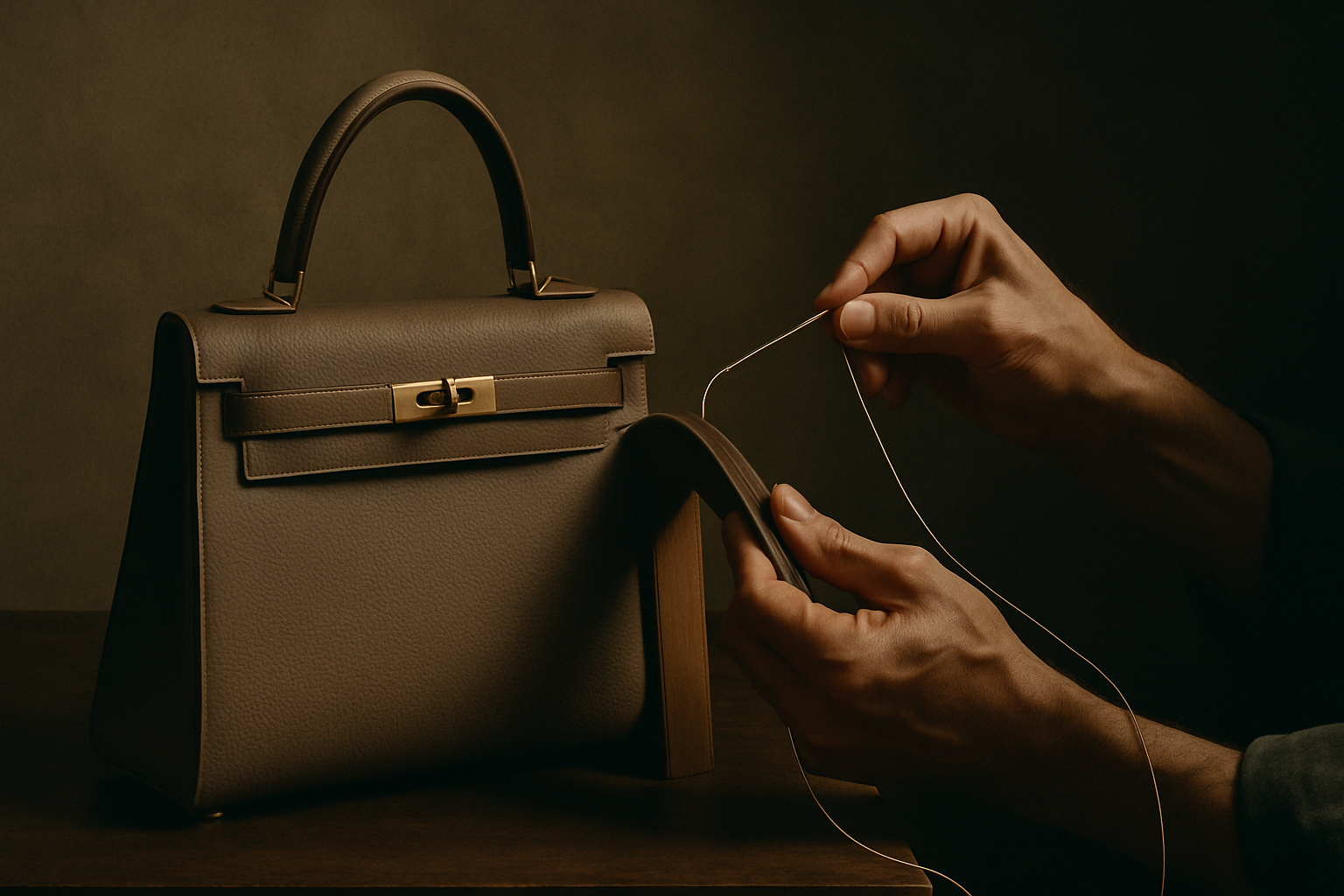
The saddle-stitching on a Kelly bag requires two needles, both threaded, both moving in opposing directions through the same hole. The artisan pulls each thread taut with equal force. If one side pulls harder, the seam warps. The stitch has been done this way since 1837, when Thierry Hermès opened a harness workshop on rue Basse-du-Rempart. It is still done this way in the ateliers at Pantin.
That symmetry—two forces, one seam—is the structure underneath everything Hermès makes.
Thierry Hermès and the logic of the saddle
Thierry Hermès did not start as a visionary. He started as a harness-maker serving the carriage trade in Paris, a city dense with horses and the people who kept them. The work was specific: bridles, saddles, reins. Leather cut to withstand friction and weather. Stitching that would not fail under load.
By the 1850s, Hermès had built a reputation. The house supplied European nobility and the French military. The skill was in durability, not decoration. A harness is a functional object. It must distribute weight evenly, move with the animal, hold under tension. Hermès understood those requirements as design problems, not just craft.
When Charles-Émile Hermès took over in 1880, he kept the same principles but expanded the catalogue. Saddles for sport riders. Leather goods for travel. The maison did not pivot away from its origins—it extended the logic of the saddle into new forms. A travel bag is also a load-bearing object. It also moves. It also must endure.
The first handbag appeared in 1922: the Haut à Courroies, a tall bag with straps, originally designed to carry a saddle. It was not conceived as fashion. It was storage. But the construction—hand-stitched, with a single piece of leather folded and shaped—set a template. Hermès would make objects that worked first and signified second.
Robert Dumas and the postwar refusal
By 1951, Robert Dumas had been running the house for a decade. He was Émile Hermès's son-in-law, trained as an architect, and he approached design with an architect's sense of proportion. Under Dumas, Hermès became something other than a luxury supplier. It became a study in restraint.
The Kelly bag—named retroactively after Grace Kelly carried one in 1956—was not invented for her. It was the Sac à dépêches, introduced in the 1930s, a structured top-handle with a single flap and a turn-lock. When Kelly used it to shield her early pregnancy from photographers, the bag acquired a second life. Hermès did not stage that moment. The house simply made an object sturdy enough to be borrowed for that purpose.
Dumas's era was marked by refusal. He refused overt branding. The Hermès logo remained small, often hidden inside a pocket. He refused trend cycles. The house released new designs slowly, sometimes years apart. He refused to scale production beyond what the ateliers could make by hand. That decision was not romantic. It was structural. Saddle-stitching cannot be mechanised without compromising the seam.
In 1956, Dumas introduced the carré—the silk scarf, 90 centimetres square. It became one of Hermès's most recognisable products, but it followed the same logic. The scarf was not seasonal. It did not go out of style. It was a frame for illustration, yes, but also a functional object: something to tie, fold, wear against wind. The maison released new designs each season, but the format stayed fixed.
Dumas's refusal to accelerate made Hermès an outlier in the postwar boom. Other houses expanded, licensed, diversified. Hermès stayed narrow. That narrowness became the brand.
Nadège Vanhée-Cybulski and the question of now
When Nadège Vanhée-Cybulski was appointed creative director of women's ready-to-wear in 2014, she inherited a house that had spent 177 years not changing very much. Her task was not to modernise Hermès—that word implies the maison was behind—but to articulate what the house meant in a market now defined by speed and noise.
Vanhée-Cybulski had worked at Maison Martin Margiela, The Row, Céline under Phoebe Philo. She understood construction and understatement. Her first collection for Hermès, shown in March 2015, was almost severe. Clean shirting. Wide trousers with a high waist. Coats with no visible closures. The palette was sand, navy, black, cream. The silhouette was about shoulder and ease, not waist or cling.
What she did not do: she did not make the clothes louder. Hermès had no logo T-shirts, no statement sneakers, no collaboration with a streetwear label. While other luxury houses chased hype, Hermès continued to make the same bags it had made for decades. The waitlist for a Birkin stretched into years. That scarcity was not engineered as marketing. It was the result of production limits that had been in place since Dumas.
Vanhée-Cybulski's work is often described as quiet, but that misses the point. The clothes are not quiet. They are specific. A leather jacket is cut like a shirt, with a collar that lies flat and sleeves that taper at the cuff. A dress is a single piece of fabric, shaped by darts, with no ornamentation. The construction is visible if you know how to look.
Her collections do not argue with the archive. They assume it. A spring 2022 look: a belted trench in calfskin, worn over wide trousers and a silk blouse. The trench is not reimagined. It is made the way Hermès makes things—stitched by hand, edges turned, weight distributed across the shoulder. The innovation, if there is one, is in proportion. The belt sits lower. The sleeve is wider at the shoulder and narrower at the wrist. These are small moves, but they shift how the garment sits on the body.
Hermès now operates in a market where luxury is increasingly about access and visibility. Logomania has returned. Collaborations are common. Drops and limited releases drive traffic. Hermès does none of that. The house does not discount. It does not do pop-ups. It does not seed product to influencers. The strategy, if it can be called that, is to continue making what it has always made, at the same pace, with the same methods.
That approach has worked. Hermès reported €13.4 billion in revenue in 2023, with an operating margin above 40 per cent—higher than any of its peers. The growth is not from volume. It is from people willing to wait.
What holds
There is a photograph from the Pantin atelier, taken in 2019. An artisan is stitching the handle of a Birkin. Two needles, both threaded, both moving through the same hole. Her hands are steady. The leather is pulled taut across the work surface. The seam is invisible until you know to look for it.
That is what Hermès has protected: not a style, but a method. The house has not stayed the same because it is conservative. It has stayed the same because the original problem—how to make an object that endures—has not changed. A bag is still a load-bearing form. A coat still moves with the body. The saddle-stitch still requires two needles, equal tension, no shortcuts.
The maison is not immune to the market. It operates within it, answers to shareholders, adjusts prices, opens new stores. But the core offer has not shifted. Hermès makes things that last longer than the season in which they are sold. That is rarer now than it was in 1837, which makes it more valuable.
The artisan finishes the seam. She trims the thread, runs her thumb along the edge to check for irregularities, sets the bag aside. Another one waits on the bench. The work continues, two needles at a time.