Jacquemus, a starter primer
The Chiquito bag, barely larger than a credit card, sat on a café table in the Marais last spring, propped against an espresso cup. Its owner — mid-twenties, linen shirt, gold hoops — was fielding questions from the next table over. How much does it hold? (A lipstick, two cards, nothing else.) Where did you find it? (Resale, naturally.) Is it... practical? She shrugged. "It makes me smile."
That exchange, overheard and unscripted, captures something essential about Jacquemus: the house traffics in objects that announce themselves, that invite conversation, that prioritise silhouette over function. Whether that appeals or irritates is a question of temperament. Either way, the maison has carved out a position in contemporary French fashion that feels both inevitable and unlikely — a Provençal sensibility applied to accessories and ready-to-wear with enough commercial savvy to land collaborations with Nike and enough aesthetic consistency to merit serious attention.
The founding and the myth
Simon Porte Jacquemus launched his eponymous label in 2009, aged nineteen, with no formal training and a story that has since been told so often it risks calcifying into legend. Raised in the south of France, left school early, moved to Paris, named the house after his mother — Valérie Jacquemus — who had died the year prior. The narrative is lean, affecting, and true, which makes it irresistible to editors and exhausting in repetition. What matters more, on balance, is what he made of it.
The early collections leaned into a kind of naïve charm: raw hems, primary colours, straw hats worn at odd angles. The silhouettes referenced both Provençal folk dress and a certain strain of 1990s minimalism, though neither influence was made explicit. By 2013, the house had secured a slot on the Paris Fashion Week calendar. By 2015, it had attracted backing from LVMH's prize for young designers. The trajectory was swift but not, in hindsight, surprising. Jacquemus understood that a clear point of view — sun-drenched, slightly irreverent, unmistakably French — could carry a young house further than technical virtuosity alone.
The accessory moment
If there is a single turning point, it arrived in 2017 with Le Chiquito, the micro-bag that became both meme and commercial engine. Measuring roughly ten centimetres across, rendered in grained leather with a single top handle, the bag was absurd by any practical measure and precisely calibrated for Instagram. It sold out within days. Jacquemus followed it with Le Grand Chiquito (still small), Le Petit Chiquito (smaller still), and an entire ecosystem of bags that played with proportion in ways that felt fresh even as the joke wore thin.
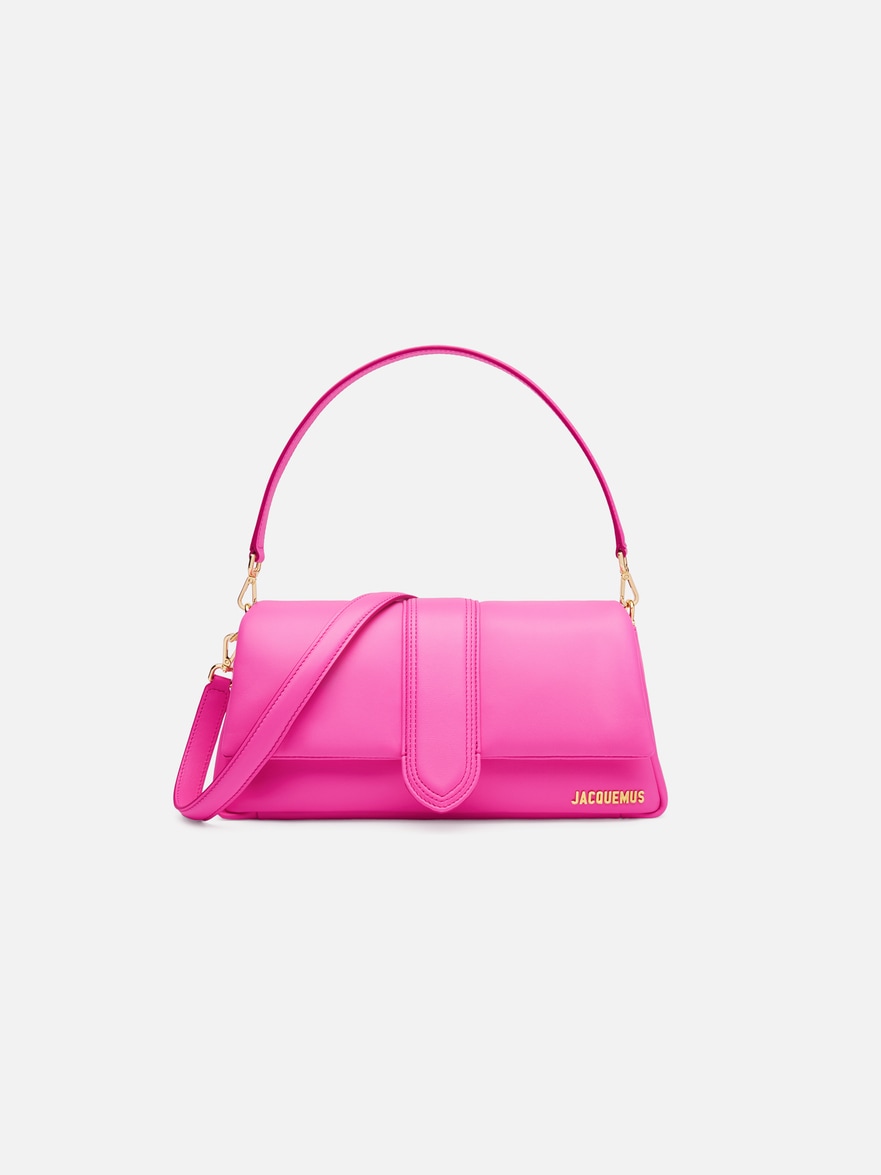
The house's other breakout accessory, Le Bambino, arrived around the same time: a structured top-handle bag with a curved base and a single leather strap, available in saturated shades of orange, yellow, and cobalt. Unlike Le Chiquito, Le Bambino was genuinely functional — it held a phone, a wallet, keys, the essentials — and it photographed beautifully against white linen or terracotta walls. Prices hovered around €500 to €700 at launch, positioning the bag as accessible luxury, a tier below Celine or Loewe but well above contemporary labels.
The footwear followed a similar logic. Les Mules Carino, a square-toed slide with a spherical heel, became ubiquitous in 2019. The heel itself — a perfect globe of wood or resin — was the kind of detail that read instantly in a photograph and felt, in person, like a small act of whimsy. Retail sat between €400 and €600, depending on material. The shoes were not, strictly speaking, comfortable. They were, however, distinctive, and in the attention economy that distinction carries weight.
Ready-to-wear and the Provençal codes
While accessories drove revenue, the ready-to-wear established the house's visual grammar. Cutouts appeared frequently: a circle excised from a ribbed knit dress, an asymmetric slash across a linen shirt, negative space used as ornament. Colours skewed warm — terracotta, wheat, lavender, the occasional sharp citron. Fabrics leaned natural: linen, cotton, raffia, leather left unlined. The silhouettes often played with exaggerated proportion — a tiny cropped jacket over wide-leg trousers, an oversized shirt worn as a dress, a bra top paired with a floor-length skirt.
The aesthetic was legible as "south of France," but it was a stylised version, scrubbed of anything rustic or unflattering. This was not the Provence of lavender farms and market stalls but of beach clubs and modernist villas. Prices for ready-to-wear ranged widely: a cotton poplin shirt might land at €350, a tailored blazer at €800, a leather trench north of €2,000. The value proposition, such as it was, rested less on facture than on design — you were paying for the silhouette, the colour, the way the garment signalled a particular kind of ease.
Collaborations and the expanded universe
Jacquemus has pursued collaborations with a frequency unusual for a house of its scale. The partnership with Nike, launched in 2023, produced a reinterpreted Humara trail shoe in cream and tan, retailing around €150. It sold briskly. Earlier, a capsule with Barbie leaned into the house's affinity for saturated pink and logo-heavy sportswear. These projects function as both brand extension and accessibility play — a way to reach customers who might baulk at a €600 handbag but will consider a €150 sneaker.
The house has also staged shows that double as events: a lavender field in Valensole, a salt flat in Utah, a Paris Métro station commandeered for a single evening. These productions generate significant press and position Jacquemus as a maison that understands spectacle. Whether the clothes themselves justify the fanfare is a question critics revisit each season, often with ambivalence.
What to know before buying
If you are considering a first Jacquemus purchase, a few practicalities merit attention. The sizing runs European and tends toward the fitted — if between sizes, size up. The leather goods, particularly bags, use grained calfskin that holds up well to daily wear but shows scuffs on lighter colours. Hardware is typically gold-toned, occasionally silver, and the quality is competent if not exceptional. Stitching is clean; linings are present but minimal.
The resale market is active, particularly for signature bags like Le Bambino and Le Chiquito. Prices on the secondary market often sit twenty to thirty per cent below retail for pieces in good condition, which suggests the house has not yet achieved the scarcity premium of, say, Hermès or Bottega Veneta. That may shift as the archive deepens.
For ready-to-wear, the construction is straightforward — machine-sewn, with occasional hand-finishing on tailored pieces. The linen wrinkles beautifully, which is to say it wrinkles, and if you prefer crisp lines you will spend time with an iron. The cutouts and asymmetries that define the house's silhouettes can read as costume if styled too literally; they work best when tempered with something plain.
Where the house stands now
Jacquemus occupies a curious position: too commercial to be avant-garde, too idiosyncratic to be mainstream. The house generates significant revenue — estimates place it north of €200 million annually — and maintains independence, a rarity in an industry dominated by conglomerates. Simon Porte Jacquemus remains the sole creative voice, which lends coherence but also limits range. The question is whether the Provençal codes that launched the house can sustain another decade, or whether they will begin to feel like a formula.
For now, the work continues. The shows draw crowds. The bags sell. And somewhere, probably, a Chiquito sits on a café table, prompting the same questions it did last spring. How much does it hold? Not much. Is it practical? Not especially. Does it make you smile? That, in the end, is between you and the bag.