Jacquemus now: where the house stands
The Le Chiquito — smaller than a deck of cards, functionally useless, genuinely expensive — is the kind of object that should have collapsed under its own irony. It didn't. It sold. It sold in four colourways, then eight, then as a charm, a keychain, an earring. By 2019, you could buy a miniature version of an already miniature bag. The joke had become the business model, and the business model worked.
That's Jacquemus in a single accessory: aware of the absurdity, committed to it anyway, and somehow still making money.
The founding story, compressed
Simon Porte Jacquemus started the house in 2009, aged nineteen, with no formal training and a surname borrowed from his mother's maiden name. The early collections — shown in apartments, on rooftops, with budgets that required favours rather than invoices — leaned into a kind of Provençal fantasy that felt both specific and oddly universal. Straw hats the width of a café table. Linen in shades that suggested lavender fields without directly referencing them. Proportions that looked wrong in lookbook stills and right in motion.
By 2013, he was showing during Paris Fashion Week. By 2015, LVMH's young designer prize put him in front of the industry's machinery without absorbing him into it. The house stayed independent. Jacquemus the designer stayed visible. The two things mattered equally.
What set the brand apart wasn't the clothes — plenty of designers were working in linen and asymmetry — but the way Jacquemus understood that fashion had started to function as content before it functioned as product. The lavender field show in Valensole, 2020. The pink salt flats, 2021. The wheat field with a single runway, 2019. Each one existed as much for the aerial shot as for the attendee experience. Instagram didn't document the work; it was the work.
The accessories line, or: how a house survives
Clothing made Jacquemus's reputation. Accessories made the business viable.
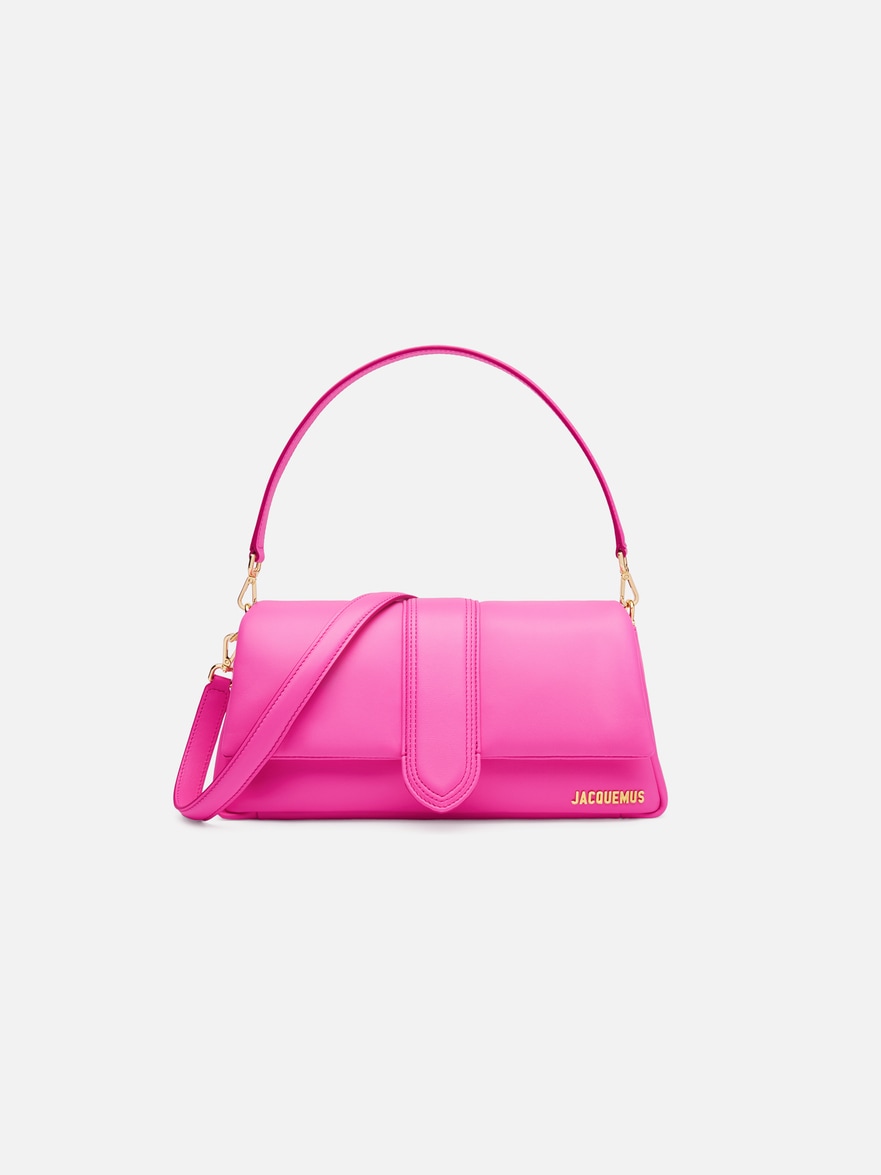
The Le Chiquito launched in 2017, priced around $200, and became the kind of object people bought to signal they were in on something. Not a joke, exactly. A wink. The bag served no practical function — you could fit a credit card, maybe a folded bill — but it didn't need to. It was a totem. It said: I know this is ridiculous, and I'm buying it anyway, and that's the point.
Jacquemus followed with the Bambino, slightly larger, actually usable. Then Le Grand Bambino, for those who wanted the design language without the performance art. The Chiquito Long, a baguette-length version that restored some function while keeping the formal strangeness. By 2021, bags and shoes accounted for roughly 60 percent of revenue, a ratio that most heritage houses take decades to achieve.
The shoes followed a similar logic. The Rond Carré mules — that aggressively square toe, the low sculptural heel — looked like something between a Brancusi and a hotel slipper. They worked. The Les Sandales Basgia, with their spherical heels, shouldn't have been wearable. They were. Jacquemus understood that accessories could carry more formal risk than clothing because the commitment was smaller. A $600 bag is a statement. A $2,000 coat is a mortgage payment.
Leather quality sits in the mid-range. Not bad, not heirloom. The hardware feels light but doesn't read cheap. Stitching is clean. The bags age adequately — the Bambino's handle softens, the Chiquito's clasp loosens slightly, but neither falls apart. They're built to last three years of regular use, maybe five if you rotate. For the price point, that's fair.
The current direction, or: what happens when the trick is known
Spring/Summer 2024 showed in a warehouse in Aix-en-Provence. The set was minimal. The casting was broader — more men, more age range, more body types than the house typically shows. The clothes themselves pulled back. Fewer of the sculptural cutouts that had become shorthand for the brand. More shirts, trousers, outerwear that worked without needing a stylist's intervention.
It felt like a correction. Not a retreat, but a recognition that the house had become so associated with a specific kind of image — sun-drenched, overtly sexy, tuned for the algorithm — that it risked becoming only that image.
The menswear, launched in 2018, has grown steadily without ever quite breaking through. The tailoring is soft, often in linen or cotton blends, cut close but not restrictive. Shirts tend toward the boxy. Outerwear reads more coastal than urban. It's convincing clothing, but it hasn't generated a signature the way the womenswear has. No male equivalent of the Bambino. No single piece that moves units and defines the line.
Collaborations have multiplied. Nike, in 2021 and 2023. A capsule with Levi's. A homeware line that included €400 ceramic lemons and sold out anyway. Each one extends the brand's reach without diluting the core — mostly because Jacquemus has been careful to keep the collaborations within the same tonal register. Playful, expensive, self-aware.
The question now is whether that register has a ceiling. Whether a house built on a very specific kind of visual and tonal consistency can grow past a certain point without either softening the edges or repeating itself into irrelevance.
Where the house stands
Revenue sits somewhere north of €200 million annually, depending on whose estimates you trust. The company doesn't publish figures. It remains independent, though investment structures have shifted — Bastille Capital took a minority stake in 2021, the kind of move that suggests preparation for scale rather than immediate need.
Retail presence has expanded carefully. Flagship stores in Paris, Milan, London. A Rome location opened in 2023. No New York store yet, which feels deliberate. Wholesale still accounts for a significant portion of sales — the brand is stocked in the usual suspects, from Matches to Mytheresa to Net-a-Porter. The direct-to-consumer push is real but not aggressive.
The brand's social media following — 15 million on Instagram as of late 2024 — gives it a reach that most independent houses don't touch. But reach isn't revenue, and Jacquemus has been navigating the gap between the two for years. The lavender field show generated hundreds of millions of impressions. It also cost a lot to stage, and impressions don't pay for Italian factories.
What Jacquemus has managed, and what many houses haven't, is turning cultural presence into actual sales without letting the former collapse into pure marketing. The bags sell because they're covetable, yes, but also because they're buyable. The price points sit just inside accessible luxury. You can want one and actually get one without a waiting list or a sales associate's approval.
The risk is that the house becomes a bag-and-shoe brand that also makes clothing. It wouldn't be the first. Plenty of contemporary labels have followed that trajectory — build the image on ready-to-wear, make the money on accessories, let the clothing become increasingly secondary. Jacquemus hasn't tipped that way yet, but the margins push in that direction.
The image problem that isn't quite a problem yet
There's a specific customer Jacquemus conjures: mid-twenties to mid-thirties, lives in a city but holidays in the countryside, owns three pairs of Birkenstock but would never wear them to dinner. Buys the bag, maybe the shoes, considers the clothing but doesn't commit. Follows the Instagram, watches the shows, participates in the brand as a kind of aspirational theatre.
That customer is real, and she's valuable. But she's also narrow. And as the house pushes toward €250 million, then €300 million, the question becomes whether the image can stretch to accommodate a broader base without losing the specificity that made it work in the first place.
The Fall/Winter 2024 show, staged at the Château de Versailles, suggested one possible answer. The setting was grand, the casting was more varied, the clothing itself was more wearable. But the tone — that careful balance of irreverence and polish — held. A model walked in an oversized coat and tiny briefs, and it didn't feel like a stunt. It felt like Jacquemus.
Whether that tone can carry a house past the €500 million mark is the open question. Whether Simon Porte Jacquemus wants it to is another.
For now, the house sits in a strange and possibly unsustainable position: too big to be niche, too specific to be mass, too self-aware to be taken entirely seriously, too successful to be dismissed. The Le Chiquito is still in production. Still selling. Still the size of a deck of cards, still functionally useless, still somehow the whole point.