The atelier still keeps a pair of scissors from 1947, nickel-plated, with a worn thumb-loop
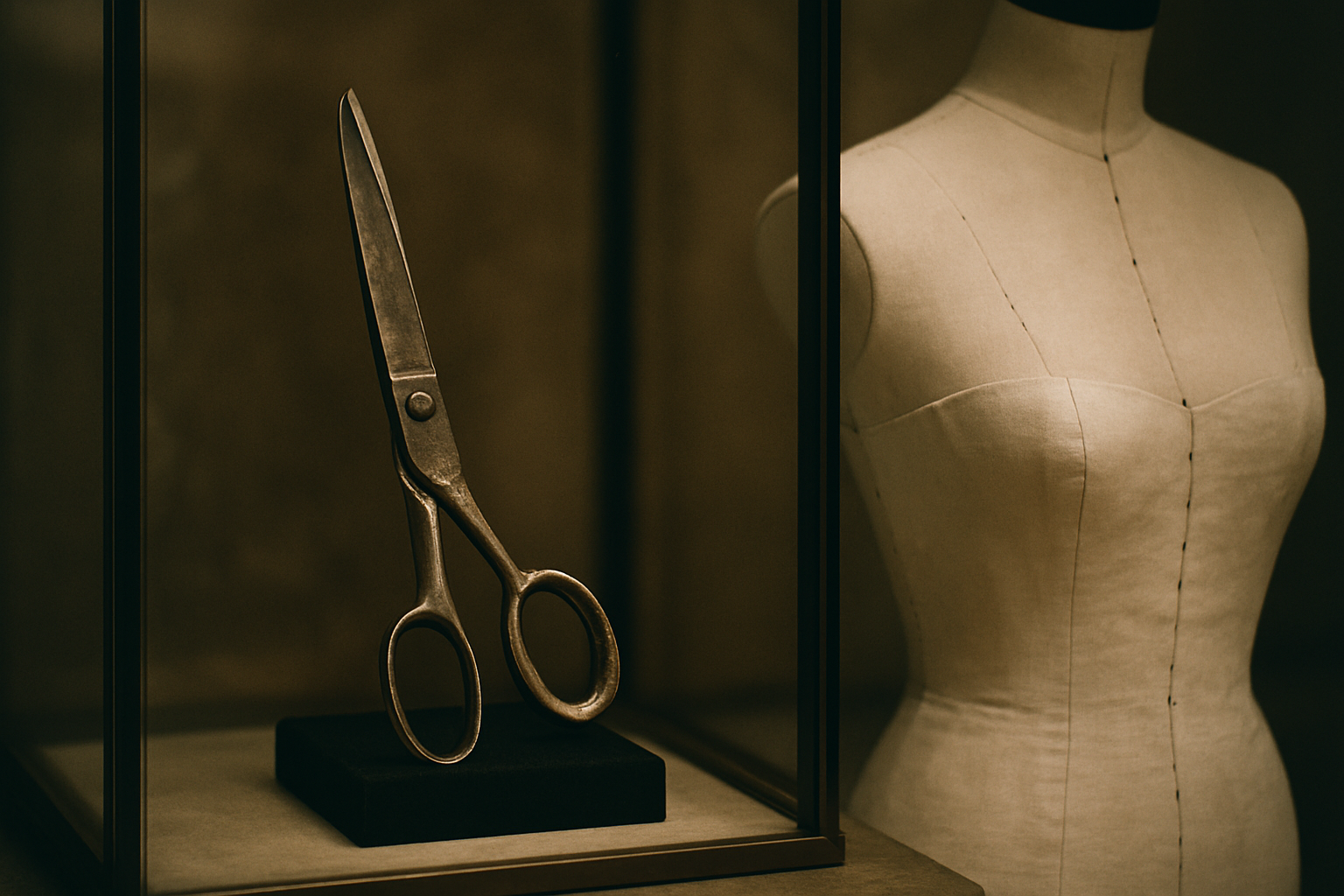
The atelier still keeps a pair of scissors from 1947, nickel-plated, with a worn thumb-loop. They sit in a vitrine on Avenue Montaigne, beside a muslin toile and a single spool of ivory thread. One suspects the display is meant to gesture toward origins, toward craft — but what it actually does is mark distance. Seventy-seven years separate those scissors from the current collection, and the gap is not merely chronological.
Christian Dior opened his maison in December 1946 with a staff of eighty-five and backing from the textile magnate Marcel Boussac. The first collection, shown the following February, comprised ninety looks. Carmel Snow of Harper's Bazaar called it the New Look, a term Dior himself disliked but never managed to dislodge. The silhouette was clear: nipped waist, rounded shoulder, skirt that required twenty-odd metres of fabric. It was, by design, the opposite of wartime austerity — a calculated extravagance that read, depending on one's position, as either a return to femininity or a retreat from the freedoms women had claimed during the war years.
Dior was forty-one when he opened the house, older than most designers at their debut, and the maturity showed. He understood proportion not as abstraction but as architecture. The Bar Suit — ivory shantung jacket over a black wool skirt — remains the clearest distillation of his method: structure that shaped the body without apologising for it. He was not interested in ease. He was interested in silhouette, in the way a woman might move through a room and be remembered for it.
He died in 1957, ten years and twenty-two collections later. The house passed to Yves Saint Laurent, who was twenty-one.
The Saint Laurent interlude and the Bohan years
Saint Laurent's tenure at Dior lasted six collections. The first, in January 1958, was received as a relief — the house would continue, the proportions would hold. The second, autumn of that year, introduced the Trapeze line: a shift away from the waist, toward a looser, younger silhouette. It sold poorly. By 1960, Saint Laurent was drafted into military service, suffered a breakdown, and was replaced by Marc Bohan, who would remain at Dior for twenty-nine years.
Bohan's work is often described as elegant, which is to say it was competent and left little impression. He refined rather than redirected. The house under his direction became what many French maisons became in the second half of the century: a reliable producer of expensive clothing for a narrowing clientele, increasingly dependent on licensing deals and perfume sales to underwrite the couture operation. Dior the brand grew; Dior the atelier calcified.
The exception, arguably, was the launch of ready-to-wear in 1967 and the opening of the first Miss Dior boutique. These were commercial decisions, not creative ones, but they acknowledged a shift in how women were buying clothes. Bohan understood his role: to maintain the house's reputation without unsettling it. He succeeded, and in succeeding, made Dior less urgent.
Galliano and the return to spectacle
John Galliano arrived in 1996, appointed by Bernard Arnault, who had acquired the house through LVMH a decade earlier. Galliano was forty-six, English, trained at Central Saint Martins, and known for collections that treated fashion as theatre. His first couture show for Dior, in January 1997, opened with a model in a gold-embroidered coat and a tricorn hat, styled after an eighteenth-century adventuress. It was excessive, referential, technically virtuosic, and nothing like what Dior had produced in the previous forty years.
Galliano's method was accumulation. He layered references — Marlene Dietrich, Madame de Pompadour, the Marchesa Casati — and sent them down the runway in silhouettes that quoted Dior's archive without repeating it. The Bar Jacket returned, but cut in leather and worn over tulle. The New Look's volume reappeared, but exaggerated to the point of costume. He was not interested in wearability. He was interested in image, in the way a collection might circulate as spectacle.
The work sold. Couture clients returned, and the ready-to-wear line expanded. Dior under Galliano became synonymous with a particular kind of excess — not the disciplined extravagance of the founder, but something more baroque, more self-referential. The atelier produced extraordinary garments. Whether they advanced the language of the house or simply performed its history is a question that remains open.
Galliano was dismissed in 2011 following a public incident. Raf Simons replaced him a year later.
Simons, Chiuri, and the question of now
Raf Simons stayed three and a half years. His first collection, in July 2012, was widely praised for its restraint: clean lines, a muted palette, a return to structure without the theatrical overlay. He brought in artists — Sterling Ruby, for one — and treated the runway as a site for collaboration rather than spectacle. The clothes were beautiful in a way that felt contemporary, which is to say they did not require a degree in fashion history to appreciate.
He left in 2015, citing the pace. Maria Grazia Chiuri, formerly of Valentino, succeeded him in 2016 and remains in the role. She is the first woman to lead the house's creative direction — a fact that Dior's communications team mentioned often in her early seasons, and which Chiuri herself addressed by staging her debut collection around a slogan tee that read "We Should All Be Feminists."
The gesture was clear, perhaps too clear. Chiuri's work since has centred on questions of female agency, craft traditions, and what she has called "real clothes for real women." The ready-to-wear leans toward ease: pleated skirts, blouses with volume, tailoring that does not insist on a single silhouette. The couture, by contrast, remains technically ambitious — embroidered tunics that reference historical dress, gowns constructed in collaboration with Indian ateliers. She has expanded the house's vocabulary, though not always in ways that feel native to it.
One can argue that Dior under Chiuri has become more accessible, more politically legible. One can also argue that it has lost some of its edge. Both are true, and neither is fatal. The house continues to generate substantial revenue — €8.8 billion in 2023, per LVMH's fashion and leather goods division, of which Dior is the largest contributor. The question is not whether Dior is successful. The question is what, at this scale, success allows.
What remains
The atelier on Avenue Montaigne still operates much as it did in 1947. A première oversees each garment's construction. The fittings happen on a live model, adjustments marked in chalk. The work is slow, manual, expensive. It is also, in the context of a global luxury conglomerate, a rounding error. Couture accounts for a small fraction of Dior's revenue; its value is symbolic, a claim to heritage that justifies the ready-to-wear prices and the handbag margins.
This is not unique to Dior. It is the condition of nearly every major French house. But Dior, more than most, has made its archive visible — has insisted, collection after collection, that its past remains legible in its present. Whether that insistence is a strength or a limitation depends, perhaps, on what one believes a house is for.
There is a photograph from 1955, taken in the atelier, of Christian Dior adjusting the hem of a gown. His back is to the camera. The model stands still, patient. The fabric pools at her feet. It is a working image, not a portrait, and what it shows is a man solving a problem of proportion with his hands. The scissors in the vitrine cannot do that. Neither can a slogan, or a reference, or a quarterly earnings call. But the problem remains.