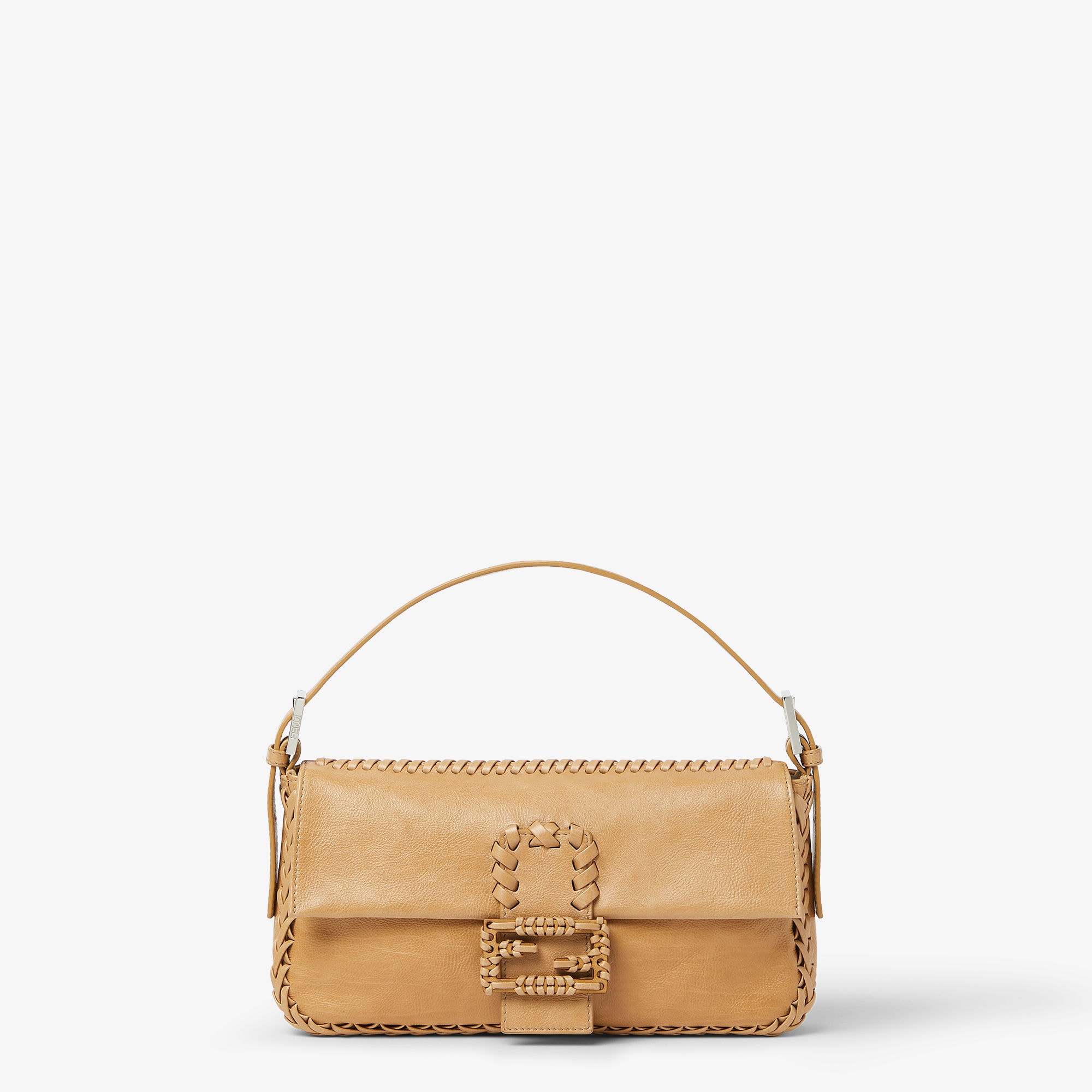
The Baguette arrived in 1997 wearing its name like a dare
The Baguette arrived in 1997 wearing its name like a dare. Not because it resembled a loaf — though the tucked-under-arm silhouette did echo a Parisian commute — but because Silvia Venturini Fendi decided that was what it should be called. Twenty-seven years on, the bag has outlasted most of its contemporaries, not by staying quiet but by refusing to apologise for being exactly what it is: a small, structured, logo-forward accessory that makes no pretense of practicality.
That tension — between Roman craft tradition and a willingness to court the absurd — is Fendi in a sentence.
Founding and the five sisters
The house opened in 1925 as a fur and leather atelier on Via del Plebiscito, Rome. Adele and Edoardo Fendi ran it as a workshop first, boutique second. By the postwar years, their five daughters — Paola, Anna, Franca, Carla, Alda — had taken over operations, each managing a division: furs, leather goods, sales, production, administration. The arrangement sounds quaint until you consider that it lasted four decades and built the business into a luxury conglomerate.
In 1965, the sisters hired a twenty-seven-year-old Karl Lagerfeld to design furs. He stayed for fifty-four years. That partnership, more than any single collection, is what shaped Fendi's identity: irreverent, technically ambitious, and utterly uninterested in the sort of minimalism that defined Milan in the nineties. Lagerfeld treated fur like fabric — slicing it, intarsia-ing it, screen-printing it — and the result was a house vocabulary that prized craft but refused solemnity.
The double-F logo, designed by Lagerfeld in 1965, became shorthand for that attitude. It wasn't discreet. It wasn't trying to be.
The Lagerfeld era and what it left behind
Lagerfeld's work at Fendi operated on two registers. The runway collections — often shown in unlikely venues, a Shanghai hutong or the Trevi Fountain — leaned theatrical. But the atelier work, particularly in fur, was exact. He pioneered lightweight mink treatments and a technique called sfumato, which gradates colour across a pelt so subtly that the dye appears to evaporate mid-hide. You either care about that or you don't, but it's worth knowing that the house still maintains a fur atelier in Rome where artisans spend years learning these methods.
After Lagerfeld's death in 2019, the question wasn't whether Fendi would continue — LVMH had owned the brand since 2001, and the infrastructure was secure — but whether it could hold onto the specific mix of grandeur and wit that he'd built. The answer, so far, has been partial.
Kim Jones, appointed artistic director of womenswear and couture in 2020, brought a different sensibility: more references, less acid. His collections nod to Bloomsbury, to Italian cinema, to archival Fendi prints, and the result is polished but less sharp. The bags, however, have remained consistent, which matters more than runway narrative for most buyers entering the house now.
What to buy, and what it costs
Start with the Baguette if you want the clearest distillation of what Fendi does. The classic version — soft nappa leather, FF clasp, short shoulder strap — runs around $3,200. Seasonal variations in sequins, shearling, or jacquard can push past $5,000. The bag holds almost nothing: a cardholder, keys, possibly a phone if you're judicious. That's the point. It's not a tote. It's a signal.
The Peekaboo, introduced in 2009, offers more utility and costs more accordingly. The medium size in calfskin starts near $5,500. It's a structured top-handle with an internal frame and a twist-lock closure that reveals contrasting leather when opened — hence the name. The bag reads more conservative than the Baguette, which makes it easier to wear in contexts where a double-F logo might feel like overstatement. Fendi positions it as the "serious" bag in the lineup, and the pricing reflects that.
For entry-level access, consider the small leather goods. The continental wallet in grained leather runs about $650. The card holder, stamped with a tonal FF, is $310. These aren't throwaway purchases, but they let you test the house's leather quality — which is, on balance, very good — without committing four figures.
Scarves deserve mention. Fendi's silk production, overseen for years by the late Franca Fendi, maintained unusually high thread counts and hand-rolled edges. A large square in printed silk twill costs roughly $450. You can find similar dimensions elsewhere for half that, but the hand-feel is different. Whether that difference justifies the gap is your call.
The ready-to-wear is harder to recommend without caveats. A cashmere crewneck will cost $1,800. An FF-jacquard knit dress, $2,400. The construction is sound, but you're paying as much for the logo as the garment, and the house's tailoring doesn't carry the same authority as, say, Céline under Phoebe Philo or The Row now. If you're drawn to a specific piece, buy it. But don't assume the clothing represents the best value in the collection.
Where the house stands now
Fendi occupies an odd position within LVMH's portfolio. It's neither a cornerstone brand like Dior nor a high-margin disruptor like Loewe under Jonathan Anderson. Revenue is steady — estimated around €1.6 billion annually — but growth has plateaued. The brand still commands attention during fashion week, still sells bags at a brisk pace in Asia and the Middle East, but it lacks the momentum of five years ago.
Part of that is structural. The fur business, once central to Fendi's identity, has contracted sharply as retailers and consumers pull back. The house hasn't abandoned fur — the Rome atelier remains operational — but it no longer drives the narrative. What's replaced it is leather goods and logo play, which is lucrative but less distinct. Several houses do monogram canvas well. Fewer can do what Fendi did with fur.
Jones has brought craft credibility and a softer, more narrative-driven approach to the runway. His couture work, in particular, has earned respect for its embroidery and draping. But couture represents a fraction of revenue, and the question for Fendi is whether the ready-to-wear and accessories can sustain the level of cultural presence the brand enjoyed under Lagerfeld.
The answer, for now, is that they sustain it differently. Fendi remains visible, commercially healthy, and technically accomplished. It no longer feels dangerous.
A last thought
There's a photograph from 1985 — backstage at a Fendi show, probably Milan — of Lagerfeld adjusting a fur collar on one of the five sisters. She's laughing. He's not quite smiling, but his posture suggests satisfaction. The collar in question is dyed an improbable shade of violet and cut in a way that defies how fur is supposed to fall.
That image, more than any campaign or logo treatment, captures what Fendi was. Whether it still is remains a question the house answers collection by collection, bag by bag. If you're buying in now, you're buying a version of that history — one that still knows how to cut leather and set a clasp, even if the provocation has dulled.