The collar arrives first
The collar arrives first. High, structured, curved precisely at the nape. It frames the throat without touching it — a gesture of distance that reads as intimacy. Hubert de Givenchy cut this line in 1952, and it has appeared in nearly every collection since, though rarely as the headline. It is not the Antigona. It is not the 4G. It is the thing that happens before you notice you are looking.
Givenchy's reputation rests on a handful of monuments: Hepburn's black Sabrina dress, the shark-lock hardware, Tisci's gothic years. But the house's actual vocabulary is quieter. It lives in the way a sleeve is set, the width of a lapel, the refusal to soften a shoulder even when softness is the season's directive. These are not gestures made for the camera. They are made for the body in motion, and they require a second look.
The founding grammar
Hubert de Givenchy opened his atelier in 1952 with a collection called 'Separates'. The name was tactical. He was twenty-four, trained under Schiaparelli and Lelong, and he had no interest in the sculptural excess that defined Paris couture at the time. His proposition was different: blouses that could be tucked or left loose, skirts with hidden pleats, jackets that worked over trousers or worn alone. The pieces moved independently, but they shared a syntax — clean armholes, narrow waists, collars that stood without stiffening.
The separation was also conceptual. Givenchy did not design for an imagined muse. He designed for Audrey Hepburn, Bunny Mellon, Babe Paley — women who appeared in his atelier and asked for clothes that would not announce themselves before they entered a room. The relationship was reciprocal. Hepburn wore Givenchy in seven films, but she also wore him to the grocery. The dress did not change between contexts. That was the point.
What emerged was a house defined by restraint, but not minimalism. Givenchy used ornamentation — embroidery, bows, jewelled buttons — but always as punctuation, never as subject. A black wool coat from 1958 has a single line of white topstitching at the collar. The stitching is visible only when the wearer turns her head. It is there because the coat requires it structurally, and because Givenchy understood that a woman notices what is near her face before she notices what is across the room.
The other signature: proportion. Givenchy lengthened the torso and shortened the sleeve. He raised the waist and dropped the hem. He treated the body as a series of intervals, and he adjusted them until the eye moved smoothly from shoulder to wrist. His evening gowns from the sixties are studies in this — long columns of silk gazar or duchess satin, often backless, always cut so the fabric skims rather than clings. The silhouette is narrow, but it does not constrict. The woman inside can walk, sit, bend to retrieve a glass from a low table. She is not performing elegance. She is wearing it.
The Tisci interruption
When Riccardo Tisci arrived in 2005, the house had spent twelve years under the direction of designers who treated Givenchy as a problem to solve. The codes were there — the collars, the proportions, the refusal of excess — but they had calcified into formula. Tisci did not discard them. He inverted them.
He kept the high neckline but rendered it in leather and lace. He kept the narrow silhouette but added zippers, harnesses, hardware borrowed from fetish wear and military uniform. The Antigona bag, introduced in 2010, is a structured trapezoid with sharp corners and a top handle — an echo of the boxy handbags Givenchy made in the fifties, but heavier, more angular, designed to be carried as statement rather than accessory.
Tisci's Givenchy was darker, more theatrical, but it was not a departure. He understood that the house's elegance had always contained an edge. Givenchy dressed Hepburn, but he also dressed Lauren Bacall and Marlene Dietrich. His clothes were precise, but precision is a form of control, and control can read as coldness. Tisci made that coldness explicit. He turned the collar into a choker. He cut the evening gown in black instead of ivory. He put Mariacarla Boscono and Lea T on the runway in clothes that looked like armour.
The work was commercially successful — Tisci quadrupled Givenchy's revenue during his tenure — but it also overshadowed the house's quieter codes. The Antigona became the reference point, and the ready-to-wear became a vehicle for logo T-shirts and graphic sweatshirts. The tailoring remained, but it was no longer the lead. Givenchy became known for what it put on the surface, not for what it held back.
The Williams reset
Matthew Williams took over in 2020, and his first collection was an exercise in subtraction. He showed sharp blazers with exaggerated shoulders, slip dresses in bias-cut silk, trousers with a high waist and a wide leg. The palette was black, white, navy, camel. The hardware — Williams's signature, carried over from his work at Alyx — appeared on bags and belts, but it was integrated into the construction rather than applied as decoration. A lock became a closure. A chain became a strap.
The move was a return, but not a restoration. Williams did not recreate Hubert de Givenchy's fifties tailoring. He took the principle — structure, proportion, restraint — and translated it into a contemporary vocabulary. The shoulder is wider now, almost aggressive. The waist is higher. The sleeve is cropped above the wrist, a detail borrowed from menswear. The effect is harder than the original, more urban, but the logic is the same. The garment shapes the body without restricting it.
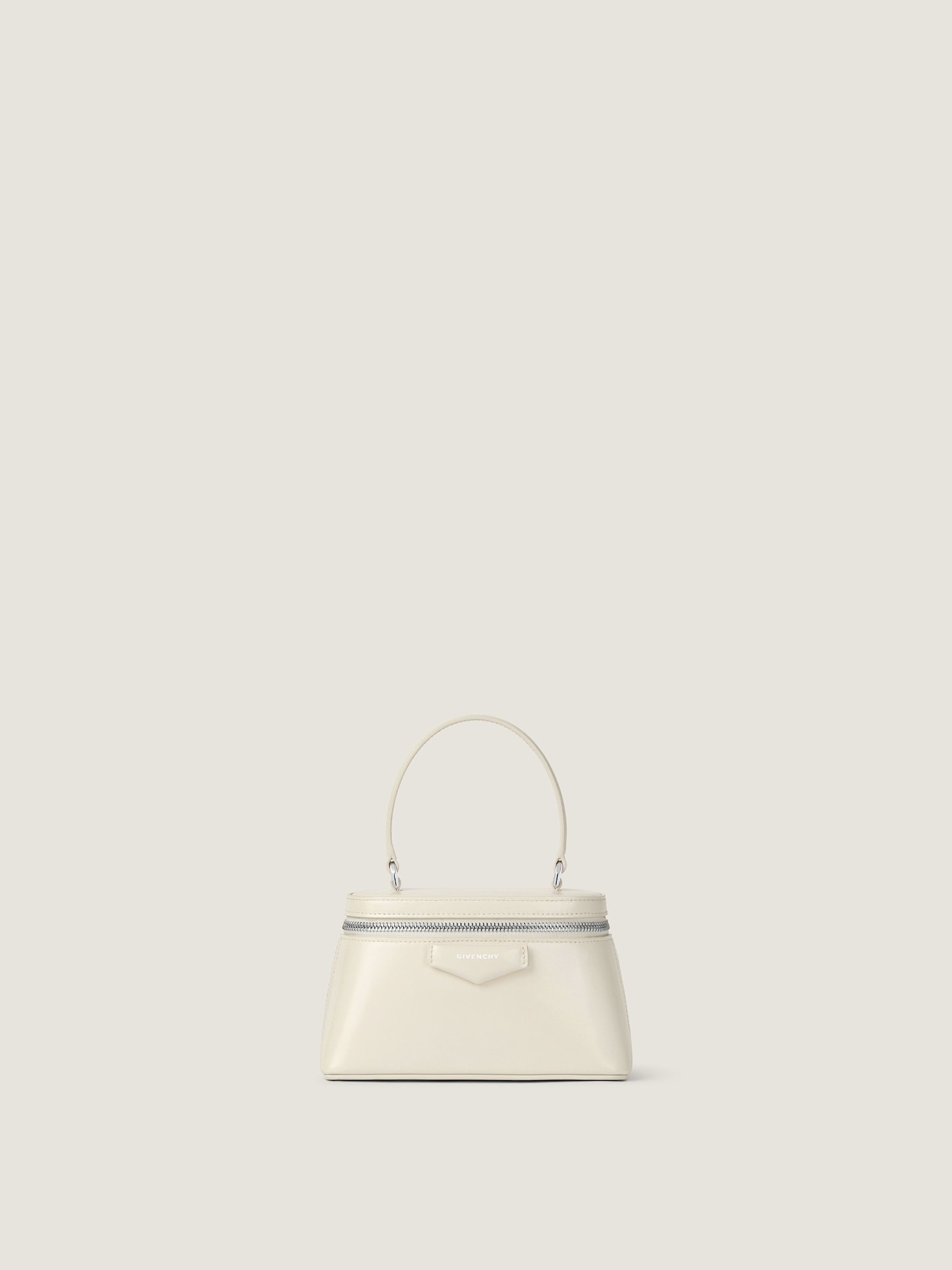
Williams also reintroduced the house's forgotten accessories. The Voyou bag, released in 2021, is smaller and softer than the Antigona, with a curved top handle and a tucked base. It references the handbags Givenchy made in the sixties — structured but not rigid, formal but not precious. The name, French for 'hoodlum', is a nod to Tisci's gothic years, but the bag itself is quiet. It does not announce. It accompanies.
The tailoring has become the centre again. Williams's suits are cut with a dropped shoulder and a nipped waist, a silhouette that reads as both masculine and feminine depending on how it is styled. The trousers are high-waisted and wide-legged, often worn with a cropped jacket or a fitted turtleneck. The look is sharp, but it is not severe. It allows for movement, for adjustment, for the small shifts that happen when a body is worn rather than displayed.
What remains
Givenchy's overlooked codes are not hidden. They are structural. The collar that frames without touching. The sleeve that ends above the wrist. The proportion that elongates the torso and narrows the leg. The refusal to soften a shoulder even when softness is expected. These are not trends. They are constants, and they require a wearer who understands that elegance is not about being seen but about being remembered.
The house is not defined by its logo or its hero bag. It is defined by the way a jacket closes, the angle of a lapel, the space between the collar and the skin. These are small things, but they are the things that last. A woman in a Givenchy coat from 1960 and a woman in a Givenchy coat from 2024 are wearing different clothes, but they are making the same argument. The garment does the work. The body does not have to.
There is a photograph from 1956: Audrey Hepburn in a white blouse and black trousers, standing in Givenchy's atelier. The blouse has a high collar and long sleeves. The trousers are narrow and cropped at the ankle. She is not posing. She is standing still, and the clothes are doing nothing but what they were made to do. That is the house. That is the code.