The double-G clasp sits at the centre of a calfskin belt, eighteen millimetres wide, priced at €490
The double-G clasp sits at the centre of a calfskin belt, eighteen millimetres wide, priced at €490. It is not particularly subtle. It is not trying to be. One finds it on the waist of a sixteen-year-old in Milan, a banker in Seoul, a stylist in Los Angeles. This is Gucci now — not the house of a single vision, but the house of a logo that travels faster than any creative director can steer it.
The question, three years into Sabato De Sarno's tenure, is whether that matters.
The inheritance
Gucci began in Florence in 1921, a saddlery concern trading on the myth of English equestrian refinement. Guccio Gucci had worked at the Savoy in London; he returned to Italy with an eye for what the moneyed classes carried. Leather goods, bamboo-handled bags, the horsebit loafer — all of it emerged from an atelier fluent in harness-work but aimed at a customer who had never mucked out a stall.
By the 1970s, the house had become synonymous with a very particular kind of gilt excess. Tom Ford, arriving in 1994, understood that this was not a problem to solve but a tension to exploit. His Gucci was unapologetically carnal — the ad campaigns, the cut of a trouser, the way a silk shirt opened over skin. It sold extravagantly. It also reset the terms: Gucci would be the house that said yes when others demurred.
Alessandro Michele, taking the creative director role in 2015, said yes to everything at once. Maximalism, anachronism, gender fluidity, clashing prints, Sèvres porcelain next to a Donald Duck motif. The work was divisive in the way only genuinely popular things can be. Sales doubled. Then they stalled. By late 2022, Kering moved him out.
The correction
De Sarno arrived from Valentino with a brief one suspects was more commercial than poetic. His first collection, shown in September 2023, proposed a return to something he called "everyday luxury" — a phrase that means little until you see the clothes. Tailoring in muted tones. Leather bombers. Slip dresses. The kind of pieces one might wear to an office, a dinner, a weekend in the country, without announcing which house dressed you.
The reaction was cool. Not hostile — cool. The clothes were well made, wearable, forgettable. They lacked the semiotic density of Michele's work, the unambiguous eroticism of Ford's. What they offered instead was competence, and competence does not photograph well.
Sales have reflected this. Gucci's revenue fell 20 per cent in the first quarter of 2024, then another 18 per cent in the second. Kering's stock followed. Analysts noted that the house was "in transition," which is the polite way of saying it had not yet found a reason for customers to return.
The wager
De Sarno's wager, if one can call it that, is on a kind of anti-spectacle. Where Michele turned every runway into a cabinet of curiosities, De Sarno offers restraint. Softer shoulders. Fewer logos, or at least fewer visible ones. Leather treated to a fine patina rather than a high shine. It is a bet that the customer, after a decade of maximal signalling, wants to be dressed rather than costumed.
There is precedent for this. Phoebe Philo's Céline succeeded precisely because it refused to shout. But Philo had time, and she had a smaller house with lower revenue expectations. Gucci, by contrast, is Kering's largest brand, responsible for half the group's sales at its peak. It cannot afford to whisper.
The autumn-winter 2024 collection, shown in February, leaned further into this territory. Shearling coats. Knit separates in camel and grey. A certain Milanese restraint that one might admire in a showroom but struggle to remember a week later. The accessories — still the house's commercial engine — were more assertive. The Jackie bag returned in new colourways. The Horsebit loafer, evergreen, appeared in crocodile. These are the pieces that move, and De Sarno knows it.
The logo problem
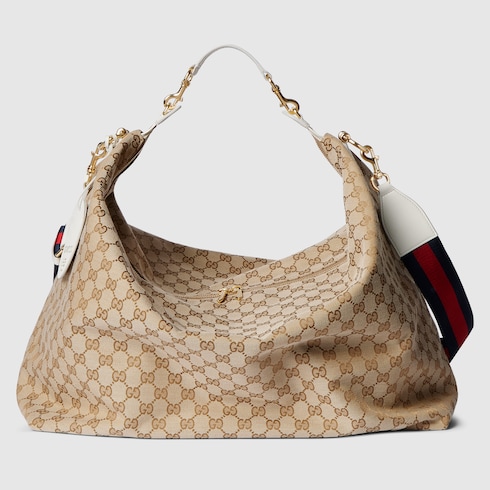
Here is where the tension lives. Gucci's logo — the interlocking Gs, the green-red-green web stripe — is among the most recognised in the world. It sells belts, wallets, sneakers, phone cases. It moves product in airports and department stores and third-party e-commerce platforms at a velocity no runway collection can match.
De Sarno has not abandoned the logo, but he has dialled it back in the ready-to-wear. The result is a house at odds with itself. The image projected on the runway is one of discreet, grown-up luxury. The image projected in a duty-free shop is louder, younger, less concerned with facture than with signalling. Both are Gucci. Neither is wrong. But they do not cohere.
One thinks of Hedi Slimane at Celine, who stripped the accent and the logo and built a new house on the bones of the old. That was possible because Celine was smaller, less encumbered by legacy product lines. Gucci cannot do this. It has 483 directly operated stores. It has licensing deals, franchises, a diffusion line in eyewear and fragrances. The logo is infrastructure, and infrastructure is not easily redesigned.
The customer
Who, then, is buying Gucci now? Not the same customer who queued for Michele's Dionysus bag in 2016. That customer has moved on — to Loewe, to The Row, to Bottega Veneta, or simply to a rotation of smaller labels that feel less solved. The customer buying Gucci today is either new — younger, less familiar with the Michele era — or loyal to the house itself, not to any one designer's vision.
This is not necessarily a crisis. Many houses survive on exactly this model: a rotating cast of creative directors, a stable base of logo-driven accessories, a brand identity larger than any individual. Louis Vuitton has managed it. Dior has managed it. But those houses also invest heavily in spectacle — the kind of runway theatrics and celebrity partnerships that keep the brand in circulation even when the clothes themselves are secondary.
Gucci, under De Sarno, has been quieter. There have been campaigns, yes — shot by David Sims, featuring Debbie Harry and Kelsey Lu, visually striking in the way high-budget fashion campaigns tend to be. But they have not generated the kind of ambient cultural presence that Michele's work did. They do not meme. They do not trend. They exist, are admired by those who see them, and then recede.
The question
So where does Gucci stand? In revenue terms, diminished. In cultural terms, uncertain. In product terms, competent. De Sarno has steadied the house, but he has not yet given it a reason to accelerate. Whether that reason will come from the ready-to-wear, from a breakout accessory, from a shift in consumer sentiment, or from something else entirely is not yet clear.
What is clear is that Gucci remains, in the trade's blunt arithmetic, too big to fail and too visible to ignore. Kering will give De Sarno time — not infinite time, but more than a few seasons. The question is whether he can find a vocabulary that speaks both to the house's heritage and to a customer who no longer wants to be told what luxury looks like.
There is a Gucci store on Via Montenapoleone, next to Prada and across from Valentino. In the window, a mannequin wears a camel coat, a leather belt, a pair of loafers. The double-G is there, on the belt, small but legible. A woman pauses, looks, moves on. Another pauses, enters. This is the work now: not to provoke, not to transform, but to be present when the customer decides she is ready. Whether that is enough depends on how patient Kering is willing to be.