The first thing you notice in an Acne Studios showroom isn't the Face motif or the Baker bag
The first thing you notice in an Acne Studios showroom isn't the Face motif or the Baker bag. It's the coat hangers. Matte black, minimal width, no logo. They hold the garments at a slight forward angle, as if the pieces are leaning in to be examined. It's a small choice that reveals the house's actual logic: everything designed to within a millimetre of neutrality, then pulled back one more step.
Most people still think of Acne Studios as the jeans brand that pivoted to ready-to-wear, or the Scandi label with the smiley logo. Both true, neither complete. The codes that actually structure the house are quieter than that — and far more specific than the minimalism shorthand usually applied to anything north of Copenhagen.
The founding accident
Jonny Johansson started Acne in 1996 as a creative collective. The name stood for Ambition to Create Novel Expressions, which tells you how seriously the early crew took themselves and also how little that origin story matters now. What does matter: the first product was a run of raw denim jeans with red stitching, given away to friends in Stockholm. The jeans fit well. People wanted to buy them. Johansson, who had studied at Stockholm's Beckmans College of Design but never formally trained in tailoring, began building a fashion house by accident.
By 2006, Acne was showing in Paris. The move wasn't about validation — it was practical. Swedish production couldn't scale to meet demand, and French ateliers understood the kind of precision Johansson wanted in outerwear. He wasn't chasing French elegance. He was chasing French tolerances.
The early collections leaned hard into a kind of androgynous severity: sharp shoulders, dropped armholes, trousers cut to pool slightly at the ankle. But the through-line wasn't minimalism. It was reduction. Johansson would design a blazer with four pockets, then remove three. He'd draft a coat with a notched lapel, then flatten it into a standing collar. The question wasn't what does this need? It was what can this lose?
That approach produced the house's first overlooked code: the standing collar. Not a Mao collar, not a band collar — something in between. You see it on the Avalon coat, on half the knitwear, on shirts that otherwise read as Oxford basics. It's a collar that doesn't frame the face or add structure. It just ends the garment one inch higher than expected.
The era of the object
Between 2012 and 2017, Acne hit a stride that wasn't about individual hero pieces. It was about a cumulative aesthetic: if you owned four things from the house, they began to make sense of each other. The Pistol boot — a Chelsea with an almond toe and stacked heel — became the default footwear for a specific type of woman in Berlin, London, New York. Not because it was trend-forward. Because it was a boot you could wear for five years without looking like you were wearing a boot from five years ago.
The Jensen boot followed the same logic. Shearling-lined, flat-soled, just slightly too chunky to be sleek. It looked like something borrowed from a Swedish grandfather's wardrobe, then re-cut in Italian leather. Johansson has said in interviews that he designs for his friends, and the Jensen made that literal: it was a boot for people who walk to the studio in February.
During this period, Acne also began working with oversized hardware — not as embellishment, but as structure. The Velocite jacket, a cropped leather moto, used zips so heavy they changed the drape of the garment. The Lark shearling had a single oversized D-ring at the waist. These weren't details you noticed first. They were details you noticed third, after you'd already decided you wanted the piece.
The other code from this era: visible topstitching in tonal thread. Not contrast stitching, which announces itself. Tonal topstitching, which you only see when the light hits the garment at an angle. It shows up on the Avalon, on the Canada scarf, on jersey basics that cost twice what jersey basics should cost. It's the kind of finish that doesn't photograph well, which means it only matters in person.
What Johansson actually does
Jonny Johansson is still creative director. That's unusual for a house that's been majority-owned by a Chinese investment group since 2019. Most founders get repositioned or eased out. Johansson stayed, and the house didn't soften.
His process, by multiple accounts, is iterative to the point of obsession. He'll draft a trouser, fit it on a model, remake it with the waistband a centimetre lower, fit it again, then scrap the whole thing and start from a different block. He works in garment, not sketch. The studio in Stockholm is full of half-finished samples that never made it to the runway because the shoulder was wrong or the cuff didn't break the way he wanted.
This is why Acne Studios doesn't have a signature silhouette in the way Lemaire has a blouson or The Row has a coat. The house has a signature tolerance for revision. Pieces get reworked season to season. The Avalon coat has been in the line since 2009, but the 2024 version has a different interlining, a narrower lapel, and sleeves that taper less aggressively. If you own both, you notice. If you don't, it still just looks like a good camel coat.
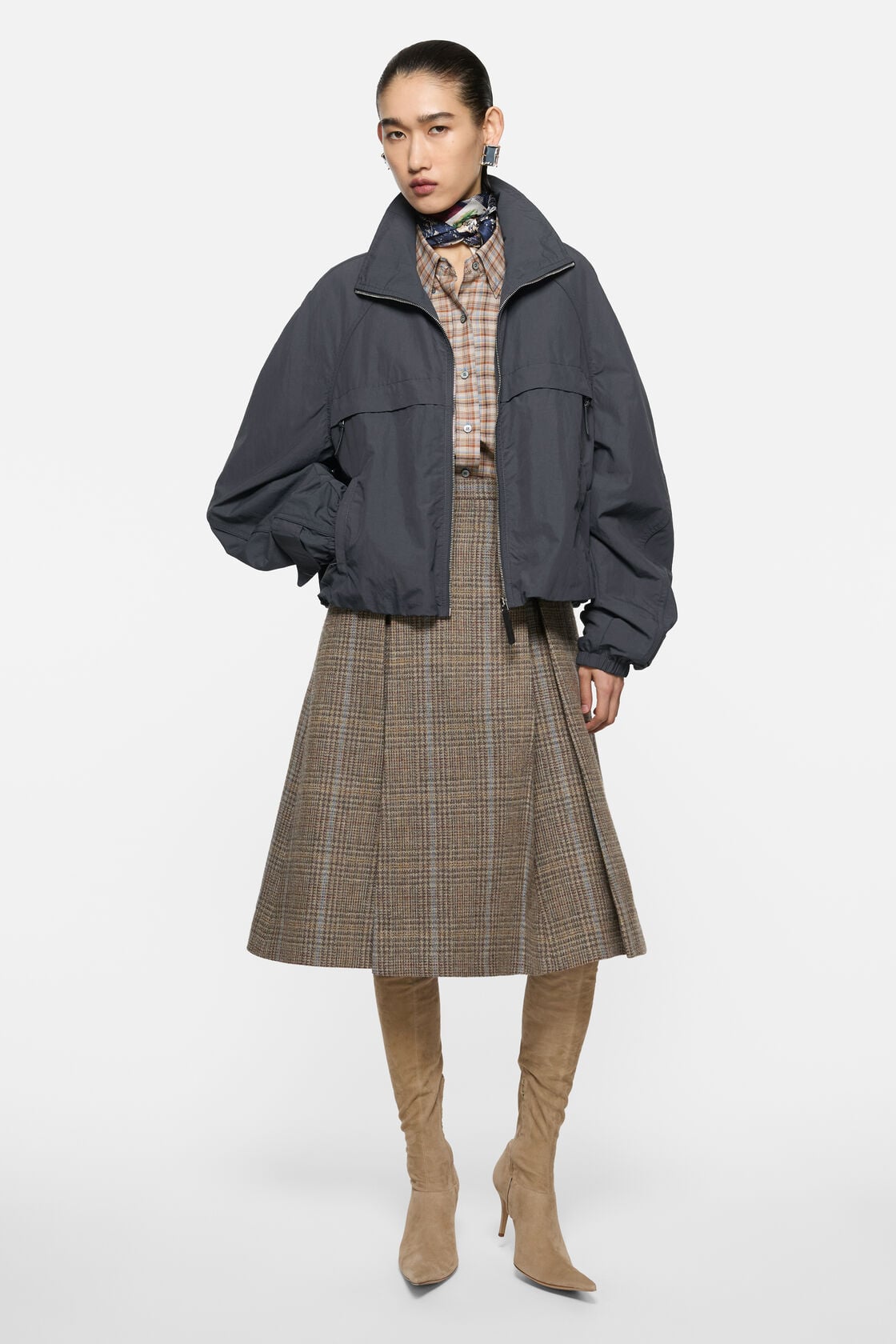
The current collections — shown in Paris, produced between Italy and Portugal — continue the reduction logic. But there's a new code layering in: unexpected ease in tailoring. The blazers from the past three seasons have a soft shoulder, almost no canvassing, and sleeves set high enough that you can lift your arms without the whole jacket riding up. It's tailoring that assumes you're going to move, maybe even work, in the garment.
The knitwear has moved in the opposite direction. Heavier gauge, tighter knit, less drape. The Kalon cardigan, which has become a quiet bestseller, is dense enough that it holds its shape on a hanger. It's a cardigan that acts like a shirt-jacket. Johansson has said he doesn't like knitwear that collapses when you take it off — he wants pieces that retain memory.
The bag no one talks about
Acne's leather goods sit in a strange position. The Musubi, with its knotted-handle gimmick, got press. The Baker, a soft hobo with minimal hardware, became the accessible entry point. But neither bag is particularly interesting if you're looking at the house's actual codes.
The bag that matters is the Clio. Structured, top-handle, made in supple vacchetta that doesn't come pre-distressed. It has a single interior pocket, a magnetic closure, and a detachable strap that most people never use. The proportions are just off enough that it doesn't slot neatly into 'work bag' or 'weekend bag' — it's something in between. It's also one of the few Acne bags that doesn't carry visible branding beyond a small embossed logo inside the frame.
The Clio doesn't sell the way the Musubi does. But it's the bag that makes sense if you've been wearing the house for a few years. It's the bag that works with the Avalon, with the Jensen boots, with the kind of wardrobe that's built on pieces that don't announce themselves.
Where the house is now
Acne Studios is in a consolidation phase. The menswear and womenswear are increasingly converging — not in a unisex way, but in a shared vocabulary. The same trousers appear in both lines, cut from the same block, offered in the same fabrics. The same knitwear, the same outerwear. Johansson has said he's less interested in designing for men or women than in designing for bodies that move.
The retail footprint has stayed selective. Acne doesn't open flagships in secondary markets. The stores that exist — Stockholm, Paris, New York, Tokyo — are small, concrete-heavy, lit like galleries. The clothes sit on those same matte black hangers, angled forward, waiting to be examined.
The house's overlooked codes are still there, still doing the work. The standing collar. The tonal topstitching. The oversized hardware that adds weight without decoration. The ease in tailoring. The refusal to let a piece collapse when you're not wearing it.
You can walk into an Acne Studios store and leave with a Face T-shirt and a Musubi bag, and you'll have bought the brand's two most recognisable products. Or you can buy a Clio and an Avalon and a pair of trousers with a waistband that sits exactly where it should, and you'll have bought the house.