The first thing you notice in the archive room is not the woven leather
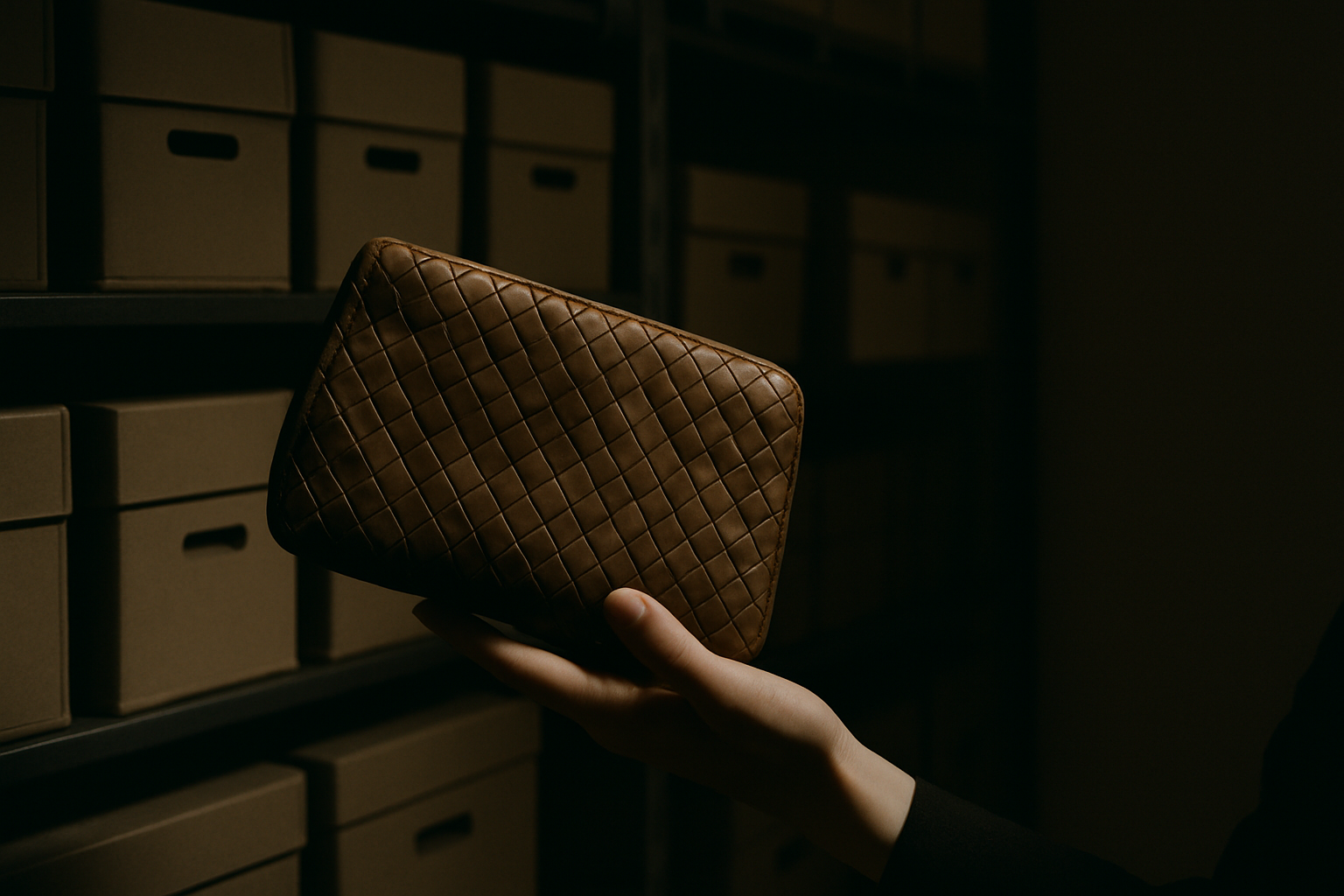
The first thing you notice in the archive room is not the woven leather. It is the weight. A small clutch from 1978 sits heavier in the palm than it should. The intrecciato is tight, the strips narrow, and the whole thing feels like it was built to last through a decade of evening tables and taxi floors. No hardware. No lining visible at the opening. Just structure that doesn't announce itself.
Bottega Veneta was founded in 1966 in Vicenza by Michele Taddei and Renzo Zengiaro. The name translates directly: Venetian workshop. The city is not Venice. Vicenza sits west, closer to the leather ateliers and the tanneries that supplied the region. The founders were not designers in the atelier sense. They were craftsmen who understood material first, and the house grew out of that orientation. By the mid-1970s, the intrecciato weave had become the house signature—not because it was new, but because it was executed with a level of tension and regularity that turned a traditional technique into something you could recognize across a room.
The weave is the obvious code. Everyone knows it now. But there are others, and they are quieter.
The inside-out construction
Bottega Veneta does not use linings the way other houses do. Open a bag from 1982 or 2024 and you will often find the interior finished with the same leather as the exterior, reversed or turned. Seams are enclosed. Edges are bound back on themselves. The construction is closer to garment-making than to industrial bag production, and it shows in the way a piece ages. There is no fabric lining to separate or pill. The leather continues all the way through.
This is not about luxury for luxury's sake. It is about eliminating the break between surface and structure. A lining introduces a seam, a failure point, a place where the bag becomes two materials instead of one. Bottega's historical approach was to treat the bag as a single skin, folded and stitched in a way that the outside and inside are part of the same gesture. You see this in the Cabat, the large tote that has no internal frame and no hardware. It holds its shape because the weave itself is the structure. The leather is thick enough, the intrecciato tight enough, that the bag does not collapse when empty.
The colour as information
Bottega Veneta's colour range has always been specific. Not bright, not neutral. Espresso, parakeet, mallow, fern. The names are borrowed from plants and animals and food, and the dyes are mixed to sit just off the expected note. A brown is not chocolate or cognac. It is darker, cooler, with a grey undertone that reads as shadow. A green is not olive or forest. It is softer, more vegetal, the colour of a leaf before it fully opens.
The palette was established in the 1970s and refined under creative directors who understood that colour could work as a code without being loud. Tomas Maier, who led the house from 2001 to 2018, expanded the range but kept the principle: colours that photograph as one thing and appear as another in person. A bag that looks black in an image reveals itself as deep aubergine when you see it in daylight. This is not a trick. It is a choice about how colour registers in memory versus in hand.
Daniel Lee, who directed from 2018 to 2021, shifted the palette slightly cooler and introduced more contrast—pistachio, bubblegum, electric blue—but he kept the undertone strategy. A pink was never pure. It carried grey or beige beneath it. Matthieu Blazy, in place since 2021, has pulled the colours back toward earth again. His palette feels like it was mixed with clay and silt. The brightness is there, but it sits under a matte surface that absorbs light instead of reflecting it.
The hardware that isn't
Bottega Veneta has historically avoided visible hardware. No logos, no metal plaques, no turn-locks that announce themselves. When hardware is present, it is recessed or wrapped in leather. The Knot clutch, introduced in 2001, uses a twisted knot of intrecciato as the closure. The Jodie, one of Lee's key introductions, has a knotted handle and a single gathered seam—no buckle, no clasp. The bag closes with a magnet hidden inside the leather.
This is not minimalism. Minimalism suggests reduction for aesthetic effect. Bottega's approach is functional. A metal clasp is a place where the bag can scratch a table or catch on fabric. A logo plate is a surface that will tarnish or fade. The house has always preferred to solve these problems by building the closure into the form itself. The Lauren 1980 clutch, reissued under Blazy, uses a single loop of leather that slides over a knot. No spring, no hinge. The tension holds it closed.
The exception is the Triangle bag, introduced by Lee, which uses a metal triangle as both closure and structure. But even here, the hardware is not decorative. It is load-bearing. The triangle holds the bag's shape and allows the leather to drape from a single point. The metal is brushed, not polished, and it sits flush with the leather edge.
The garment construction in leather
Bottega Veneta has always cut leather the way a tailor cuts wool. Panels are shaped and darted. Seams are pressed open or topstitched flat. The Arco tote, a house style since the 1970s, uses a curved top edge that requires the leather to be stretched and eased into place, the same technique used in a jacket lapel. The Moon bag, introduced under Lee, has a gathered seam that mimics ruching in fabric. The leather is soft enough to hold the gathers without bulk.
Blazy has leaned further into this. His first collection included leather trousers with a center crease, as if the hide had been ironed. He has shown leather coats with set-in sleeves and shaped armholes, construction details that are common in tailoring but rare in leather outerwear, which is usually cut in flat panels and sewn with straight seams. The technique requires leather that is thin and pliable, and it requires a workroom that knows how to handle it without stretching or distorting the skin.
This approach extends to the bags. The Kalimero, one of Blazy's key introductions, is a small bag with a drawstring top and a body that collapses and expands. The leather is treated to be as soft as jersey, and the bag behaves more like a pouch than a structured frame. It moves with the wearer. The shape is not fixed.
Where the house stands
Bottega Veneta is not in a rebuilding phase. It is in a clarifying one. Blazy has taken the house back toward its material origins without rejecting the innovations of his predecessors. The intrecciato is still central, but it appears in new scales and applications—micro-woven leather, macro-woven rubber, intrecciato-embossed canvas. The colour palette has shifted, but the principle of undertone and mutability remains. The construction is still garment-based, still focused on eliminating the break between surface and structure.
The house is also producing more in Italy than it has in years. The Montebello atelier, opened in 2021, is dedicated to leather goods and employs over 200 artisans. The workrooms are set up for small-batch production and for training new makers in techniques that are not widely taught anymore. This is not heritage branding. It is infrastructure.
The overlooked codes are still there. They are in the way a seam is finished, the way a colour sits in certain light, the way a bag holds its shape without a frame. They are not loud, and they do not need to be. A woman at a restaurant in Milan sets her bag on the table. No logo, no hardware, just a folded edge and a knotted handle. The waiter knows what it is before she opens it.