The first thing you notice in the archive room isn't a Dionysus or a Jackie
The first thing you notice in the archive room isn't a Dionysus or a Jackie. It's a leather-lined trunk from 1938, oxblood cowhide over poplar, with brass corner caps that have gone soft at the edges. The interior is lined in faille the colour of burnt sugar. No monogram. No web stripe. Just construction so tight the seams feel like they were drawn with a ruling pen.
That trunk tells you more about Gucci than most of what moves through the boutiques now. It tells you the house was built by a saddler who understood load-bearing joints and how leather ages under pressure. It tells you there was a moment when the work didn't need to announce itself.
The codes everyone knows — the interlocking Gs, the red-and-green web, the horsebit — arrived later, and louder. But underneath that, there's a second layer of signatures that never needed a logo to function. They're still there. You just have to know where to look.
The saddlery foundations
Guccio Gucci opened the first shop on Via della Vigna Nuova in Florence in 1921. He'd worked at the Savoy in London and seen how the travelling set moved through Europe with trunks that had to survive being thrown onto trains and strapped to the roofs of motorcars. When he came back to Florence, he started making luggage that could take the same beating.
The early pieces were about joinery. Gucci used vegetable-tanned Tuscan leather, which is slower to produce and more expensive than chrome-tanned, but it burnishes instead of cracking. The hardware was solid brass, not plated. The stitching was saddle-stitched by hand — two needles pulling a single thread through each hole from opposite directions, locking the seam so that if one side fails, the other holds.
This wasn't about luxury signalling. It was about function. A bag that falls apart in transit isn't a bag. It's a liability.
The bamboo handle came in 1947, during the postwar material shortages. Steel and brass were hard to source, so Gucci's artisans started heat-forming bamboo into curved handles. It worked. The material was light, strong, and flexible enough to take the stress of a loaded bag. It also looked like nothing else on the market.
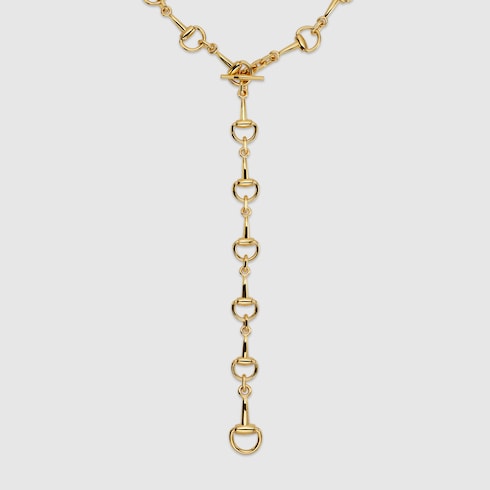
The horsebit arrived in 1953, borrowed directly from equestrian tack. It was decorative, yes, but it was also structural — the metal loop distributed weight across the vamp of a loafer or the flap of a bag. You could use it. That's the part people forget.
The era no one talks about
There's a period between Tom Ford's exit in 2004 and Alessandro Michele's arrival in 2015 that the house would probably prefer to skip over. Frida Giannini was creative director for most of it, and the work was competent, commercial, and almost entirely forgettable. The bags got bigger. The hardware got shinier. The logo got louder.
But if you go back and look at the quieter pieces from that era — the soft leather totes with minimal branding, the small crossbodies in grained calf, the flat sandals with just a thin horsebit detail — you can see the house trying to remember what it was before it became a logo. Those pieces didn't sell. They didn't photograph well. But they were closer to the 1938 trunk than anything else the house was making at the time.
Giannini also brought back the bamboo handle in 2013, not as a nostalgic flourish but as a structured top-handle bag with a tassel lock. It was one of the last things she designed before leaving. It didn't get much attention. Ford's Gucci had been about sex and surface. Michele's Gucci would be about collage and irony. Giannini's Gucci was about trying to find a middle path, and middle paths don't make headlines.
What Michele actually changed
When Alessandro Michele took over in January 2015, the first collection hit the runway six days later. It was built from pieces already in production, reworked. Pussy-bow blouses. Pleated skirts. Fur-lined loafers. Embroidered everything. The press called it geek chic. The house called it a new romantic vision.
What Michele actually did was turn the volume up on everything Gucci had been trying to suppress. He made the decorative the point. He stacked references — 1970s Hollywood, 1990s grunge, 18th-century portraiture — until the collection stopped trying to resolve into a single idea. It was a collage, and collages don't need to make linear sense.
But underneath the embroidery and the maximalism, Michele was using the same construction techniques the house had always used. The loafers were still Goodyear-welted. The bags were still lined in suede or grosgrain. The leather was still vegetable-tanned Tuscan calf. He just put a tiger's head on the flap and called it a night.
The Dionysus, which became the hero bag of Michele's tenure, is a good example. The sliding chain strap, the structured shape, the top flap — all of that is straight out of the 1970s Gucci playbook. The tiger-head closure is the only thing that's new, and even that is borrowed from Greek mythology by way of Victorian jewellery. Michele didn't invent a new bag. He just made an old bag feel like it had been dug out of someone's attic and claimed as a trophy.
The bamboo came back too, but this time as a small top-handle bag with a detachable shoulder strap. It wasn't trying to be a carryall. It was trying to be an object. That's the shift. Under Michele, Gucci stopped pretending its bags were tools and started treating them as talismans.
What Sabato De Sarno is keeping
Sabato De Sarno's first collection for Gucci landed in September 2023, and the read from most of the press was that he was stripping the house back, returning to simplicity, dialling down the maximalism. That's half true.
What De Sarno is actually doing is isolating the codes that don't need decoration to function. The Blondie bag, which became the first signature piece under his direction, is built around a circular interlocking-G hardware piece. It's prominent, yes, but it's also the closure mechanism. It does something. The bag itself is soft, unstructured, minimal. The hardware is the only ornament, and it's working.
He's also brought back the Bamboo 1947 in a more restrained silhouette — less about the handle as a statement, more about the handle as a solution. The leather is matte. The hardware is brushed, not polished. The bag looks like something you'd find in a Milanese apartment that hasn't been redecorated since 1983, and that's the point.
De Sarno worked at Prada and Valentino before this. He knows how to make a bag that doesn't need to announce itself. He also knows that Gucci can't go back to being quiet — the market won't allow it, and the brand's position won't support it. So he's splitting the difference: keeping the logo, keeping the codes, but lowering the volume just enough that the construction can come back into focus.
The loafers are a good indicator. He's kept the horsebit, but he's using softer leathers — unlined suede, washed calf — so the shoe moulds to your foot instead of holding its shape against it. It's a small shift, but it changes how the shoe ages. It goes from being an object you own to being an object that knows you.
Where the house is now
Gucci is still the second-largest brand in the Kering portfolio, but the numbers have been softer than expected for the past eighteen months. Part of that is the China slowdown. Part of that is brand fatigue — Michele's Gucci was everywhere for seven years, and everywhere eventually becomes nowhere. Part of that is De Sarno needing time to establish a language that feels like his, not like a reaction to what came before.
But if you go into a Gucci boutique now and ignore the hero bags, ignore the runway pieces, and look at the small leather goods — the cardholders, the zip-around wallets, the coin purses — you'll see something closer to that 1938 trunk. Clean lines. Solid hardware. Leather that will burnish, not crack. No embroidery. No appliqué. Just construction.
Those pieces don't make the Instagram grid. They don't get carried by influencers. But they're the ones that will still be in someone's coat pocket in 2038, softened and scratched and perfectly functional. That's the code that never needed a logo. That's the code that's still there, if you know where to look.