The flat-topped trunk sits behind glass on the second floor of the Asnières workshop, north-west of Paris proper
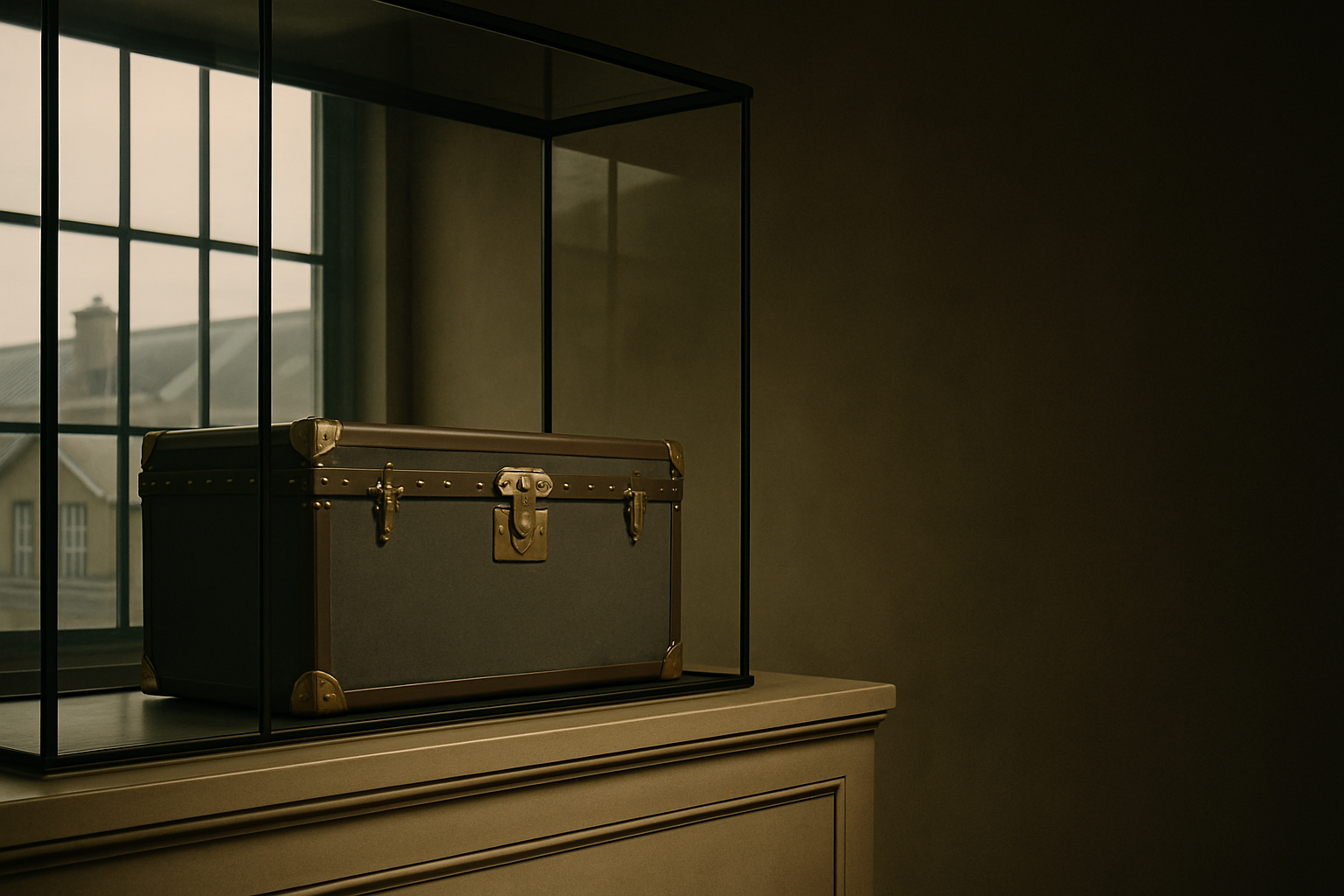
The flat-topped trunk sits behind glass on the second floor of the Asnières workshop, north-west of Paris proper. Grey Trianon canvas. Brass corners. A lock whose mechanism still turns, though no one has opened it in decades. Stamped on the lid: L. Vuitton, 1 Rue Scribe. The date is 1858, and what strikes you isn't the object's age but its clarity of purpose. It was built to stack. That mattered, in the hold of a steamship, more than ornament.
Louis Vuitton did not invent luggage. He refined a problem. Before him, trunks had domed lids — a holdover from the days when rain was the chief threat. But domed trunks don't stack, and by the mid-nineteenth century, travel had moved indoors: rail carriages, ship cabins, the sorts of spaces where vertical real estate mattered. Vuitton's flat trunk was a spatial solution dressed in grey poplar and canvas. It was also, quietly, the beginning of a house whose primary skill would turn out to be answering the question: what does mobility look like now?
Monogram as passport
By 1896, the house had a problem of a different sort. Counterfeits. The flat trunk had been successful enough to spawn imitators across Europe, and Louis Vuitton's son Georges needed a mark that couldn't be easily copied. He commissioned a pattern: interlocking LV initials, quatrefoils, stylised flowers, all rendered in a shade of brown the house would later call havane. The Monogram canvas.
It was, on one level, a practical measure — harder to forge a repeating pattern than a plain weave. But it was also the moment Louis Vuitton became legible as a brand in the modern sense. The Monogram didn't just identify the maker; it made the object itself a sign. You carried it, and in doing so, you carried a shorthand for a certain kind of person: someone who moved, who had places to be, who could afford the real thing.
This is where the house's trajectory starts to complicate. The Monogram worked because it was both functional and visible. It signalled without announcing. But visibility has a way of attracting attention that exceeds intention, and by the latter half of the twentieth century, the canvas had become something else: not a mark of travel but a mark of aspiration. The bag no longer needed to go anywhere. It just needed to be seen.
Marc Jacobs understood this when he arrived in 1997. His first collection for Louis Vuitton included ready-to-wear, which the house had never produced at scale, and he opened with a premise that seemed, at the time, either bold or foolish: that a luggage house could also be a fashion house. Not in the couture sense — Louis Vuitton has never made clothes in an atelier the way Dior or Chanel does — but in the sense that it could set a pace, propose a look, collaborate with artists who had no prior interest in leather goods.
The Stephen Sprouse graffiti collection in 2001. Takashi Murakami's multicoloured Monogram in 2003. Richard Prince's nurse paintings printed on Speedy bags in 2008. These weren't collaborations in the polite sense. They were disruptions, and they worked because Jacobs seemed to grasp that Louis Vuitton's real asset wasn't the Monogram itself but the tension between its historical weight and its contemporary ubiquity. He could play with it because it was already everywhere.
One suspects that Jacobs also understood the risk. When you make the logo the subject, you cede a certain kind of control. The bag becomes a canvas in the literal sense, and what people project onto it — status, taste, aspiration, resentment — starts to matter more than the object's original function. By the time Jacobs left in 2013, Louis Vuitton was the world's most valuable luxury brand, and also, in certain circles, the most contentious. The Monogram had become too loud to ignore and too obvious to admire without qualification.
The Ghesquière question
Nicolas Ghesquière took over womenswear in 2013 with a different set of concerns. He had spent fourteen years at Balenciaga, where he had built a reputation for clothes that looked simultaneously historical and alien — sharp shoulders, complex seaming, a kind of rigour that didn't announce itself. At Louis Vuitton, he inherited a house whose identity was tied to an accessory, and his first collections read like an attempt to reverse the equation: make the clothes matter, and let the bags follow.
The Petite Malle, introduced in his debut collection, was a deliberate provocation. A trunk reduced to handbag scale, complete with brass lock and leather straps. It was, in one sense, a return to the archive — a literalisation of the house's founding object. But it was also a test. Could Louis Vuitton make something that referenced its own history without becoming a nostalgia piece? Could it be specific without being kitsch?
The answer, on balance, has been yes, though not without friction. Ghesquière's tenure has been marked by a kind of productive tension between his instincts — which lean cerebral, referential, occasionally austere — and the house's commercial imperatives, which require a certain level of accessibility. His runway shows reference everything from Eero Saarinen to Brazilian Modernism to science fiction, and the clothes themselves often feel like they're in conversation with architecture rather than other garments. But the bags, which still account for the majority of Louis Vuitton's revenue, have had to remain legible. The Twist. The Capucines. The Coussin. Each one carries enough design detail to justify its price, but none of them ask too many questions.
This is, arguably, the central challenge of running creative at a house like Louis Vuitton. You are not designing for a niche. You are designing for a global apparatus that includes hundreds of stores, thousands of employees, and an audience that ranges from collectors who buy runway pieces to first-time customers saving for a Neverfull. The work has to hold both ends of that spectrum, and the result is often a kind of elegant compromise: clothes that are more interesting than they need to be, bags that are more restrained than they used to be.
What the house holds now
Virgil Abloh's arrival in menswear in 2018 introduced yet another variable. Abloh came from streetwear, and his first collection for Louis Vuitton was, in many ways, a conversation with the Monogram's second life — the one that existed in hip-hop, in resale markets, in the hands of people who had never set foot in a Louis Vuitton boutique but knew exactly what the logo meant. He made that conversation explicit: collaborations with Nike, with artist collective MSCHF, runway shows that felt more like installations than fashion presentations. His work was populist in the best sense, and it expanded the house's range without diluting it.
Abloh's death in 2021 left a gap that the house has not yet filled with a single successor. Pharrell Williams now oversees menswear, and his first collections have leaned into craft — hand-painted bags, intricate leatherwork, a certain tactile richness that feels less about logo and more about material. Whether this represents a new direction or a momentary pause is unclear. Louis Vuitton is large enough now that it can absorb multiple directions at once.
What remains consistent is the question the house has been answering since 1858: what does it mean to carry something? A trunk, a bag, a logo, a set of associations. The answer changes depending on who's asking, but the question itself holds. There's a Keepall in the Asnières archive, canvas long since softened, handles worn pale where hands gripped them. It has been somewhere. You can tell by looking.