The jacket is ivory wool, cut like a frock coat but abbreviated at the hip
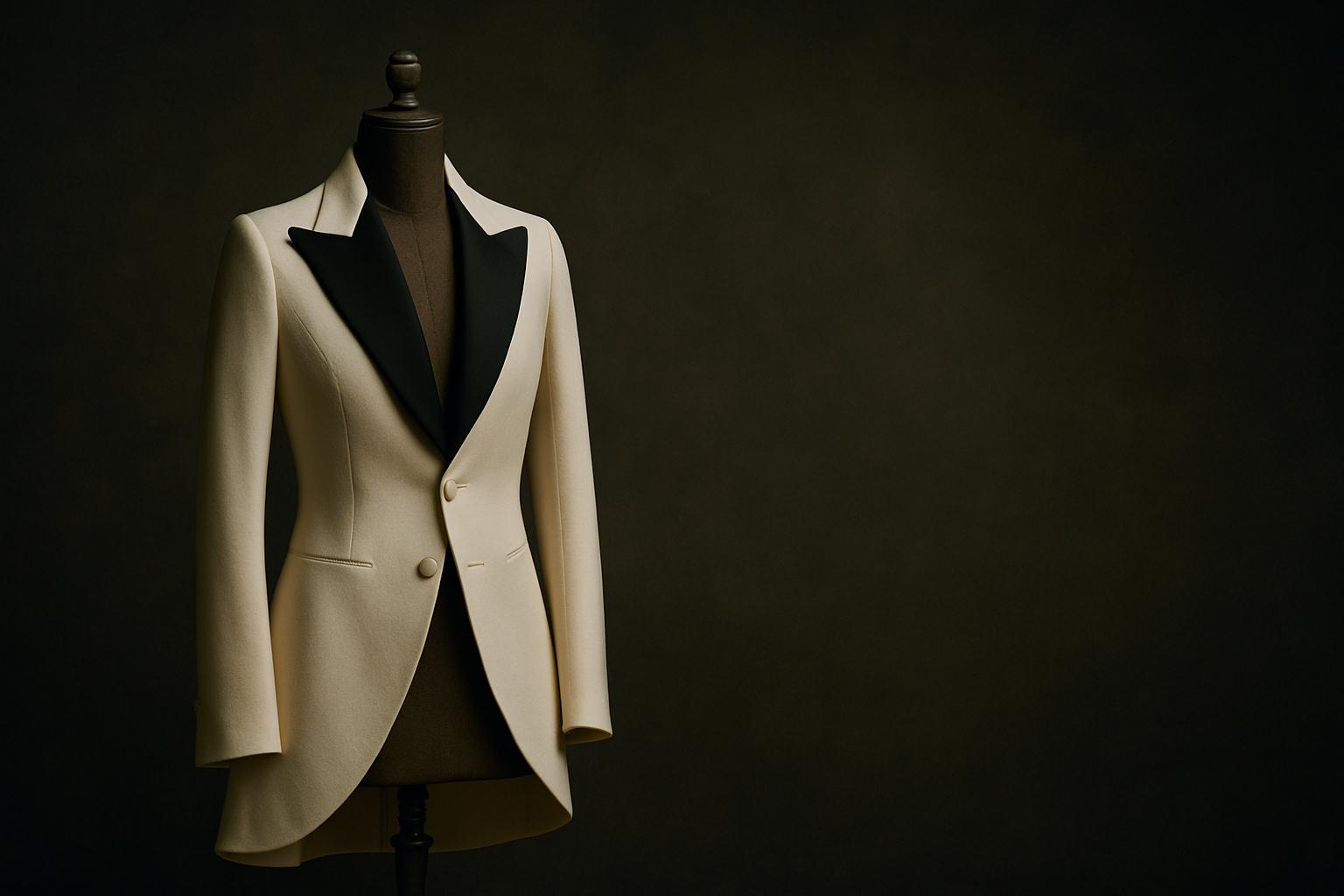
The jacket is ivory wool, cut like a frock coat but abbreviated at the hip. The lapels are faced in grosgrain. The shoulders sit exactly where shoulders should sit. It is from the autumn of 1996, the collection titled Dante, and it looks like something you could wear tomorrow if you had somewhere serious to go. That is the first surprise. The second is the seam running down the centre back, which splits open to reveal a scarlet silk lining and then, below that, a panel of black lace over skin. McQueen built propriety and then opened a door in it.
Alexander McQueen was founded in London in 1992, though the name carried weight before that. Lee Alexander McQueen had trained at Anderson & Sheppard on Savile Row and cut his teeth at Gieves & Hawkes. By the time he showed his graduate collection at Central Saint Martins, he already understood how a jacket was supposed to behave. His thesis collection, Jack the Ripper Stalks His Victims, included hair sewn into the linings. Isabella Blow bought the entire collection for three thousand pounds. The work was theatrical, but the construction was not.
What followed was not a slow build. McQueen showed in London, then took the role of head designer at Givenchy in 1996, then launched his own Paris shows while still at the French house. The pace was relentless. The work was often described as dark, which is accurate only if you also call it disciplined. McQueen's tailoring came from the Row. His cutting technique came from pattern-making manuals and from watching how fabric moved on a body in motion. The darkness was in the narrative, not the technique. The technique was exact.
The founding era: 1992–2000
The early collections were shown in warehouses and car parks and churches. They had titles that doubled as manifestos. Highland Rape in 1995 was not subtle. Models walked in torn lace and tartan, hair matted, eyes blank. The British press called it misogyny. McQueen said it was about England's treatment of Scotland. Both could be true. What is undeniable is that the clothes themselves were not careless. The tailoring was sharp. The fabrics were often destroyed, but they were destroyed with intention.
It's a Jungle Out There, spring 1997, ended with a model in a white muslin dress standing on a turntable while two robotic arms sprayed her with black and yellow paint. The dress became a Jackson Pollock in real time. The mechanism was industrial. The effect was both violent and beautiful, and McQueen was interested in that overlap. He did not resolve it. He let it sit.
During this period, McQueen also worked at Givenchy. The relationship was difficult. Hubert de Givenchy himself reportedly wept when he saw what McQueen had done with the house codes. McQueen called the Givenchy atelier old-fashioned. He stayed for four years. The work he did there was competent and occasionally brilliant, but it was not where his attention lived. His own line was the site of experiment. Givenchy paid for it.
By 2000, Gucci Group acquired a fifty-one percent stake in Alexander McQueen. The brand had a structure. McQueen had a studio in Clerkenwell and a runway slot in Paris. He also had a reputation for working until four in the morning and expecting the same from his team. The clothes from this era are now in museum collections. The bumster trousers, the razor-clam shell heels, the dresses that looked like they had been grown rather than sewn. McQueen was not trying to make wearable fashion. He was trying to make an argument.
The consolidation: 2000–2010
The middle decade was when Alexander McQueen became a house that could sustain itself. The runway shows remained spectacular—VOSS in 2001, with its mirrored box and the moths and the naked model on a chaise; Widows of Culloden in 2006, with Kate Moss appearing as a hologram inside a glass pyramid—but the business began to support the vision rather than the other way around.
Shoes became a category. Handbags followed. The Novak bag, named after Kim Novak, appeared in 2008 and sold. The skull scarf, which first appeared in 2003, became a signature. McQueen was still showing collections that made people uncomfortable, but he was also making accessories that people wanted to carry. The tension between those two modes was productive. The house could take risks on the runway because the commercial line held.
McQueen's tailoring during this period became even more refined. The Sarabande collection in spring 2007 featured suits with exaggerated hips and nipped waists, but the construction was flawless. He was using the same techniques he had learned on the Row, but he was applying them to silhouettes that had no precedent. A jacket could have a twenty-two-inch waist if the pattern was right. McQueen proved it.
The last collection McQueen worked on before his death in February 2010 was Plato's Atlantis, spring 2010. The prints were digital, generated to look like reptile skin and coral. The shoes were thirty-centimetre heels that bent the foot into a hoof shape. The finale dress was worn by Raquel Zimmermann, and it looked like the ocean had learned to walk upright. McQueen had been thinking about evolution, about what comes after the human form. The collection was shown in Paris. He died two weeks before the autumn 2010 presentation.
The continuation: 2010–present
Sarah Burton had worked alongside McQueen since 1996. She took over as creative director in May 2010. Her first collection under her own name was spring 2011, titled Angels and Demons. The silhouette was softer than McQueen's had been, but the tailoring was still precise. Burton had trained in the same studio. She knew how the patterns worked.
Burton's McQueen was not Lee's McQueen, and she did not try to make it so. The shows were still ambitious—she put models in gowns made entirely of feathers, in dresses that looked like they had been carved from marble—but the tone shifted. There was less aggression. The clothes were still conceptual, but they were also more openly beautiful. Burton designed the wedding dress for Catherine Middleton in 2011. It was watched by two billion people. The house could do both.
For thirteen years, Burton maintained the codes: the tailoring, the embroidery, the sense that a McQueen garment should be an event. She left the house in 2023. Seán McGirr, formerly of JW Anderson and Dries Van Noten, was appointed in October of that year. His first collection was autumn 2024. The reviews were mixed. McGirr brought a looser silhouette, a younger energy, more streetwear influence. It is too early to say what his McQueen will become.
The house now operates as part of Kering. There are stores in London, New York, Tokyo, Shanghai. The archive is vast. The question facing any creative director at Alexander McQueen is not whether to reference the past but how much of it to carry forward. Lee McQueen built a language, and Burton refined it. McGirr is still learning the grammar.
A dress from McQueen's final collection is in the permanent collection at the Metropolitan Museum. It is silk, printed with a pattern that looks like scales or cells or ocean water seen from above. The bodice is structured. The skirt moves. If you stand in front of it long enough, you can see both the Savile Row training and the graduate who sewed hair into linings. The garment holds all of it. That is what a house is: a container for contradictions that somehow still stands.