The jeans came first
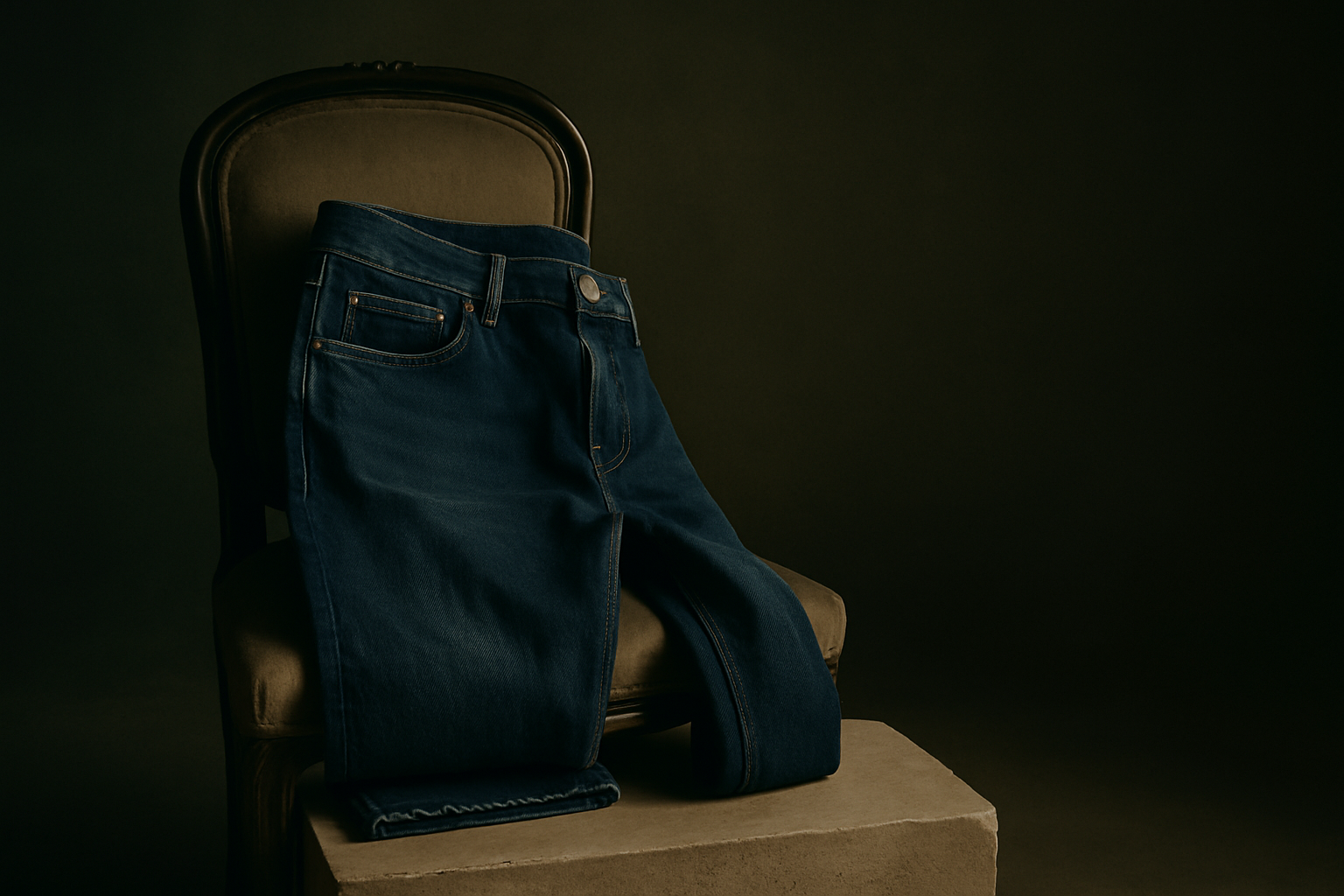
The jeans came first. Not as a statement, exactly — more as a proof of concept. In 1996, Jonny Johansson and three partners in Stockholm printed 'ACNE' across the back pocket of a hundred pairs of raw denim, gave them to friends, and watched what happened. The acronym stood for 'Ambition to Create Novel Expression', which is the sort of name one assigns to a creative collective when one is twenty-five and has no intention of becoming a fashion house. The jeans, though, had a cut worth copying: low-slung, straight through the leg, with a red topstitch that read from across a room. Within a year, the collective had become a denim label. Within five, it had become something else.
What Acne Studios is now — a Stockholm-based maison with two-hundred-odd stores, a Chanel-backed balance sheet, and collections that land somewhere between cerebral sportswear and wearable art — took shape across three distinct eras, each one a recalibration of what the house believed it could be.
The Johansson Years: 1996–2019
Johansson, who studied at Stockholm's Beckmans College of Design but never completed a formal fashion degree, approached the work sideways. Early collections mixed references with the kind of casual disregard that only works when the eye is good: Comme des Garçons proportions, Helmut Lang fabrication, a bit of Margiela's deconstruction, all filtered through a Scandinavian instinct for restraint. The house showed in Paris from 2006 onward, but the aesthetic never bent toward French polish. Seams stayed visible. Hems frayed on purpose. Colour, when it appeared, came in blocks — oxblood, mustard, a particular shade of dusty pink that became, for a time, shorthand for the brand itself.
The signature pieces accumulated slowly. The 'Jensen' boot, introduced in 2012, was a Chelsea with an exaggerated toe and a stacked heel that looked almost orthopedic until you saw it styled with cropped trousers and an oversized blazer. The 'Canada' scarf, a wool rectangle embroidered with the house name in sans-serif capitals, became the kind of thing you spotted on every third person at a certain kind of gallery opening. The 'Avalon' double-breasted coat — long, boxy, made in a boiled wool that held its shape without stiffness — turned up in enough street-style slideshows that the house stopped needing to explain itself.
What held it together was a sensibility, not a signature. Johansson's collections felt considered without feeling precious. The tailoring was sharp but never uptight. The knitwear was oversized but not sloppy. Face motifs — smiling, frowning, sometimes just two dots and a line — appeared on sweaters and T-shirts, a visual tic that could have read as juvenile but instead landed as wry. The house understood, early on, that a certain kind of customer wanted clothes that signalled taste without announcing effort.
By the mid-2010s, Acne Studios had become the sort of brand that fashion editors referenced as shorthand for a specific mood: intellectual but not austere, directional but not difficult, expensive but not ostentatious. The price points crept upward — a wool coat that cost €800 in 2010 was €1,200 by 2015 — but the customer base widened. The house opened flagships in New York, London, Tokyo. In 2017, Chanel acquired a minority stake, which meant access to atelier resources and supply-chain infrastructure without, at least initially, a visible shift in creative direction.
Johansson stepped back from the runway in 2019, citing a desire to focus on brand strategy and special projects. The timing was curious — the house was profitable, the collections were coherent, the press was largely favourable — but not inexplicable. After twenty-three years, perhaps the work had simply stopped feeling novel.
The Transition: 2020–2022
For three years, Acne Studios operated without a named creative director. Johansson remained involved, overseeing the studio from a distance, but the collections were credited to an in-house team. The result was a kind of stylistic holding pattern: the proportions stayed familiar, the palette stayed muted, the face motif stayed in rotation. The clothes were competent. They were also, by the house's own standards, a bit inert.
The pandemic complicated the picture. Stores closed, reopened, closed again. The brand leaned into e-commerce, which meant leaning into the pieces that photographed well and moved quickly: the Jensen boots, the logo scarves, the oversized hoodies with the face embroidered at the chest. The deeper cuts — the deconstructed blazers, the asymmetric skirts, the pieces that required a dressing room and a full-length mirror to make sense — receded.
It wasn't a crisis, exactly. The house was still profitable, still relevant, still capable of selling out a leather jacket within a week of it hitting the site. But the momentum had shifted. Where Acne Studios had once felt like a house with a point of view, it now felt like a house with a product line.
The Camille Hurel Era: 2023–Present
Camille Hurel arrived in early 2023 with a background that read, on paper, as impeccable: stints at Balenciaga under Demna, a brief tenure at Loewe, a reputation for understanding how to make conceptual work feel wearable. Her first collection for Acne Studios, shown in Paris that June, was a reset.
The proportions shifted. Trousers sat higher on the waist. Jackets nipped in at the ribs before flaring at the hem. The fabrics leaned harder into texture — crinkled leather, felted wool, a silk-cotton blend that caught the light without looking precious. The face motif, which had started to feel like a crutch, appeared only once, embroidered small on the interior lining of a coat. The palette stayed Nordic — grey, cream, charcoal, the occasional flash of rust — but the silhouettes felt less like uniform and more like wardrobe.
What Hurel brought, more than any single garment, was a willingness to complicate the house's relationship with ease. The early Johansson years had been about making cerebral fashion feel accessible. Hurel's work, by contrast, asks the wearer to meet the clothes halfway. A leather trench coat with an asymmetric closure and a single oversized button requires a certain confidence to pull off. A knit dress with a built-in scarf that wraps twice around the neck and trails to mid-thigh is not, strictly speaking, easy. But the pieces feel earned in a way that the logo hoodies never quite did.
The market has responded cautiously. Sales are steady but not explosive. The press has been warm but not ecstatic. The house, for now, occupies a space that is neither avant-garde nor commercial, neither niche nor mass. Whether that position is sustainable depends, in part, on whether Hurel can articulate a vision distinct enough to justify the prices — a leather jacket currently runs €2,400, a wool coat closer to €1,800 — without alienating the customer base that came for the jeans and stayed for the scarves.
Where It Stands
On a recent afternoon in the Marais flagship, a woman in her early thirties tried on a charcoal wool coat with an exaggerated collar and a single horn button at the sternum. She turned in front of the mirror, pulled the collar up, pushed it down, left it half-raised. The coat cost €1,650. She bought it. On her way out, she paused at a table stacked with logo scarves, ran her hand across the wool, and kept walking. It was a small moment, easy to miss, but it suggested something about where Acne Studios is now: a house that has learned, slowly, that the customer who wants the coat is not always the customer who wants the scarf, and that both are worth dressing.