The Medusa head buckle sits face-up on the glass counter, tarnished gold against black velvet
The Medusa head buckle sits face-up on the glass counter, tarnished gold against black velvet. It's from a belt, circa 1992, and the woman selling it doesn't know what to ask. You do. That's the difference between walking into Versace cold and walking in with twenty minutes of context. The house rewards homework.
Gianni Versace opened on Via della Spiga in 1978 with a women's collection that leaned hard into printed silk and body-con cuts at a moment when Milan was still buttoned into suiting. The aesthetic—classical references run through a Miami filter, maximum saturation, zero restraint—split opinion immediately. By the early nineties, that split had calcified into the brand's entire value proposition. You either wanted the Baroque print, the safety-pin dress, the Medusa, or you didn't. Gianni was murdered in 1997. Donatella took over. The codes stayed.
What matters now is that Versace operates on two registers simultaneously. There's the logo-forward, instantly recognisable stuff—Medusa hardware, Greek key trim, that particular shade of gold that photographs as brassy until you're standing next to it—and there's a second tier of tailoring and evening pieces that play quieter but still legibly Versace. Both are legitimate entry points. Neither is subtle.
The Pieces That Work
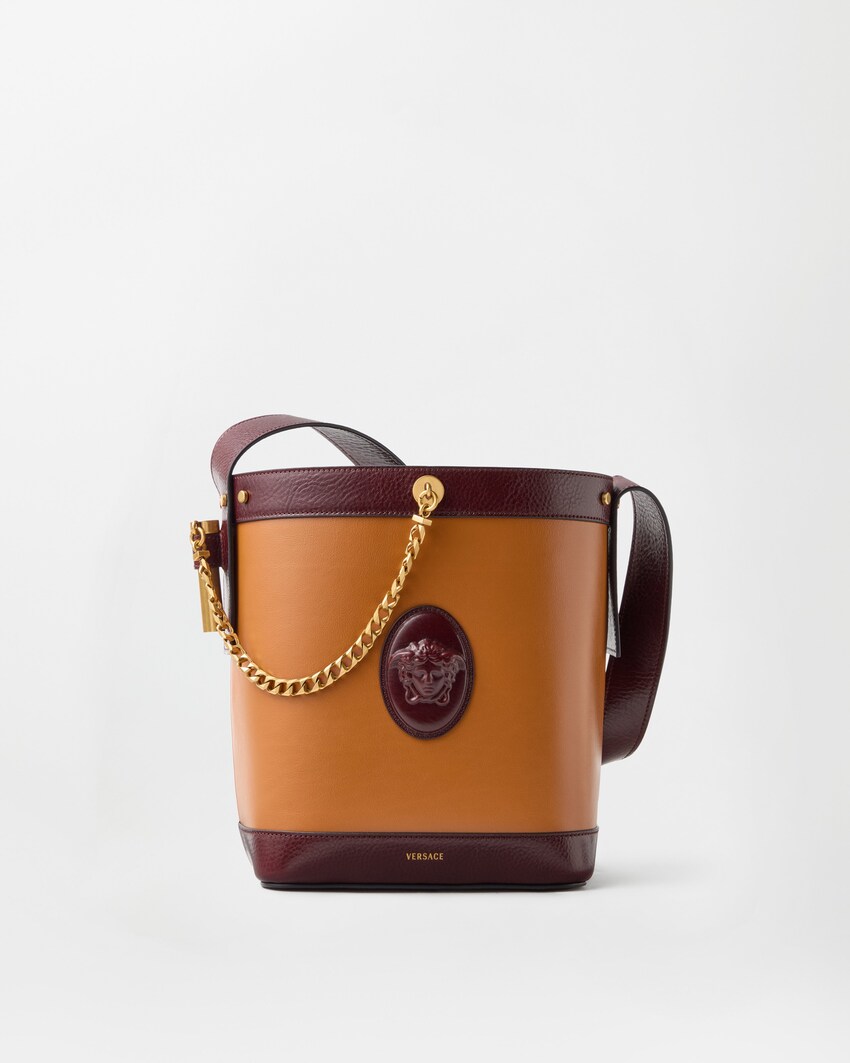
Start with the Medusa. It appears on everything from leather goods to jewellery, and its presence is the fastest way to signal house allegiance without wearing an all-over print. The Medusa '95 bag, a structured top-handle in calf leather, runs around €2,200 and holds its shape through daily use. The hardware is chunky, almost sculptural, and it's one of the few Versace bags that doesn't feel like it's trying to out-shout the room. The chain strap versions—Medusa Aevitas, Icon—push closer to €2,800 but give you flexibility between shoulder and crossbody carry.
If you're looking at small leather goods, the Medusa bifold wallet in grained leather sits at €395 and wears in well. The card holders, around €250, do the job but feel engineered for gift-box appeal rather than pocket longevity. Versace's leather accessories don't age with the same supple hand as, say, Bottega's, but they don't pretend to. The material is treated for durability, not patina.
Jewellery is where Versace's iconography compresses into wearable shorthand. The Medusa pendant necklaces in gold-tone metal start at €350 and work layered or alone. The Greca link bracelets—Greek key motif, substantial weight—run €450 to €650 depending on width. These pieces photograph well, which matters if you're buying into the brand's visual language. Versace has always understood that half its audience is performing for a lens.
Eyewear deserves mention. The Medusa Biggie sunglasses, oversized acetate frames with the Medusa medallion at the temple, sit at €310 and function as a face-altering accessory in the way most sunglasses don't. They're not for everyone. That's the point. Versace's optical frames, often overlooked, offer a more restrained entry—rectangular or cat-eye shapes in tortoiseshell or black, Medusa engraved small on the arm, around €280. You get the affiliation without the billboard.
Silk scarves and printed silk shirts are Versace's home territory. A 90cm square scarf in the Barocco print runs €395, and it's one of the few pieces that justifies the term archival—the print has barely shifted since 1991. Wear it as a scarf, tie it to a bag, frame it. The silk shirts, cut slim through the body with a spread collar, start at €850. Sizes run narrow. If you're between, go up. The prints—Trésor de la Mer, Barocco, Medusa Amplified—are not for boardrooms. They're for dinners where you want to be remembered.
What to Avoid
Versace's diffusion line, Versace Jeans Couture, exists in a separate price bracket (€150 to €600) and a separate aesthetic universe. The logo is different—a more stylised, linear Medusa—and the materials skew synthetic. It's aimed at a younger demographic and sold through different channels. If you're buying Versace proper, don't cross-shop here. The brand equity doesn't transfer.
Footwear is inconsistent. The Trigreca sneakers, chunky runners with exaggerated soles, launched in 2021 and immediately felt dated by 2023. They sit at €795 and don't hold resale value. The platform Medusa Aevitas pumps, closer to €1,100, work if your wardrobe already skews maximalist, but they're a statement piece with a narrow window of relevance. Versace's classic pointed-toe pumps and strappy sandals, less hyped but more wearable, start around €750 and offer better longevity.
Avoid anything that feels like it's chasing a trend Versace didn't originate. The house works best when it's leaning into its own excess, not trying to cosplay minimalism or streetwear adjacency. If a piece feels like it could be from three other brands, it's probably the wrong Versace piece.
Donatella's Versace vs. Gianni's
Donatella has been designing for the house since 1997, which means her tenure now exceeds her brother's by years. Her Versace is more controlled, more aware of its own mythology. Gianni's work had a raw, unfiltered quality—he was inventing the codes in real time. Donatella inherited those codes and has spent two decades refining them into a brand language that can be deployed across categories, continents, and price points.
The result is a house that feels simultaneously frozen and functional. The Medusa hasn't changed. The Barocco print hasn't changed. The silhouette—body-conscious, unapologetically sexual—hasn't changed. But the production has tightened, the retail experience has globalised, and the brand has learned to speak to a customer who wants the signifiers without necessarily wanting to wear a safety-pin dress to a work event.
This is both Versace's strength and its limitation. The house doesn't evolve so much as it iterates. Each collection is a remix of the same five or six ideas. If you're buying in, you're buying into a loop. That's fine. Most people who want Versace want exactly that loop.
Where It Stands
Versace was acquired by Capri Holdings (then Michael Kors Holdings) in 2018 for $2.1 billion. The deal repositioned the brand as part of a portfolio alongside Michael Kors and Jimmy Choo, with an emphasis on accessible luxury and global expansion. Revenue has grown, but so has the question of what happens when a house built on transgression gets absorbed into a conglomerate optimised for handbag margins.
The product itself hasn't suffered—yet. Quality remains consistent across categories, and the brand hasn't diluted its visual identity to chase a broader audience. But there's a flattening happening, a sense that Versace is becoming a greatest-hits act rather than a living design practice. The Spring 2024 collection was competent. It was also predictable. Every print, every cut, every Medusa buckle felt like it had been done before, because it had.
For a first-time buyer, this is actually useful. Versace's stability means you can walk into a boutique in 2025 and find pieces that will still read as Versace in 2030. The house isn't chasing newness. It's selling a fixed point in the fashion landscape, and if that's what you want—a Medusa bag that won't feel obsolete in three years, a silk shirt that signals exactly what you intend—then Versace delivers.
The Practical Bit
Retail prices are non-negotiable in boutiques, but outlet stores (Versace has several across Europe and the US) offer 30 to 50 percent reductions on prior-season stock. The selection skews toward logo-heavy pieces and less commercial prints, but if you're patient, you'll find cleaner items mixed in. Online, farfetch and Mytheresa carry current collections with occasional seasonal discounts.
Resale is active but not premium. Vintage Gianni-era pieces, especially from the early nineties, command high prices on Vestiaire and 1stDibs, but contemporary Versace doesn't appreciate. A Medusa bag bought at full retail will resell at 50 to 60 percent of original price within two years. Factor that in.
Sizing runs slim across ready-to-wear. If you're used to Italian sizing from other houses, Versace cuts closer to the body. Try before you buy, or if ordering online, expect to size up.
The Medusa buckle is still on the counter. The woman has decided on a price. You've decided it's fair. The transaction happens in silence, and you walk out with a piece of hardware that weighs more than it should, that catches light in a way that feels engineered. That's Versace. It doesn't ask you to discover it slowly. It hands you the codes on the first day and trusts you'll know what to do with them.