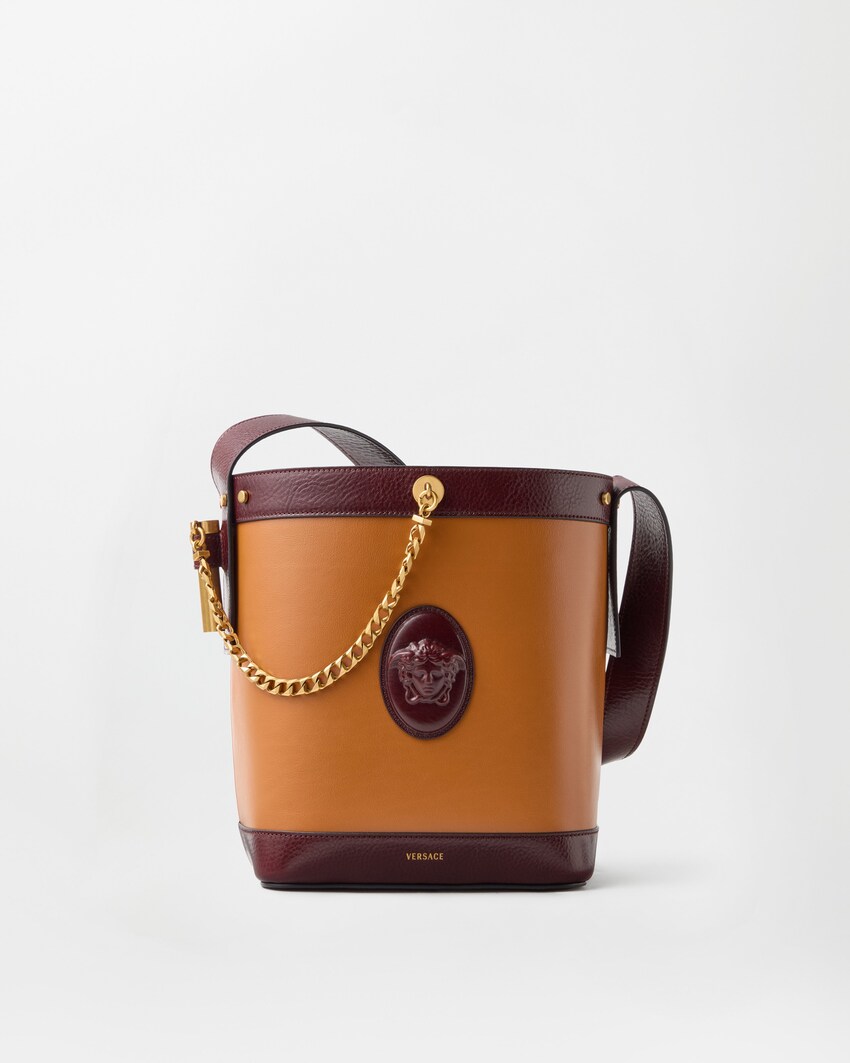
The Medusa head sits flat against the clasp of a La Medusa bag in smooth calfskin, gold-tone, not screaming but present
The Medusa head sits flat against the clasp of a La Medusa bag in smooth calfskin, gold-tone, not screaming but present. You notice it second. First, you notice the structure—angular, compact, a silhouette that holds its line whether you're carrying two things or seven. This is the entry point most buyers find now, not the silk shirt their mother warned them about in 1995.
Versace operates at a frequency most houses avoid. The prints are unambiguous. The hardware doesn't apologise. The tailoring assumes you have somewhere to be seen. For decades, this made the house a destination for people who wanted to be looked at. Now, as the brand recalibrates under Donatella's continued direction and Dua Lipa's occasional campaign presence, the question isn't whether Versace is loud—it's whether you know which pieces speak at the volume you need.
What the house was built on
Gianni Versace opened on Via della Spiga in 1978 with a clarity most founders don't manage. He wanted classicism made carnal—Greek keys and Baroque flourishes pulled through Milanese cut and a colour palette that favoured fuchsia, cobalt, gold. The clothes weren't subtle, but the construction was serious. He trained under his mother, a dressmaker in Reggio Calabria, before moving north. By the mid-eighties, the house had a vocabulary: Medusa as logo, safety pins as evening fastenings, prints that referenced Warhol and then became their own reference point.
The 1994 spring collection gave us the dress held together with gold safety pins, worn by Elizabeth Hurley to a film premiere. It became the house's most reproduced image, which tells you something about how Versace photographs versus how it sells. Gianni was murdered in 1997. Donatella, his younger sister, took over creative direction. She'd been working alongside him for years, but the transition was abrupt and public. The house wobbled, steadied, then spent the next two decades working out what Versace could mean without Gianni.
The answer, as it turned out, was Donatella's own hand—sharper tailoring, a harder glamour, and an understanding that the house's identity was never going to rest in quiet luxury. In 2018, Michael Kors Holdings (now Capri Holdings) acquired Versace for $2.12 billion. The structure changed. The aesthetic didn't.
What you're actually buying into now
Versace today operates on two registers, and knowing which one you're shopping matters. There's the mainline—the runway pieces, the Virtus and La Medusa bags, the Barocco-print silk, the Greca-embellished knits. Then there's Versace Jeans Couture, the diffusion line that carries the logo at a lower price point and tends toward denim, jersey, and more overt branding. The mainline assumes you know the references. Jeans Couture assumes you want the name.
If you're starting with accessories, the La Medusa bag is the most considered entry. It launched in 2020, sized between a small top-handle and a structured shoulder bag, available in smooth or quilted calf. Retail starts around $2,250. The Medusa hardware is integrated into the clasp rather than appliquéd across the front, which makes it wearable in contexts where the Virtus—Versace's more ornate top-handle, heavy on the Medusa and Greca detailing—would register as costume. The Virtus runs closer to $2,800 and up, depending on size and finish.
Shoes follow a similar logic. The Medusa Aevitas platform pumps, with their chunky sculpted heel and central Medusa emblem, became a signature under Donatella's recent collections. They're architectural, they photograph well, and they're not for standing in at a vernissage for three hours. Retail sits around $1,350. The Greca-sole sneakers, introduced as part of the house's push into streetwear adjacency, offer the logo at a lower threshold—around $750—and actually function as daily shoes.
Ready-to-wear is where the house's two instincts—tailoring and spectacle—either converge or split depending on the season. A Versace blazer, cut sharp through the shoulder with a nipped waist, will run you $2,500 to $3,500. The fit is precise, the buttons are Medusa-stamped, and the garment works in a way that a baroque-print silk shirt worn to a client meeting probably doesn't. That shirt exists, and it retails around $1,200, and it requires a specific confidence and a setting that won't read it as irony.
The Barocco print—gold scrollwork on black or white silk—remains the house's most recognisable textile signature. It appears on everything from pyjama shirts to evening gowns. Buying into it means accepting that you'll be visibly wearing Versace, not a piece that happens to be by Versace. There's no ambiguity in a Barocco-print blouse. It's not a wardrobe anchor; it's a statement that needs the rest of the outfit to fall back.
How the house fits into the current landscape
Versace doesn't chase quiet. While Loro Piana and The Row built entire business models on the absence of logos, Versace doubled down on the Medusa, the Greca, the prints that don't apologise for being recognisable from across a room. This positions the house oddly in 2025. It's neither in the quiet-luxury conversation nor in the full maximalist swing of early-2000s revival that younger brands are mining. It exists in its own register—Milanese, declarative, and unapologetic about the fact that some people want to be seen.
The brand's collaborations and campaigns lean into this. Dua Lipa as a brand ambassador makes sense; she wears the archive pieces without irony and the new collections without looking costumed. The FW23 and SS24 runways leaned harder into tailoring—structured coats, high-waisted trousers, blazers with exaggerated shoulders—than the house has in years. It's a recalibration, not a reinvention. Versace isn't trying to be Phoebe Philo. It's trying to be the sharpest, most unapologetic version of itself.
This doesn't mean the house is impervious to market pressures. Capri Holdings has faced uneven earnings, and Versace's revenue growth has been slower than Kering or LVMH's star performers. The brand refreshed its store concept, opened new flagships, and leaned into leather goods as a margin driver. The bags are doing the work that runway spectacle used to do—they're the repeatable purchase, the entry point that doesn't require you to build an entire outfit around a single piece.
Where to start, and what to skip
If you're buying your first Versace piece, start with something structured. The La Medusa bag, a tailored blazer, the Greca-sole sneakers if you want the logo without the evening-wear connotation. These pieces function inside a wardrobe that isn't entirely Versace. They hold their shape, their value is in the construction as much as the name, and they don't require you to commit to the full baroque vocabulary.
Skip the logo T-shirts unless you're very sure. A cotton jersey tee with an oversized Medusa or Greca print retails around $450 to $650, and it reads as diffusion-line even when it's mainline. The value isn't there. If you want Versace at that price point, a silk scarf in Barocco print—around $400—gives you the house's signature without looking like you're wearing a billboard.
The evening pieces—the chainmail dresses, the safety-pin gowns, the full Barocco-print silk separates—are not starter items. They're destination purchases. You buy them when you know exactly where you're wearing them and you've already established that Versace is part of your rotation. They don't integrate; they dominate.
Sample sales, when they surface, are worth attending if you're in Milan or occasionally New York. Versace's sale stock tends toward the previous season's more declarative pieces—the ones that didn't move at full retail because they required too much commitment. You'll find printed silk at 60% off, evening bags marked down to $800, shoes in less-common colourways. You won't find the black La Medusa bag or the core tailoring. Those move at full price.
What you're actually paying for
Versace's leather goods are produced primarily in Italy, with some manufacturing in Romania for lower-tier lines. The mainline bags are Italian-made, full-grain calf or lambskin, with hardware that's heavier and more detailed than most houses at this price point. The stitching is clean, the structure holds, and the bags age visibly—the leather softens, the corners show wear, the gold-tone hardware dulls slightly. This isn't a flaw. It's evidence of materials that respond to use rather than resisting it.
The ready-to-wear tailoring is where the house's Calabrian roots still show. The shoulder line, the waist suppression, the way a Versace blazer assumes a specific posture—it's not the same as a Loro Piana jacket that drapes soft, or a Saint Laurent piece that cuts sharp and narrow. Versace tailoring is structured, it's unapologetic, and it makes you look like you're about to walk into a room and take it over. Whether that's useful depends entirely on the room.
The silk, when it's good, is very good—printed in-house or with Italian mills that have worked with the maison since the eighties. The hand is soft but not slippery, the print registration is precise, and the weight is substantial enough that a Barocco-print shirt doesn't cling or wrinkle into illegibility after an hour. When it's not good—diffusion-line pieces, some of the Jeans Couture offerings—the silk feels thinner, the print less saturated, and the garment reads as a step removed from what you thought you were buying.
A friend in the buying office at Rinascente once said that Versace is the house people buy when they've decided they're done apologising. She didn't mean it as praise or criticism, just as fact. The clothes don't blend. The bags don't whisper. The house built its reputation on being seen, and fifty years later, that's still what it offers. You walk in knowing that. You walk out carrying it, or you don't.