The pleat on the spring trouser is sharper than it needs to be
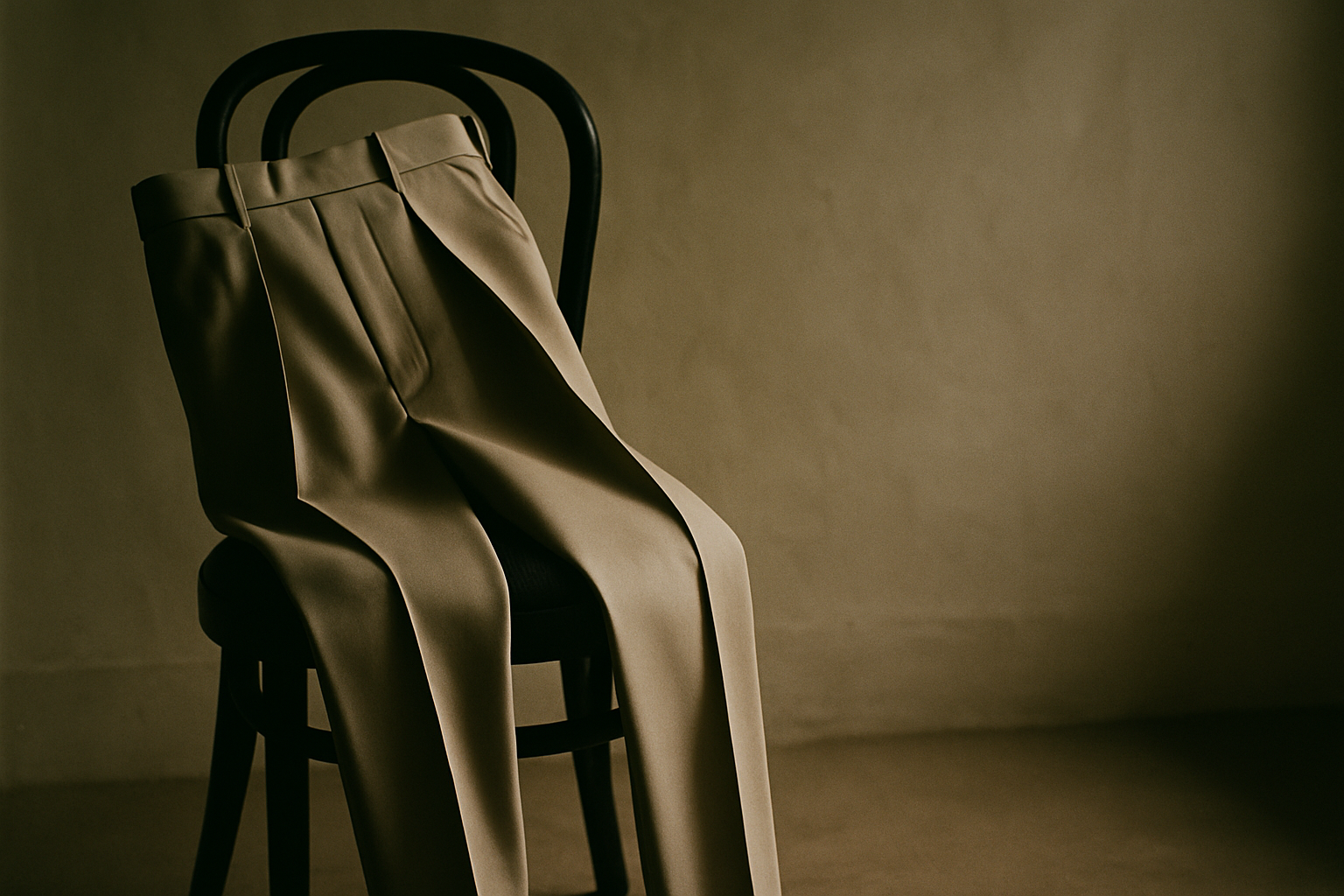
The pleat on the spring trouser is sharper than it needs to be. It runs from hip to hem without a single buckle or gathered drawstring to soften the line — a choice that feels almost perverse given how much of the rest of the collection leans into drape. But that's the tension Acne Studios has been living inside for the last three years: the house that made its name on a studied carelessness now cuts with the kind of precision that reads, in certain lights, like an apology.
Walk into the Dover Street Market corner in London or the Acne Studios flagship on rue Saint-Honoré and you'll find the same tableau. Tailoring stacked next to distressed denim. A pink bomber with contrast topstitching beside a grey wool coat so plain it could pass for Jil Sander if you squinted. The edit feels less like curation and more like hedging — an attempt to hold two audiences at once without committing fully to either.
The Early Acne, Before It Was a House
Acne Studios began in 1996 as a creative collective. Four people in Stockholm, one of whom was Jonny Johansson, who would eventually become the sole creative director. The name stood for Ambition to Create Novel Expressions, which tells you everything about the late-nineties optimism that birthed it. The first product was a pair of raw denim jeans with red stitching, given away to friends and art-world adjacents. The jeans worked because they were specific without being precious — a clean five-pocket silhouette that didn't apologise for its Scandinavian restraint but didn't intellectualise it either.
By the mid-2000s, Acne had moved into ready-to-wear, and Johansson's hand became legible. The clothes were often unfinished-looking: hems left raw, seams exposed, proportions slightly off in a way that felt more like a shrug than a mistake. There was a softness to the colour palette — powdery blues, washed-out pinks, that particular shade of grey that only works in natural light. It was fashion for people who wanted to look like they didn't think too hard about fashion, which is of course the hardest look to pull off.
The house found its audience among a specific tier of creative professional: the gallerist, the architect, the strategist who worked in tech but read Apartamento. Acne became shorthand for a kind of moneyed nonchalance, the uniform of people who could afford to look like they'd just thrown something on. By 2010, the brand had opened stores in Paris, London, New York. The expansion was steady, never frantic. Johansson stayed on as creative director. The vision held.
The Inflection Point
In 2019, Acne Studios opened a flagship in Seoul. The store was designed by the British architect Sophie Hicks — concrete, steel, an industrial coldness that felt both on-brand and slightly out of step with where the market was moving. That same year, the brand posted revenues of approximately €200 million, a figure that looked healthy until you compared it to the houses Acne was increasingly being shelved beside. Bottega Veneta, under Daniel Lee, was in the middle of a supernova. The Row had become the reference point for quiet luxury. Even Lemaire, operating at a smaller scale, had a clearer point of view.
Acne's problem wasn't that it had lost its identity. The problem was that the identity it had built — studied imperfection, Scandinavian cool, accessible intellectualism — had been absorbed into the wider market. By 2020, half the contemporary floor at Ssense looked like a softer, cheaper version of what Acne had been doing for fifteen years. The house needed to move, but in which direction?
Johansson's response, across the collections that followed, has been to tighten the silhouette and broaden the reference pool. The spring 2023 show included tailored blazers with exaggerated shoulders, straight-leg trousers with front pleats, and a series of leather jackets cut close enough to read as almost austere. The palette stayed muted — sand, slate, that same powdery blue — but the construction was sharper. Less about drape, more about structure. It felt like an attempt to claim some of the territory The Row had staked out, but without fully committing to the minimalism that makes The Row legible.
The reaction from the industry was polite. The clothes sold, but not at the velocity the brand needed to justify its retail footprint. By late 2023, Acne had quietly closed several stores, including the Cheongdam-dong flagship in Seoul that had opened just four years earlier. The brand's parent company, Investor AB, declined to break out Acne's financials in its annual report, which is never a good sign.
Where the House Stands Now
As of early 2025, Acne Studios occupies an uneasy middle ground. The brand still has cachet — you see the oversized scarves, the Baker jeans, the Canada narrow-frame sunglasses on the right people in the right cities. But cachet and momentum are not the same thing. The house is no longer leading; it's responding. The most recent collection, shown in Paris in February, included several pieces that felt like direct answers to what other houses had done six months prior: a slouchy trench that recalled Khaite, a ribbed knit dress that could have come from Totême, a pair of wide-leg trousers with a drawstring waist that looked like every other wide-leg trouser with a drawstring waist currently in the market.
There's a term buyers use when a brand starts to feel like it's chasing rather than setting: "reactive." It's not quite the same as derivative, which implies copying. Reactive means the house is still designing well, still producing quality, but the internal compass has started to wobble. You can see it in the way Acne's lookbooks are styled now — less like a singular vision and more like a mood board, a collection of influences that never quite cohere into a single statement.
The accessories have held up better than the ready-to-wear. The Musubi bag, introduced in 2018, remains a steady seller — its knotted silhouette distinctive enough to read at a distance but not so loud that it feels like a logo play. The small leather goods, particularly the cardholders and zip wallets, move consistently. But accessories can't carry a house on their own, especially not at Acne's price point. The brand needs the ready-to-wear to do the storytelling, and right now the story feels muddled.
Johansson is still at the helm, which counts for something. He hasn't been replaced by a celebrity hire or a consultant creative director parachuted in to "refresh the codes." The continuity is real. But continuity without evolution is just repetition, and repetition is what kills a house faster than a single bad collection ever could.
A Grey Wool Coat in February
There's a coat from the autumn 2024 collection that keeps coming back to me. It's grey wool, single-breasted, no belt, no epaulettes, no detail that would let you pick it out of a lineup. The cut is good — slightly dropped shoulder, sleeves that hit just past the wrist bone, a length that falls mid-thigh. It's the kind of coat you could wear for a decade without it looking dated, which is both its strength and its problem. It doesn't ask anything of you. It doesn't suggest a world beyond itself.
I saw it on a hanger at the Milan showroom in February, and the PR mentioned it had sold well to Asian accounts. She said it in the tone people use when they're relieved something moved but aren't entirely sure why. I tried it on. It fit the way a good coat should. I left it on the hanger. That's where Acne is now: making clothes that fit, that sell, that do what they're supposed to do, but that don't make you feel like you've just walked into a future you didn't know you wanted. The house is still standing. It just isn't building.