The quotation marks came first
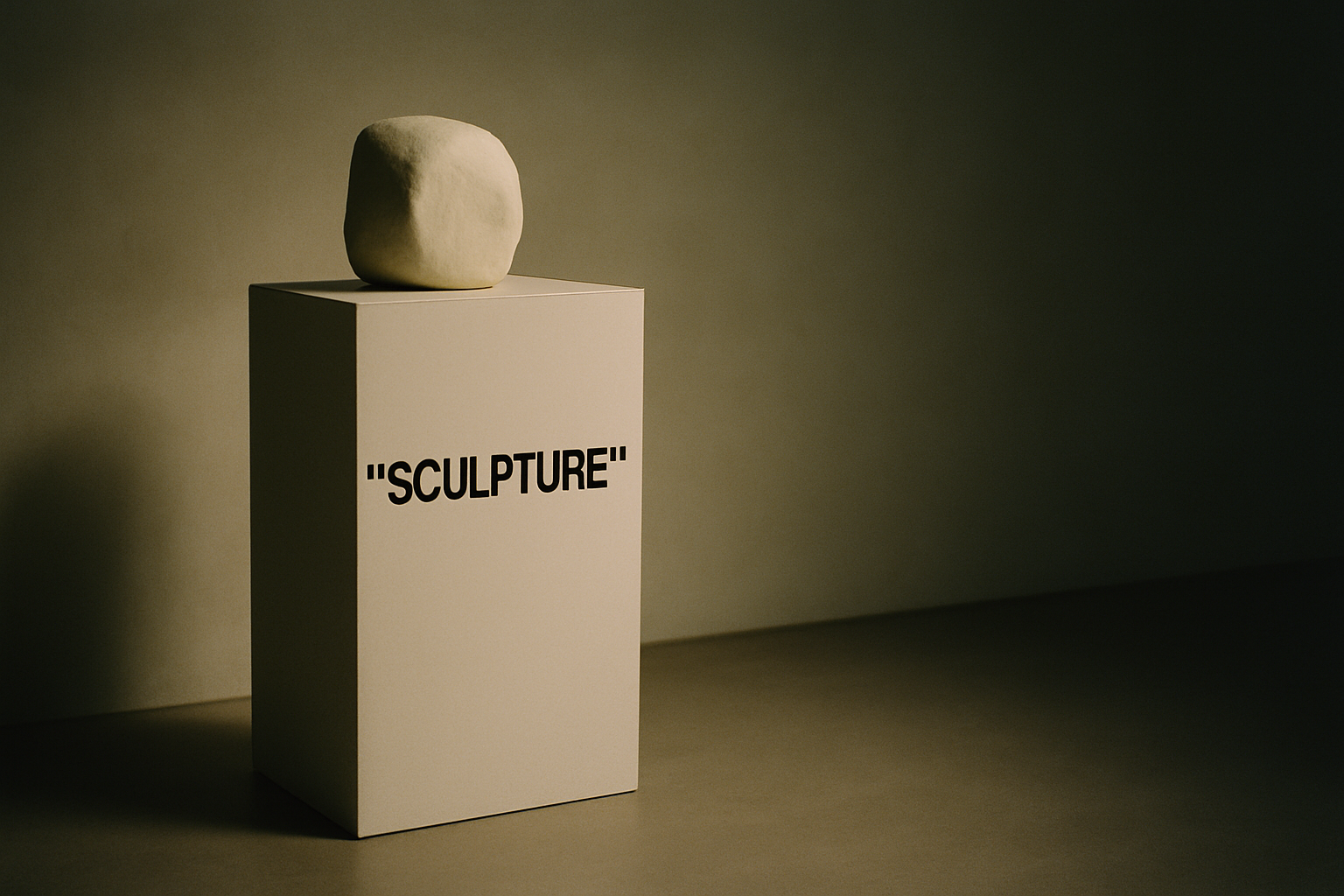
The quotation marks came first. Four of them, printed in Helvetica, bracketing the word "SCULPTURE" on the plinth of a gallery pedestal. Not irony, exactly. Not sincerity either. Somewhere in between—a gesture that acknowledged the frame while insisting the object inside still mattered. That typographic tic, lifted from graphic design and dropped onto garments, became Virgil Abloh's signature move. It also became the founding language of Off-White, a house built on the premise that fashion could operate as both product and commentary at the same time.
The founding proposition: 2013–2018
Abloh launched Off-White in Milan in 2013, two years after shuttering his first attempt at a brand. He had trained as an architect, worked as Kanye West's creative director, interned at Fendi alongside West, and absorbed the operational grammar of luxury without inheriting its reverence. Off-White arrived as a menswear line with womenswear following a season later. The name itself was deliberate—a shade between black and white, a third space where streetwear and high fashion could coexist without one collapsing into the other.
The early collections leaned heavily on industrial signifiers. Caution tape became a belt. Construction barriers turned into print motifs. Zip-ties, the kind used to secure shipping pallets, dangled from handbag handles as a kind of anti-luxury luxury trim. Abloh screen-printed instructions onto the back of denim jackets: arrows pointing to sleeves, the word "SLEEVE" in sans-serif capitals. It read as didactic, almost pedantic, except the joke was on anyone who thought fashion needed protecting from legibility.
What made it work—what separated it from mere pastiche—was the cut underneath. The tailoring was clean. The proportions were considered. A bomber might carry ten different graphic elements, but the shoulder sat where it should and the sleeve pitched forward just enough. Abloh understood that you could deconstruct a garment semiotically while keeping its construction intact. This was not deconstruction in the Margiela sense, where seams were exposed and linings became exteriors. This was deconstruction as footnote, as marginal commentary that left the body of the text untouched.
The accessories moved fastest. The Binder Clip bag, the Jitney, the Arrow tote—each one a recognisable luxury silhouette with Off-White's semiotic apparatus bolted on. Diagonal stripes, those quotation marks, the zip-tie. By 2017, the formula was legible enough that you could spot an Off-White piece from across a restaurant. That legibility was the point. Abloh was not interested in quiet luxury. He was interested in a luxury that announced its own mechanisms, that made you complicit in the performance.
In 2018, LVMH took a minority stake. The same year, Abloh was named artistic director of Louis Vuitton menswear. Off-White was no longer an insurgent project. It was infrastructure.
The Vuitton years: 2018–2021
Abloh's appointment at Vuitton did not slow Off-White. If anything, the two roles fed each other. What he could not do within the constraints of a heritage maison—push a graphic too far, lean too hard into streetwear codes—he could do at Off-White. And what he learned about atelier process, about working with petites mains and navigating the cadence of a luxury house, he brought back to his own label.
The collections during this period grew more ambitious in scope. Abloh started working with technical fabrications: ripstop nylon, Gore-Tex, bonded jersey. He introduced more tailoring, though it was tailoring that had been annotated, marked up, turned into a draft rather than a final statement. A double-breasted blazer might arrive with the pattern pieces printed on the lining, as if the garment were showing its own blueprints. A trench came with exaggerated storm flaps and extra buckles, functional details pushed past function into decoration.
The womenswear, in particular, found a clearer voice. Abloh was not a tailor in the traditional sense, but he understood how to drape jersey and how to engineer a sculptural shoulder without relying on padding. The Off-White woman of this era wore bias-cut slip dresses under oversized bombers, paired Timberlands with tailored trousers, moved between codes without stopping to explain the transitions. It was a wardrobe for someone who had absorbed the rules and no longer needed to reference them directly.
Collaborations multiplied. Nike, IKEA, Mercedes-Benz, Rimowa. Each one followed the same template: take an existing object, apply Off-White's visual language, release it in limited quantities. The collaborations were criticised as shallow, as branding exercises that prioritised logo over substance. But they also represented a kind of accessibility that traditional luxury refused. A $200 Converse Chuck Taylor with an orange tag and a zip-tie was, for many, the only way into the Off-White universe. Abloh understood that.
He also understood mortality. In 2019, he was diagnosed with cardiac angiosarcoma. He kept working. The collections continued. The collaborations did not slow. In November 2021, he died at 41.
The house after Abloh: 2021–present
Ib Kamara took over as art and image director in 2022. A stylist by training, Kamara had worked with Abloh and understood the house codes, but he was not interested in replicating them. His first collection, presented in September 2022, stripped away much of the graphic apparatus. The quotation marks receded. The zip-ties disappeared. What remained was a focus on silhouette and a willingness to let the garments speak without annotation.
The Spring 2023 collection opened with a series of tailored coats—long, lean, cut from lightweight wool in shades of sand and slate. The shoulders were soft. The lapels were narrow. There were no arrows, no industrial stripes, no text. It was, in many ways, the opposite of early Off-White. And yet it felt continuous, as if Kamara were asking what the house might sound like if it stopped shouting.
Not everyone was convinced. Sales softened. The hype cycle, which had sustained Off-White through the late 2010s, moved on to other labels. LVMH restructured the business, folding Off-White more tightly into its portfolio and investing in the atelier infrastructure. The brand was no longer a solo project. It was a house with a studio, a team, a plan.
Kamara's tenure ended in early 2024. The search for a new creative director continued through the year. In the interim, the design team produced collections that felt like a house in conversation with itself—some pieces reached back toward Abloh's graphic language, others pushed toward the quieter, more tailored direction Kamara had opened. It was not confusion, exactly. It was recalibration.
What remains
There is a photograph from 2019, taken backstage at an Off-White show. Abloh is adjusting the hem of a dress on a model, his hands working the fabric the way a draper would, checking the fall and the weight. Behind him, a rail of finished garments: bombers with text, dresses with straps, trousers with exaggerated cargo pockets. The image captures the tension that always animated the house—between the intellectual framework and the physical garment, between the concept and the thing you actually wear.
Off-White succeeded because it refused to resolve that tension. It insisted you could have both: the critique and the commodity, the footnote and the text. Whether the house can sustain that proposition without Abloh is still an open question. But the quotation marks are still there, printed on plinths and stitched into seams, holding space for whatever comes next.