The saddle-stitched edge on a Celine Classic Box is still done by hand in the Montebello workshop outside Florence
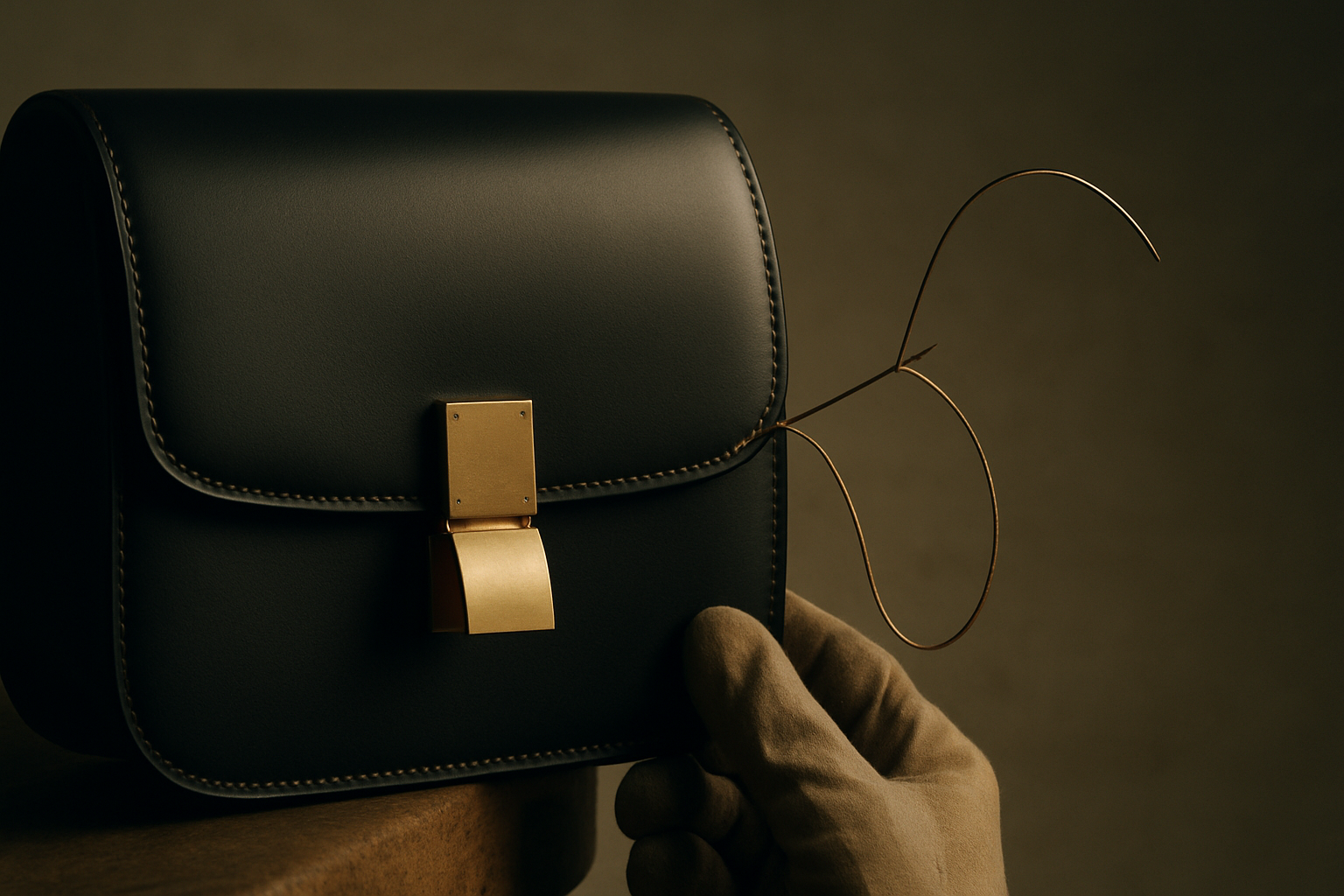
The saddle-stitched edge on a Celine Classic Box is still done by hand in the Montebello workshop outside Florence. The thread is linen, the needle curved. It takes eleven minutes per bag, longer if the calf is particularly supple and wants to give under tension. This is the kind of detail Michael Kors didn't touch when LVMH brought him in for eighteen months in the late nineties, and the kind Phoebe Philo built an entire aesthetic language around a decade later. The stitching remains. The house around it has turned over three times.
Céline Vipiana and the Bourgeois Pragmatist
Celine began in 1945 as a children's shoe atelier on rue Malte, an unremarkable stretch in the eleventh arrondissement. Céline Vipiana, the founder, had worked in leather before the war and understood how to cut a last that wouldn't blister a four-year-old's heel by the second wearing. The shoes sold. By 1959 she'd added handbags, then women's ready-to-wear by the mid-sixties. The logic was consistent: make things for women who moved through the world without fuss and expected their accessories to do the same.
The house aesthetic under Vipiana was almost aggressively unshowy. Structured bags in box calf, sensible heels, tailoring cut to flatter without clinging. This was not the space-age futurism happening at Courrèges, nor the bourgeois fantasy Chanel was monetising. Celine clothes were for women who had a car, a job, possibly both, and no interest in performing either. The logo—originally designed in 1967 by Pierre Dinand—was a restrained arc of serif capitals, often embossed rather than printed. Legibility, not declaration.
Vipiana retired in 1997. LVMH had acquired the house two years earlier, and what followed was a decade of creative directors cycling through at eighteen-month intervals, each attempting to inject heat into a brand the market had begun to read as your mother's handbag house. The work was competent. None of it moved units in a way that justified the acquisition cost.
Philo's Celine and the Uniform of Refusal
Phoebe Philo arrived in 2008 with a brief to rebuild the ready-to-wear and a studio in Paris she insisted on keeping small. She had left Chloé three years earlier to raise her daughter, and the first Celine collection she showed—Spring 2010—looked like someone who had spent those years thinking hard about what women's clothes were actually for.
The silhouette was wide, not in the exaggerated way that telegraphs avant-garde, but in the way a good coat is wide. Trousers sat at the natural waist and broke cleanly over flat shoes. Knits were boxy and substantial, the kind that held their shape after you pulled them on over wet hair. Philo used fur sparingly, always as a textural element rather than status signalling, and cut it into flat collars that didn't add volume. The palette was navy, camel, grey, ivory, rust, forest. Occasionally a slash of cobalt or acid yellow, placed where it would read as punctuation rather than statement.
The bags became the accelerant. Philo reworked the Classic Box—originally a 1970s style—into something harder and more architectural, then followed with the Trapeze, the Luggage, the Trio. Each had a structure that looked simple until you tried to knock it off, at which point you discovered the geometry was more complex than it appeared. The Luggage, with its winged sides and front gusset, required a construction sequence most factories couldn't execute at scale. It sold anyway. It sold because of that.
What Philo understood, and what the market hadn't quite processed yet, was that a significant segment of women with disposable income were tired of performing taste. The logomania of the early 2000s had curdled into self-parody, and the boho-luxe thing that followed felt like a costume. Celine under Philo offered a third option: clothes and accessories that signalled you had the resources to buy well-made things and the confidence not to announce it. The logo, when it appeared, was debossed into leather or printed small on a canvas lining. You knew, the person next to you on the plane knew, and that was sufficient.
The house became a uniform for a specific type of woman—art directors, gallerists, architects, senior editors—who needed to move between client meetings and site visits without changing. Philo's Celine worked in a studio, on a plane, at a dinner where you might be seated next to someone whose opinion mattered. It didn't work at a wedding, which was the point.
She left in December 2017. LVMH announced Hedi Slimane as her replacement two months later.
Slimane's Celine and the Bourgeois Return
Slimane dropped the accent from the logo before he showed his first collection. The move was described as a return to Céline Vipiana's original branding, which was technically accurate and also an efficient way to visually sever the house from the Philo era. He then proceeded to do what he'd done at Dior Homme and Saint Laurent: build a wardrobe for thin young women in skinny jeans and leather jackets, score it to a playlist that leaned French new wave and Laurel Canyon, and shoot it in black and white.
The first collection, shown in September 2018, included prairie dresses, pussy-bow blouses, high-waisted jeans, and a lot of silk scarves tied at the neck. The bags were smaller, more decorative, often finished with chain straps and logo hardware. The prices held steady. The silhouette was not what the woman who'd been buying Philo's Celine for the past decade was looking for, and Slimane didn't seem particularly interested in her.
What he was interested in was volume. Slimane's Celine opened more stores, expanded into menswear, added a beauty line, pushed deeper into Asia-Pacific markets. The clothes were easier to produce at scale than Philo's structured tailoring, and the aesthetic—polished French bourgeois with a rock-and-roll edge—had a broader demographic appeal. It also had precedent: this was the territory Saint Laurent had occupied in the seventies, and Slimane had already demonstrated at his previous house that the market would buy it again if you styled it correctly.
The Philo devotees largely left. Some moved to The Row, others to Loewe, a few to Khaite. The business grew anyway. By 2022, Celine's revenue had reportedly doubled since Slimane's arrival, driven by handbag sales and a younger customer base willing to pay €2,400 for a logo-stamped Triomphe bag in box calf.
What Holds
Walk into the Montebello atelier now and the saddle-stitching station is still there, still eleven minutes per bag, still linen thread. The Classic Box is in the current collection, reissued with a chain strap and more visible hardware, but the construction sequence hasn't changed. Slimane's Celine and Philo's Celine and Vipiana's Celine are different houses in nearly every way that matters to a customer, but the through-line is leather goods made with a level of finish that justifies the price.
The question the house keeps answering differently is: who is this for? Vipiana said the pragmatic bourgeoisie. Philo said women who'd rather not explain themselves. Slimane says anyone who wants to look like they summer in Normandy and know the right bistro in the Marais. All three positions are commercially viable. Only one at a time gets to be called Celine.