The safety pin dress didn't need a name
The safety pin dress didn't need a name. Liz Hurley wore it to a Leicester Square premiere in 1994, and by morning every picture desk in London had filed the same image: black silk, gold hardware, four oversized pins holding the thing together at the hip. Versace had been dressing celebrities for years by then, but this was different. The garment wasn't just seen — it was seen through. The pins suggested both couture and improvisation, as if the dress might come apart at any moment. It didn't, of course. Gianni Versace knew exactly how much tension a bias-cut panel could take.
That balance — between control and the appearance of abandon — defined the house from the start.
The Founding: Opulence as Statement, 1978–1997
Gianni Versace opened his atelier in Milan in 1978, at a moment when Italian fashion was still explaining itself to Paris. The city had tailoring, it had knitwear, but it lacked a language for excess that didn't read as vulgarity. Versace supplied one. His early collections pulled from Greco-Roman motifs, Warhol's color fields, and a particular strain of Miami baroque that hadn't yet been named. The Medusa head, adopted as the house logo in 1980, wasn't subtle. It was a dare.
By the mid-eighties, Versace had built a vocabulary: body-conscious silhouettes in technical jerseys, often printed with imagery that belonged in a museum vitrine rather than on a hemline. The 1991 Vogue collection featured gowns screen-printed with Picasso and Matisse. The estate permissions alone must have taken months. But the effect was immediate — high art rendered wearable, or at least photographable, which in Versace's economy amounted to the same thing.
Gianni understood that fashion, at a certain altitude, is a form of portraiture. He dressed Elton John, Madonna, Diana. The clothes weren't neutral canvases; they were co-authors. A Versace gown didn't flatter so much as amplify. If you had presence, the house would double it. If you didn't, the dress would expose that, too.
The technique behind the spectacle was considerable. Versace's atelier developed a method for bonding metal mesh directly onto silk chiffon, creating a fabric that moved like liquid but photographed like armor. The chainmail dresses from the early nineties — often cited, rarely replicated — required a two-layer construction: an inner sheath of stretch silk to protect the skin, an outer layer of anodized aluminum links, each one hand-looped. The result weighed less than a winter coat but looked like it could stop a blade.
Gianni was murdered in Miami in July 1997. The house he left behind had annual revenues approaching $1 billion, twenty-three boutiques, and a design language so specific that a Versace print could be identified from across a room. What it didn't have was a plan for succession.
The Sister Years: Donatella and the Refinement of Excess, 1997–2016
Donatella Versace had been her brother's closest collaborator for two decades, but she'd never led a collection alone. Her first show, for Spring 1998, arrived six months after Gianni's death. The reviews were kind in the way reviews are kind when the circumstances preclude honest criticism. But Donatella wasn't interested in kindness. Over the next five years, she stripped the house vocabulary down to its most legible elements — Medusa, Greek key, baroque print, chainmail, safety pin — and rebuilt from there.
The early Donatella era is often misread as a holding pattern. In fact, it was a deliberate narrowing. She understood that Versace's strength wasn't range; it was recognition. A customer should be able to spot a Versace from the back of a ballroom. So the prints got bolder, the cuts more architectural, the gold hardware more insistent. The Spring 2000 collection, shown in Milan that September, featured Jennifer Lopez in a green silk-chiffon gown with a neckline that plunged to the navel. The dress broke Google Image Search — literally, the search query volume that week exceeded the engine's capacity — and became the reason Google Images exists as a standalone product. One could argue that a single Versace gown reshaped how the internet handles visual information. Whether that's a triumph or a cautionary tale depends on where one stands.
Donatella's Versace was louder than Gianni's, but it was also more focused. She leaned into celebrity in a way her brother had only begun to explore. The front row became part of the collection. The house sponsored tours, fragrance launches, red carpets. By the mid-2000s, Versace wasn't just dressing stars — it was producing them. The brand's diffusion line, Versus, launched collaborations with musicians and athletes, turning runway codes into streetwear before that term had fully calcified.
But the financial architecture was fragile. The 2008 crisis hit luxury hard, and Versace, still family-owned, had limited access to the capital required for global expansion. The house sold a 20 percent stake to Blackstone in 2014, then bought it back two years later. By 2016, Donatella had been creative director for nearly twenty years, and the house codes — once radical — had become expected. Versace needed either a reinvention or a buyer. It got both.
The Kering Bid and the Capri Interlude: 2018–Present
Michael Kors Holdings, later rebranded as Capri Holdings, acquired Versace for $2.12 billion in September 2018. The deal surprised no one and disappointed many. Kors had purchased Jimmy Choo the year prior and was assembling a portfolio of accessible-luxury brands aimed at the global middle market. Versace, with its $3,000 gowns and its Medusa-head belt buckles, didn't quite fit. But Capri wasn't buying the atelier. It was buying the logo.
Donatella stayed on as creative director, and to her credit, the collections haven't softened. If anything, they've leaned harder into maximalism as a counterpoint to the minimalist turn elsewhere in Milan. The Fall 2023 show featured micro-mini skirts in leather patchwork, tailored blazers with exaggerated shoulders, and a closing look — a floor-length gown in gold lamé, slit to the hip — that could have walked out of a 1992 runway without revision. The house knows what it is.
The question isn't whether Versace can still produce a compelling collection. It can. The question is whether the broader luxury market has room for a house whose entire premise is more. Kering passed on Versace in 2018, reportedly because the brand's positioning — too loud for quiet luxury, too expensive for fast fashion — left it without a clear lane. Capri made the opposite bet: that Versace's recognizability, its sheer visual volume, would translate to handbag sales and fragrance licensing in markets where subtlety doesn't scan.
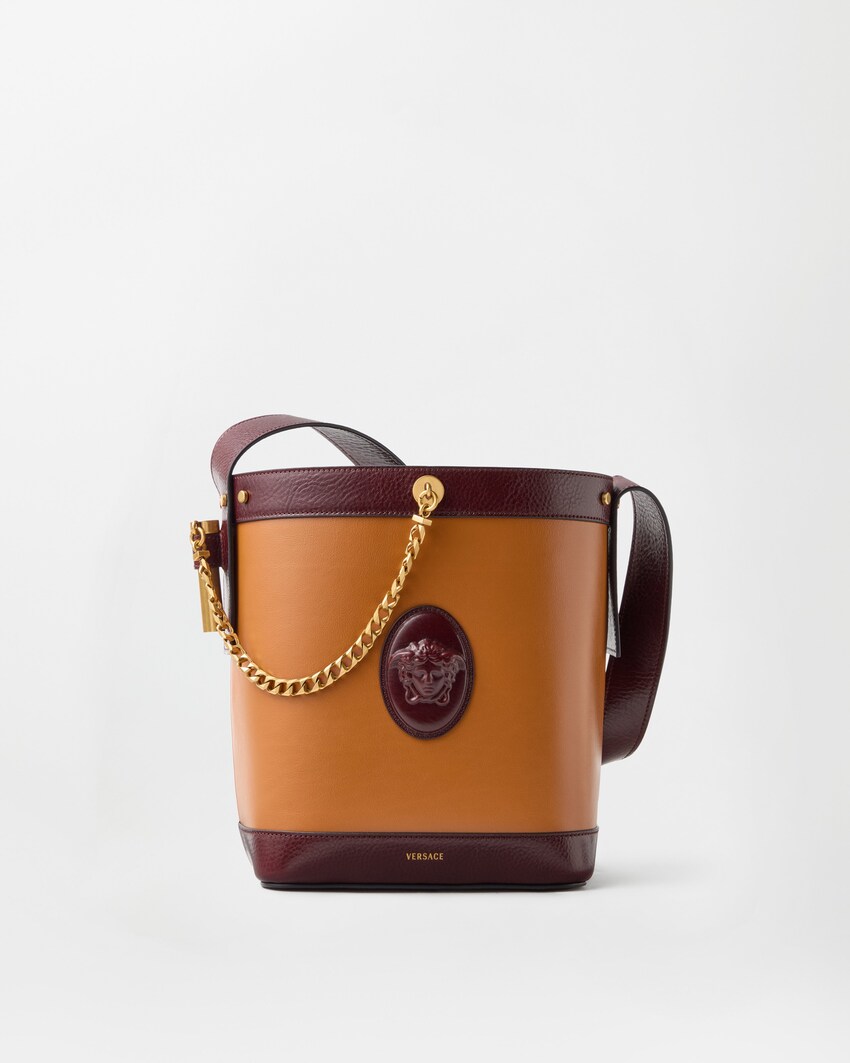
So far, the numbers suggest they were half right. Versace's revenues have grown, but not at the pace Capri projected. The brand's challenge isn't creative — Donatella remains one of the few designers who can close a show and generate headlines the same night. The challenge is structural. Luxury, as it's currently defined, rewards discretion. A Bottega bag signals wealth through the absence of logos. A Versace bag signals wealth by putting the Medusa on the clasp, the lining, and the dust bag. Both are strategies. Only one is ascendant.
What Remains
There's a photograph from Gianni's final collection, Spring 1998, shown posthumously that October. Donatella is backstage, adjusting the strap on a model's gown. The dress is coral silk, printed with a trompe-l'oeil colonnaded courtyard, as if the wearer were walking through Pompeii. The model is looking straight ahead. Donatella is looking down, at the place where the fabric meets the skin, making sure the line is right. The collection went on without him, and the house went on after that, and the clothes kept coming. Not quieter. Not simpler. Just forward, in the only direction Versace knows.