The safety pin dress gets the headlines
The safety pin dress gets the headlines. The Medusa gets the merchandising. But walk through a Versace archive sale — the kind held twice a year in a windowless room off Via Gesù — and what you notice isn't the iconography. It's the weight of the silk. Specifically, the printed silk twill used for shirts in the mid-nineties, a fabric so dense it doesn't wrinkle in your hand. You can feel the excess before you see it.
Versace has spent thirty years as its own caricature, and the house has leaned into that with a kind of defiant self-awareness. Donatella knows what people expect. But underneath the baroque prints and the gold hardware, there's a set of techniques the brand doesn't talk about much — not because they're secret, but because they don't photograph as well as a logo belt.
The Gianni era wasn't subtle, but it was specific
Gianni Versace opened his atelier in 1978 with a line that already understood one thing: fabric dictates silhouette more than cut ever will. He worked with mills in Como that could print onto weights most designers reserved for coats. A Versace blouse from 1982 often used the same twill as a men's spring jacket, which meant it held structure without darts. The sleeves stood slightly away from the body. The collar didn't collapse by evening.
This wasn't about drape. It was about armour.
The metal mesh pieces — the ones that show up in retrospectives as proof of Gianni's innovation — were actually produced by a Milanese company called Albini Metals, which usually made industrial chainmail. Versace bought their entire 1982 output and had it hand-linked into halter tops. The process took four hours per piece. The fabric moved like liquid but weighed close to a kilo. You couldn't wear it casually. That was the point.
By the early nineties, Versace had developed a house vocabulary that didn't rely on the Medusa or the Greek key. There was the asymmetric neckline, almost always cut higher on the left side. There was the use of contrast piping — not as trim, but as a structural line that separated panels. And there was the atelier's approach to lining, which involved using a heavier silk than the shell fabric. Most houses do the opposite. Versace's logic was that the lining should control the garment, not follow it.
The safety pin dress from 1994 worked because of the lining. Without it, the pins would have gaped. The technical achievement wasn't the pins — it was engineering a silk crepe heavy enough to stay taut under tension.
What Donatella kept, what she didn't
Donatella took over in 1997 under conditions no designer should have to navigate. The first collections were understandably close to Gianni's templates. But by 2001, she'd begun stripping back some of the house codes in ways that only became obvious years later.
She kept the print-on-weight approach. A Versace printed dress from 2005 still used a heavier silk than comparable pieces from Cavalli or Pucci. But she shifted the colour palette slightly cooler. Gianni's prints leaned into saturated primaries and golds. Donatella introduced more black, more silver, more acid green. The prints became sharper, less painterly.
She also quietly retired the contrast piping. It had been a Gianni signature, but it read as fussy in the early 2000s, when minimalism was creeping back through the Milan schedule. The asymmetric neckline stayed, but it became less pronounced — a two-centimetre difference instead of five.
The biggest shift was in tailoring. Gianni's suiting was structured to the point of rigidity, with shoulder pads that extended past the natural line and lapels that sat away from the chest. Donatella softened the shoulder but kept the extended lapel, which created a silhouette that looked unfinished if you didn't know what you were looking at. It was tailoring that required a certain posture. Slump in a Versace blazer from 2003 and the whole thing collapses.
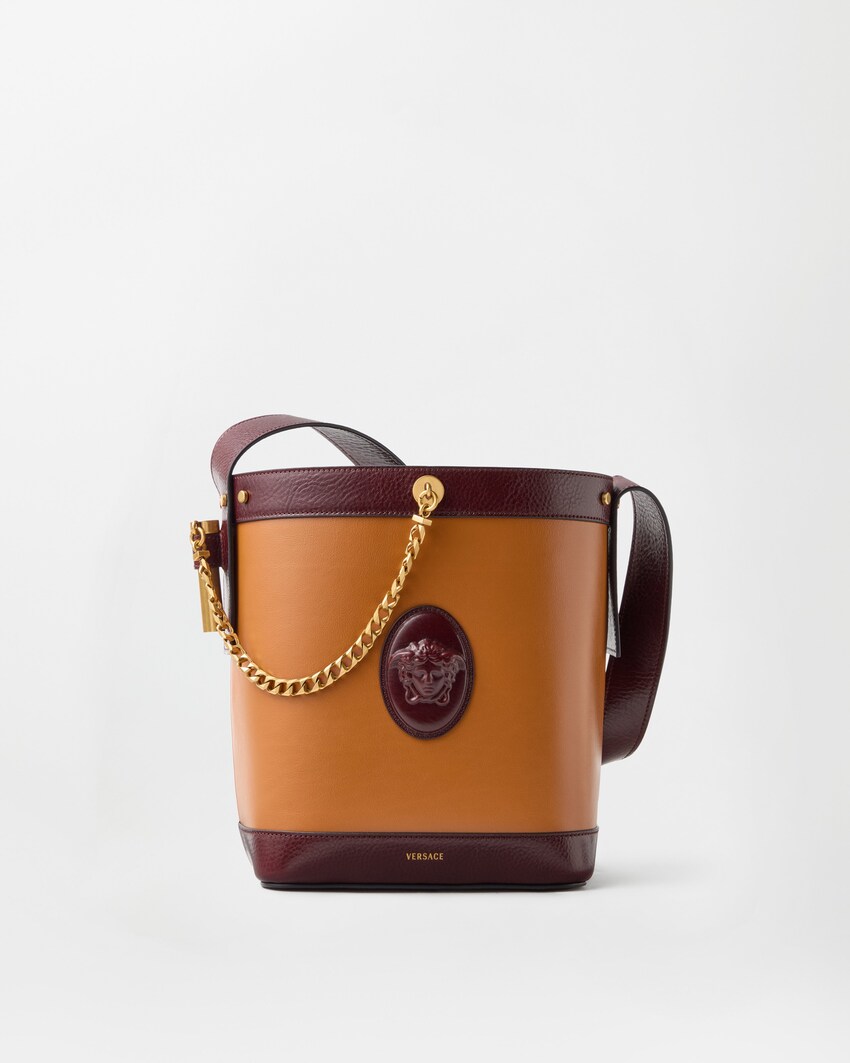
She also expanded the atelier's leather program, which had been a secondary category under Gianni. The Palazzo bag, introduced in 2017, used a vacuum-moulded calf that held its shape without internal structure. The technique came from automotive upholstery. It's the kind of detail that doesn't make it into press releases but explains why a Versace bag from that era feels different in the hand than a Valentino or a Fendi from the same season.
The Capri thing
No one outside Italy seems to know that Versace's relationship with Capri isn't just about the summer advertising. Gianni bought Villa Fontanelle on Lake Como in 1980, but he spent more time at Casa Casuarina in Miami. Donatella, though, kept a house on Capri from 1995 until 2008, and the island's specific light — that flat, white Mediterranean glare — shows up in her colour choices in ways that aren't immediately obvious.
Look at a Versace campaign shot on Capri versus one shot in Milan. The Capri images always have cooler shadows, which means the clothes are cut to work in harder light. The prints read differently. A baroque scroll that looks dense in a showroom becomes legible outdoors. Donatella has said in interviews that she prefers to fit clothes in natural light, which is unusual for a designer working at her scale. Most fittings happen under controlled studio lighting.
This also explains why Versace's resort collections often feel more resolved than the mainline. They're designed for the context Donatella actually lives in for part of the year. A silk shirt from the 2015 resort collection had a longer back hem and a higher armscye than the equivalent piece from the fall runway. Those aren't arbitrary adjustments. They're responses to sitting in a boat versus sitting in a car.
The Kering question and what it didn't change
When Michael Kors Holdings (later Capri Holdings) bought Versace in 2018 for over two billion dollars, the assumption was that the house would be streamlined into something more accessible. And yes, the pricing architecture shifted — more entry-level bags, more logo-driven small leather goods. But the atelier's internal standards didn't move much.
A Versace jacket still takes longer to make than comparable pieces from other houses under the same corporate umbrella. The sample room in Milan still uses the same patternmaking software Gianni installed in 1991, because no one wants to retrain the cutters. The house employs four full-time print technicians whose only job is colour-matching across fabric weights, which is the kind of overhead that makes CFOs nervous but keeps the product consistent.
Donatella's position as creative director has been secure enough that she hasn't had to justify those costs the way other designers might. The trade-off is that Versace doesn't do the kind of viral product drops that other legacy houses use to goose quarterly numbers. There's no Versace equivalent to the Prada nylon bag reissue or the Fendi baguette comeback. The house moves slower.
What did change post-acquisition was retail. Versace opened more directly operated stores and closed some of the older franchise locations that had been operating since the nineties. If you bought Versace in Dubai or Tokyo in 2005, you were often buying through a licensee with inconsistent quality control. Now the distribution is tighter, which means the product you see in a Milan flagship is the same as what's in the New York store. That sounds basic, but it wasn't true for most of Versace's history.
What you don't see on the runway
The house still produces a small capsule of archive reissues every season, sold only in the Milan flagship and the London store. These aren't advertised. They're pieces from the nineties and early 2000s that the atelier remakes using original fabric stock when it's available, or commissioning new runs from the same Como mills when it's not.
A friend who works in the Via Montenapoleone store says they sell out in a week, mostly to clients who've been buying Versace since before the acquisition. The prices are higher than mainline because the production runs are smaller. A printed silk shirt from this program costs about €1,800, versus €900 for a comparable current-season piece. The difference is the fabric weight and the fact that the collar is still fused by hand.
This is the Versace that doesn't make it into the brand's Instagram feed. It's not the one celebrities wear to the Met Gala. But it's the part of the house that explains why the name still means something beyond the logo. The safety pin dress is in a museum. The twill is still in the warehouse.