The safety pin dress is back in production
The safety pin dress is back in production. Not a reissue, not an homage — the actual thing, commissioned again by special request, stitched to the same grid of gold hardware that held black silk to Elizabeth Hurley's body in 1994. One supposes this tells you something about where Versace stands: mining its own archive with the fervour of a prospector who knows the seam still runs deep.
The house turns forty-eight this year. Not old, not young. An age at which most luxury brands either calcify into museum pieces or thrash toward relevance with collaborations that read like ransom notes. Versace does both, often in the same season, and somehow the contradiction holds.
The Founding Logic
Gianni Versace opened his atelier in Milan in 1978 with a conviction that haute couture and ready-to-wear need not occupy separate moral universes. He built bias-cut gowns using techniques borrowed from Vionnet, then printed them with Warhol silkscreens and metal mesh. The work was operatic, unsubtle, and technically accomplished in ways the press did not always acknowledge. A Versace dress from 1982 might involve twelve pattern pieces, each one engineered to move independently across the body — but what people remembered was the gold, the Medusa, the models who looked like they'd just stepped off a yacht.
Gianni understood that fashion is a medium of immediate impact, not delayed gratification. He made clothes for women who entered rooms with intent. By the early nineties, the house had established a visual language so specific that a single motif — the Greek key, the baroque print, the Medusa head — could stand in for the whole. That kind of iconographic density is rare. You see it in Chanel's quilting, in Hermès' saddle stitch, in very little else.
His death in 1997 cleaved the house in two: before and after. Donatella, his younger sister, took the creative helm. She had been his muse, his confidante, his sounding board; now she was the sole author. The early collections under her direction were uneven, sometimes painfully so, but they held the line. She did not attempt to soften the house's language or apologise for its volume. If anything, she turned it up.
The Kering Years, and What Came After
In 2000, the Versace family sold a stake to an investment group. In 2014, Blackstone acquired a share. In 2018, Michael Kors — rebranded as Capri Holdings — bought the house outright for $2.1 billion. That figure, at the time, felt both extravagant and insufficient. Versace had revenue of around $800 million annually, profitable but not wildly so. What Capri wanted, one suspects, was the name itself: a brand with global recognition, a back catalogue of imagery that still moved product, and a creative director who had survived two decades of industry consolidation.
Donatella stayed on. The terms were not disclosed, but she retained her title and, crucially, her authority. What changed was the infrastructure: supply chain, retail footprint, licensing agreements. Capri poured capital into boutiques and e-commerce. They streamlined the accessories line, which had grown bloated with sub-brands and diffusion labels. They raised prices.
The results were mixed. Revenue climbed to $1 billion by 2019, then stalled. The pandemic hit. Stores closed. By 2023, Versace's sales had contracted to roughly $900 million, and Capri's stock was trading at half its 2018 peak. Earlier this year, the conglomerate announced it would sell Versace to Tapestry — parent of Coach and Kate Spade — for an undisclosed sum, pending regulatory approval. The deal has not yet closed. As of this writing, Versace exists in a state of corporate suspension, neither fully independent nor fully absorbed.
The Collections Now
Donatella's recent work oscillates between retrospection and a kind of hyper-contemporary polish that feels, at times, like it belongs to a different house entirely. The Spring 2024 collection featured tailored blazers with exaggerated shoulders, micro-mini skirts in patent leather, and a series of gowns cut so close to the body they required bespoke undergarments. The palette was black, white, and safety-pin gold. The references were explicit: Gianni's 1994 show, his 1991 bondage collection, his 1989 couture line with the Atelier Versace label that predated the official launch by three years.
But there were also moments of restraint — a word not often applied to this house. A white poplin shirt, crisp and unadorned. A black wool coat with a single seam running from shoulder to hem, no hardware in sight. These pieces did not photograph as well as the crystal-mesh bodysuits, and they did not make it into the advertising campaign, but they were there. One wonders if Donatella is testing a hypothesis: that Versace can hold both registers at once, the operatic and the austere, without collapsing into incoherence.
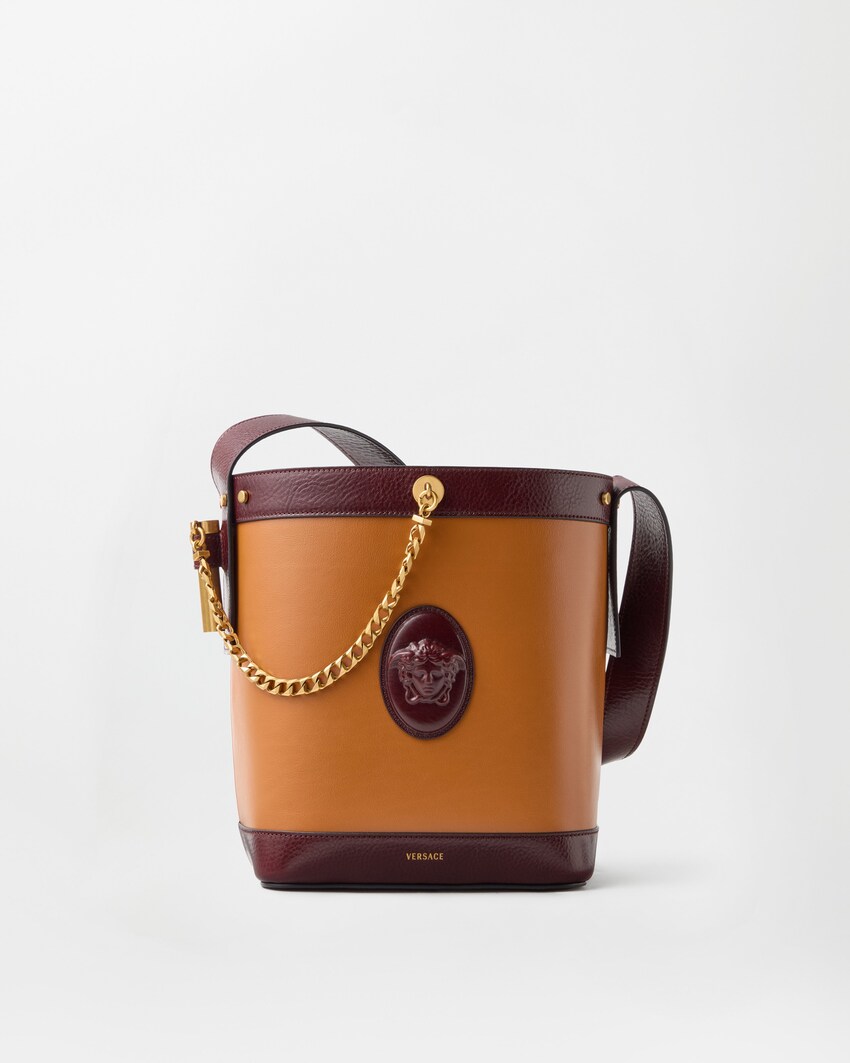
The accessories, by contrast, have leaned hard into logo play. The La Medusa handbag, introduced in 2022, features an oversized medallion that accounts for roughly a third of the bag's surface area. It is not a subtle object. It sold well in Asia, less so in Europe. The Virtus line, which uses a simpler clasp mechanism, has performed more consistently. Prices range from $1,800 for a small crossbody to $4,200 for a top-handle tote — positioning Versace squarely in the accessible-luxury bracket, below Hermès and Chanel, alongside Bottega Veneta and Loewe.
Image and Influence
Versace's cultural footprint remains outsize relative to its revenue. The house dresses musicians, athletes, actors who want to be seen. A Versace gown on a red carpet still registers as an event, not merely a styling choice. That kind of visual equity is difficult to quantify and impossible to manufacture. It is the residue of three decades of consistent, unapologetic image-making.
But there is a tension here. The house that once defined a certain kind of glamour — unearned, unapologetic, louche — now operates within a luxury market that prizes craft, heritage, and quiet sophistication. Versace has craft, certainly; the atelier work is accomplished, the draping precise. It has heritage, though much of it is bound up in a single decade and a single person. What it lacks, or what it refuses to perform, is quietness.
This may be a feature, not a flaw. In an industry increasingly homogenised by the same ateliers, the same tanneries, the same vocabulary of "timeless" and "considered," Versace's refusal to modulate its voice is almost radical. The house does not whisper. It does not suggest. It announces.
Where It Stands
On balance, Versace occupies an odd position: culturally dominant, commercially vulnerable. The brand is instantly recognisable, the imagery still potent, but the business model has not yet found stable ground under corporate ownership. Capri's stewardship did not yield the growth investors anticipated. Whether Tapestry will fare better remains to be seen.
Donatella, now sixty-eight, shows no sign of stepping back. She has outlasted most of her peers, survived the loss that might have ended a lesser house, and continued to produce work that is, at minimum, legible as Versace. Whether that work represents a creative evolution or a holding pattern is a question without a clean answer.
What is certain is this: the house still knows how to make an entrance. At the Fall 2024 show in Milan, the finale featured a black silk gown held together by thirty-seven gold safety pins, each one hand-applied by an atelier seamstress over the course of six hours. The model who wore it — name withheld at the house's request — walked the length of the runway, turned once, and exited. The pins caught the light. The crowd, as they say, went mad. Whether that constitutes fashion or theatre is, perhaps, beside the point. Versace has always understood that the two are not so easily separated.