The safety pin dress left the runway in September 1994 and entered mythology by November
The safety pin dress left the runway in September 1994 and entered mythology by November. Not because of the pins themselves — though they did hold together panels of black silk in a manner both precarious and precise — but because of what happened when someone wore it. Elizabeth Hurley stepped onto a red carpet, the world's cameras turned, and Versace understood something it had suspected all along: that a dress is only half-built in the atelier. The wearer completes it.
That principle, more than any single garment or logo, defines the house Gianni Versace founded in 1978. The work has always required a body in motion, a flash of intent. Strip that away and you're left with fabric and hardware, however expertly joined.
The Founding Proposition
Gianni Versace opened his maison in Milan at a moment when Italian fashion meant one of two things: the quiet tailoring of Armani or the cerebral constructions coming out of smaller ateliers. He proposed a third route. His clothes announced themselves. Bright silks, Greco-Roman motifs pulled from Calabrian architecture, cuts that assumed the wearer had no interest in discretion. The Medusa head, adopted as the house emblem in 1980, made the position clear. This was fashion as confrontation, as theatre, as a dare.
The technical execution, though, was never in question. Versace trained as a dressmaker in Reggio Calabria, apprenticed in his mother's atelier, and understood construction at the level of seam and dart. The chainmail dresses that appeared in the early nineties — aluminium rings linked by hand, draped to move like liquid — required both metallurgical knowledge and an almost perverse commitment to difficulty. One such piece took a single artisan roughly one hundred twenty hours to complete. The result looked effortless, which was the point.
By the early nineties, Versace had built a vocabulary: saturated colour, baroque print, body-conscious silhouette, metal mesh, safety pins used structurally rather than as repair. Naomi Campbell, Cindy Crawford, Linda Evangelista, and Christy Turlington closed his shows as a four-woman phalanx, moving in sync to George Michael. The spectacle was intentional. Versace believed in fame, in visibility, in the idea that fashion should be seen from the cheap seats.
He also believed in collaboration. The house worked with photographers who understood gloss — Richard Avedon, Irving Penn, Herb Ritts — and with musicians who shared his sense of scale. Elton John wore Versace onstage. Madonna wore it offstage. These were not endorsements. They were confirmations that the clothes worked in the context they were designed for: public life, lived at volume.
The Interregnum
Gianni Versace died in July 1997. His sister Donatella, who had been designing the Versus diffusion line and advising on the main collection, assumed creative direction. The transition was neither smooth nor quiet. Critics questioned whether the house could survive without its founder. Early reviews of Donatella's work were often unkind, focused on what had been lost rather than what remained.
What remained, as it turned out, was a certain understanding of construction and a willingness to push fabric past the point of good taste. Donatella's first solo collection, shown in February 1998, leaned into the house codes — Medusa hardware, vibrant print, the jungle-print silk that would later become a minor internet phenomenon when Jennifer Lopez wore a version to the Grammys in 2000. That dress, with its neckline plunging well past the sternum and its skirt slit to the hip, was not subtle. It was not trying to be.
The two-thousands were less kind to maximalism. As fashion moved toward minimalism and then toward a kind of studied anti-fashion, Versace's aesthetic — still loud, still committed to the idea that more is more — felt out of step. The house remained profitable, largely on the strength of its accessories and fragrance lines, but the runway work struggled to find purchase with a generation that had been taught to value restraint.
Donatella, to her credit, did not attempt to sand down the house's edges. She doubled down. The Spring 2003 collection featured chainmail in pink and turquoise. The Fall 2004 show opened with a model in a leather corset and thigh-high boots. These were not clothes for blending in. They were, in fact, quite the opposite.
The Kering Interlude and Beyond
In 2018, Versace sold to Capri Holdings — the conglomerate that also owns Michael Kors and Jimmy Choo — for just over two billion dollars. Donatella remained as creative director. The deal raised the predictable questions about creative independence and brand dilution, questions that have yet to be fully answered.
What has become clear is that Versace under Donatella in the 2020s occupies a different position than it did in the nineties. The house still produces the baroque prints, the gold hardware, the silhouettes that assume a certain comfort with attention. But it has also absorbed influences from streetwear, from social media, from a generation that treats fashion as content. The Versace Medusa Aevitas platform pumps, released in 2022, stand nearly six inches tall and come in neon colourways. They are, in a sense, the logical endpoint of the house's founding premise: footwear as declaration.
Recent collections have shown a willingness to reference the archive without simply reproducing it. The Spring 2023 runway featured reworked versions of the safety pin dress, the chainmail, the jungle print — not as direct quotations but as variations on a theme. The question, as always with heritage houses, is whether this constitutes evolution or repetition. One suspects the answer depends on who's wearing it.
Collaborations have become a house strategy. Versace has worked with Fendi on a swap collection, with Palace on a streetwear capsule, with various celebrities on limited capsules that generate significant social media engagement. These partnerships are, in a sense, an extension of Gianni's original insight: that the work completes itself in public, in motion, in the hands of someone who knows how to carry it.
What Remains
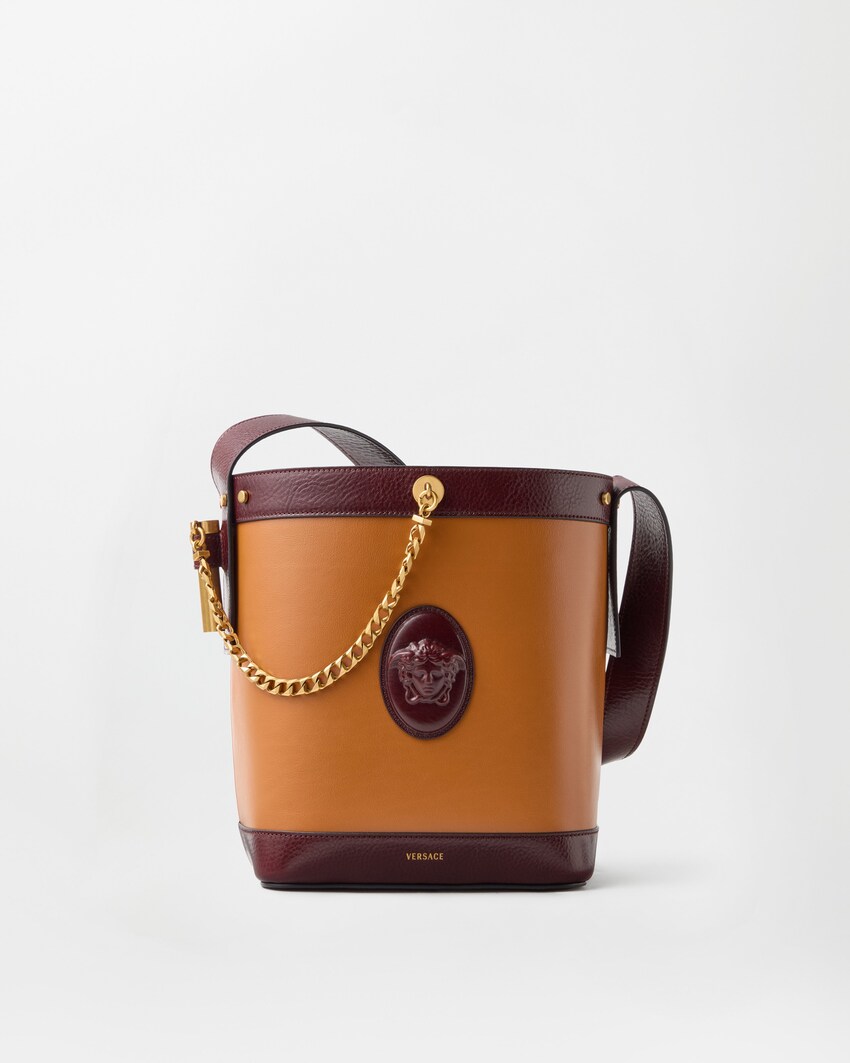
Walk into a Versace boutique now and you'll find the Medusa emblem rendered in a dozen different materials, on bags and belts and buckles and shoes. You'll find the baroque print on silk and denim and leather. You'll find platform heels and chainmail and safety pins, all executed with the same technical precision that Gianni demanded in 1978.
Whether this constitutes a living design language or a well-managed archive is, perhaps, beside the point. Versace has always been about the gesture, the moment, the flash. The house built its reputation on clothes that demanded to be seen, worn by people who had no interest in discretion. That principle has not changed.
Donatella gave an interview some years ago in which she described finding one of Gianni's sketch books after his death. The margins were filled with notes, revisions, second thoughts. But the drawings themselves were decisive, rendered in quick, confident strokes. She said it reminded her that doubt and certainty could coexist, that you could question every decision and still commit fully to the work.
The house, one imagines, continues in that spirit. The safety pin dress is in a museum now, behind glass. But somewhere, tonight, someone is fastening a Medusa-head belt, stepping into a pair of six-inch platforms, and walking out the door. The dress, as always, completes itself in motion.