The security guard at Burberry's Horseferry Road archive wears a gabardine mac
The security guard at Burberry's Horseferry Road archive wears a gabardine mac. Not the trench—the single-breasted car coat, belted at the back, no epaulettes. It is the kind of detail you notice only if you have spent time around the brand's actual language, the one that predates logomania and the Lola bag by several decades. He has worn it, he says, for eleven years. It still sheds rain.
Thomas Burberry did not set out to dress Edwardian officers or Mitteleuropean spies. He wanted to solve a problem: woven cotton that could breathe and repel water at the same time. Gabardine, patented in 1879, was that solution. The fabric was a worsted weave so tight it became near-waterproof without coating. It moved. It didn't crack in cold. By 1901, the War Office was ordering it in bulk. By 1914, every British officer above the rank of lieutenant wore a Burberry trench. The coat was a byproduct of the cloth, not the other way around.
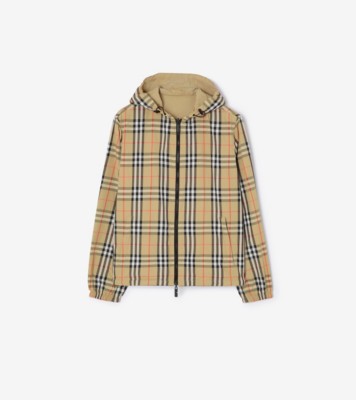
This is worth holding onto, because Burberry's codes—its actual vocabulary, not the checked lining everyone associates with football casuals and overseas tourists—live in materials and construction, not motifs. The check itself was a mistake of visibility. It began as a removable lining in 1924, meant to prove authenticity when a customer unbuttoned their coat at the tailor. It became famous by accident when it appeared in advertising during the 1960s. By the 1990s, it was licensing poison. The house spent the better part of two decades trying to bury it, then brought it back under Riccardo Tisci in 2018, this time controlled, leveraged, monetised with intent.
But that is not where the brand's authority sits.
The Architecture of the Trench
A Burberry trench is not one garment. It is a system. The storm shield across the right shoulder exists because a rifle sat there. The D-rings at the belt held grenades, later gloves. The throat latch kept wind out of a forward observer's scope line. These elements remain not because they are decorative but because removing them would collapse the coat's visual logic. The trench is not a silhouette. It is a set of relationships—between the shoulder yoke and the sleeve, between the belt and the skirt, between weight and drape.
The house still cuts its Heritage Trench on blocks drawn in 1952. The shoulder is built, not soft. The sleeve is set high and rotated slightly forward, which means the coat moves when you do but does not pull across the back when you reach for a cab. The gabardine is still woven in Yorkshire, 100-thread-count minimum, proofed but not coated. This is not romance. It is specification.
When Daniel Lee arrived as chief creative officer in 2022, he did not touch the trench. He also did not foreground it. His first collection for the house included several coats that shared its construction—storm shields, D-rings, throat latch—but rendered in black nylon or waxed cotton, cut shorter, closed with snaps instead of buckles. The vocabulary was intact. The grammar had shifted. Lee, who built his reputation at Bottega Veneta by stripping away logo and leaning into material, appears to understand that Burberry's language is structural, not ornamental. You do not revive a house by designing around its logo. You revive it by speaking its syntax fluently enough that you can write new sentences.
Equestrian Weight
The other place Burberry's codes live—quieter, less catalogued—is in its relationship to English country dressing. Not the fashion version, which tends toward waxed Barbour and borrowed-from-the-stable charm, but the actual semiotics of the shires: long scarves in brushed cashmere, car coats with set-in belts, outerwear cut to layer over knitwear without binding at the armhole.
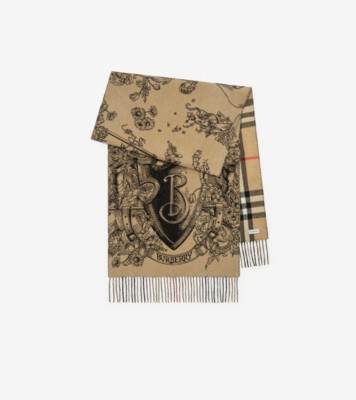
The house produced its first cashmere scarf in 1950. It was not checked. It was a solid camel, fringed, oversized enough to wrap twice and tuck into a coat. The check scarf—now the brand's single best-selling accessory—came later, and it succeeded not because of the pattern but because of the hand. Burberry's cashmere is combed, not carded, which gives it a tighter, less fuzzy surface. It wears longer. It also costs more, though the brand has lately started offering lambswool alternatives at a third of the price, which is either accessibility or dilution depending on your threshold for democratised luxury.
Lee's Burberry has leaned into this vocabulary with more confidence than his predecessors. His pre-fall 2024 collection included several pieces that could have come from a 1970s country-house catalogue: a double-faced cashmere duffle coat, toggle-closed, no check in sight; a shearling aviator with a collar wide enough to turn up against wind; a quilted riding jacket in tobacco-brown nylon, diamond-stitched, belted at the waist. These are not fashion coats. They are transport layers, designed to be worn over something else, built to move between the car and the house and the weather in between.
The risk, of course, is that this language reads as heritage cosplay. Burberry has spent the last decade trying to escape the perception that it is a brand for people who want to look like they have a country estate, whether or not they do. But Lee's approach is less nostalgic than it is materially specific. The quilted jacket is not meant to evoke equestrianism. It is simply built the way a quilted jacket should be built if you want it to insulate without adding bulk. The duffle coat closes with toggles because toggles work with gloves on. These are not gestures. They are decisions.
What Stays
Burberry's logo—the Equestrian Knight, registered in 1901—appears on almost nothing Lee has designed. It is still there, printed on the interior label, but it does not feature on hardware or woven into cloth. This is a choice. The house's previous creative directors, from Christopher Bailey to Tisci, treated the archive as a reservoir of signs to be cycled through: the check, the knight, the Thomas Burberry monogram, the 1856 founding date. Lee treats it as a technical library. He is less interested in what Burberry looked like than in how it was built.
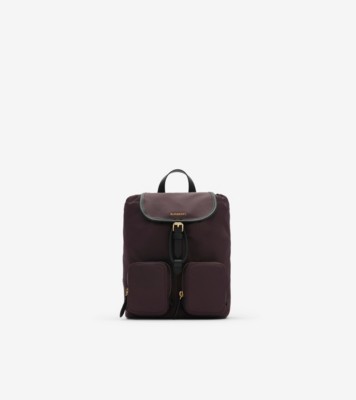
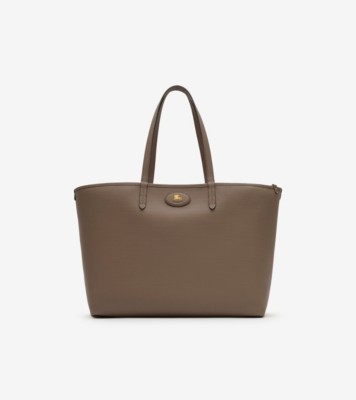
The clearest example of this is his reworking of the Rocking Horse bag, a soft, slouchy hobo shape first introduced in the early 2000s and largely forgotten until Lee brought it back in 2023. The original was logo-light, defined by its curved base and single shoulder strap. Lee's version uses the same construction but shifts the proportions: smaller body, wider strap, no visible branding except a small embossed logo on the interior pocket. It has sold steadily, without hype, to a customer base that appears to skew older and less interested in being seen carrying a Burberry bag than in simply carrying a bag that works.
This is not the brand's growth engine. The Knight bag—Lee's structured, logo-forward top-handle, introduced in his debut collection—sells faster and photographs better. But the Rocking Horse suggests a different strategy, one that does not depend on newness or noise. It suggests that Burberry's overlooked codes might be overlooked precisely because they are not codes at all. They are simply the way the house has always made things, when it is making them properly.
There is a photograph, not widely reproduced, of Ernest Shackleton's 1914 Antarctic expedition. Every man wears a Burberry gabardine anorak, hood up, face exposed. The cloth is stiff with cold but not frozen. It is doing what it was designed to do. The image is not dramatic. It is documentary. That is the point.