The skull scarf still sells
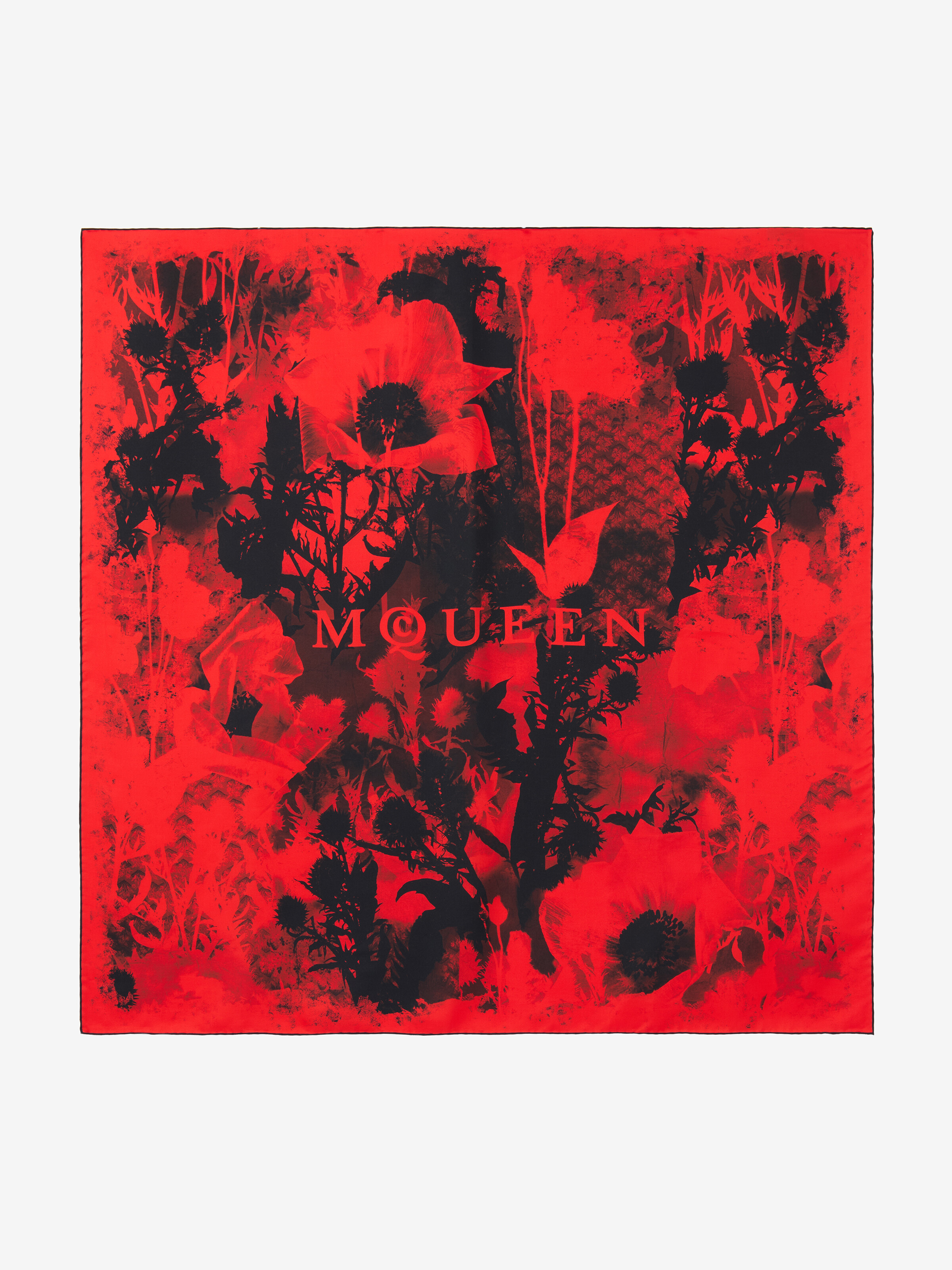
The skull scarf still sells. Twenty years after its first appearance, the chiffon square with its printed memento mori moves through airport boutiques and department store concessions at a pace that would be the envy of many runway pieces. It is not the most technically ambitious thing Alexander McQueen produces, but it is legible. It says McQueen to someone who has never seen the archives, never heard of the Highland Rape collection, never stood in front of the Savage Beauty exhibition. The scarf is shorthand. Whether that is enough depends on what you think a house is for.
The founder and the mythology
Lee Alexander McQueen died in February 2010. He was forty years old. He had built a business that combined Savile Row tailoring skill with a taste for the macabre, the theatrical, the confrontational. His shows were not presentations—they were events that made people feel unsafe in their seats. Models walked through water, through fire, through broken glass. A hologram of Kate Moss floated inside a pyramid. These were not selling tools in the traditional sense. They were reputation builders, and they worked.
The clothes themselves carried a different kind of intensity. McQueen trained on the Row, and that training showed in how a jacket moved across the back, how a sleeve set into an armhole, how a waist could be shaped without looking costumey. He understood the mechanics of a garment in three dimensions. The tailoring was never just structure for structure's sake—it was there to exaggerate, to distort, to make the body unfamiliar. He called one collection "It's a Jungle Out There" and sent models down the runway in fur and feathers and leather that looked like it had been scavenged. The technique was impeccable. The vision was hostile.
When McQueen was alive, the business was not large. The shows were famous, but the revenue was modest. The house was owned by Gucci Group, later Kering, and it operated in that space many avant-garde labels occupy: critically lauded, commercially secondary. McQueen himself seemed uninterested in making the brand a commercial engine. He was interested in making people look, and then making them look away.
The Burton era
Sarah Burton joined McQueen as an intern in 1996. She became head of womenswear in 2000. When McQueen died, she was the obvious successor, and in May 2010 she was named creative director. She had worked beside him for fourteen years. She knew the language.
Burton's McQueen is softer. That is not a value judgment—it is a description. Where McQueen used tailoring to create aggression, Burton uses it to create protection. Her shapes are still sharp, still architectural, but they do not feel antagonistic. She has leaned into the house's facility with lace, with embroidery, with surface decoration. The wedding dress she made for Catherine Middleton in 2011 was watched by two billion people. It was a masterclass in construction, yes, but it was also deeply traditional. It did not provoke. It reassured.
Under Burton, Alexander McQueen has become a functioning luxury business. The brand is no longer a loss leader for Kering. Revenue has grown steadily. The ready-to-wear is worn by actors, by editors, by women who want a particular kind of dark romanticism that does not tip into costume. The tailoring remains exceptional—Burton trained under McQueen, and she has kept that rigour. But the shows are no longer frightening. They are beautiful. They reference nature, folklore, the British landscape. They are emotional, but the emotion is melancholy rather than rage.
There is a debate about whether this is a betrayal or an evolution. The people who say betrayal point to the fact that McQueen's work was never meant to be comfortable, and Burton has made it wearable. The people who say evolution point to the fact that McQueen the man is gone, and a business cannot survive on mythology alone. Both are correct.
Burton's last show for the house was autumn/winter 2023. She announced her departure in September of that year, after twenty-six years with the brand. The statement was brief. She thanked the atelier, the team, the memory of Lee. She did not say where she was going. The question of what happens next became immediate.
The appointment
Seán McGirr was named creative director in October 2023. He came from JW Anderson, where he had spent a decade, most recently as head of design for ready-to-wear. He was not a famous name. He had not led a house before. The appointment was read as either a bold choice or a safe one, depending on whether you value external recognition or internal knowledge. McGirr had worked in the Kering system. He understood the commercial apparatus. He was not going to blow up the business.
His first show, for autumn/winter 2024, landed in March. The collection was shown in Paris, at the École des Beaux-Arts. The set was stark—white walls, bright light. The clothes were a mix of sharp tailoring and draped jersey, with a colour palette that moved from black to deep red to bone white. There were nods to McQueen's vocabulary: the low-slung bumster, the exaggerated shoulder, the lace that looked like it had been pulled from something decaying. But the overall effect was quieter than either McQueen or Burton. The silhouettes were clean. The provocation was muted.
The reviews were mixed. Some critics saw a designer finding his footing, working through the archive without being crushed by it. Others saw a lack of conviction, a collection that gestured at McQueen's language without speaking it fluently. The commercial response was harder to read—luxury sales were softening across the sector, and it was difficult to separate McGirr's impact from the broader market.
His second show, for spring/summer 2025, arrived in September 2024. The collection was lighter, more fluid. There were references to Irish folklore, to McGirr's own background. The tailoring was still present, but it shared space with softer pieces—slip dresses, sheer overlays, knitwear that looked hand-worked. The skull motif appeared, but abstracted, almost decorative. It was a McQueen collection that felt like it was asking permission to be something else.
Where it stands
Alexander McQueen is now a house with three distinct chapters. The founder's era: confrontational, technically brilliant, commercially secondary. The Burton era: romantic, wearable, a functioning luxury business. The McGirr era: still forming, still in negotiation with what came before.
The question is not whether McGirr can make McQueen relevant again—the brand never stopped being relevant in the commercial sense. The question is whether he can make it necessary. Burton made the house stable. She gave it a clear identity that was distinct from Lee McQueen's but still connected to his techniques, his materials, his obsessions. McGirr is working in a different context. The fashion system is more crowded, more image-driven, more dependent on viral moments than it was in 2010. A beautiful show is not enough. A well-made jacket is not enough. The house needs a reason to be watched.
Right now, that reason is not clear. The collections are competent. The tailoring is still exceptional—the atelier has not forgotten how to set a sleeve. But competence is not a position. McQueen, the man, had a position. Burton, over time, developed one. McGirr is still searching.
The skull scarf still sells. It sits in the boutiques next to the new pieces, next to McGirr's work, and it outsells most of them. It is a piece of intellectual property, a logo, a signal. It is not fashion in the sense that McQueen understood fashion—as a provocation, a risk, a thing that might fail. It is a product. And maybe that is what the house is now. A product that remembers, occasionally, that it used to be something else.
In the Paris flagship, there is a small vitrined archive piece from the "Widows of Culloden" collection. It is a coat, black wool, with embroidery that took two hundred hours. It does not look like anything McGirr has shown. It does not look like anything Burton showed, either. It looks like McQueen. The vitrine is lit from above, and the coat stands on a form, sleeves slightly lifted, as if the body inside had just stepped away. People stop to photograph it. Then they move on to the ready-to-wear, where the current collection waits, still hoping to be seen as clearly.