The sleeve arrives at the wrist without fanfare
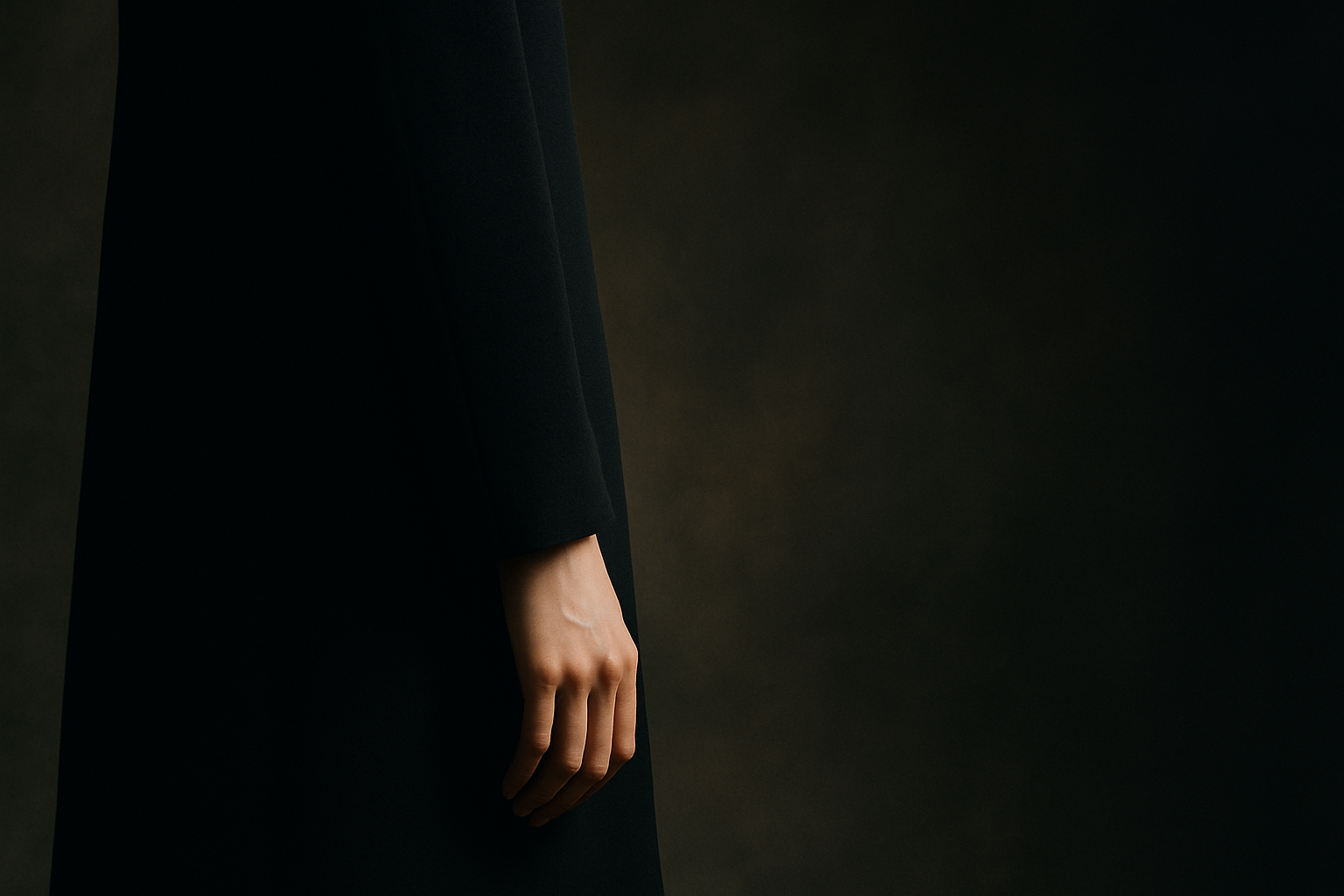
The sleeve arrives at the wrist without fanfare. No cuff, no button placket, no topstitching to announce its terminus. It simply ends — clean, deliberate, as though the pattern-cutter knew exactly where the arm stops and the air begins. This is not the Balenciaga of Triple S trainers or logo hoodies. This is the other vocabulary, the one that predates the memes and survives them. A language of structure over ornament, volume over decoration, and an almost pathological attention to where cloth meets body.
Most conversations about Balenciaga begin and end with Demna. Fair enough — he runs the house, sets the tempo, courts the controversy. But the codes he's working with, the ones that make a Balenciaga silhouette legible even when stripped of logos, were laid down seventy years ago by a Basque tailor who rarely gave interviews and closed his atelier at the height of his powers. Cristóbal Balenciaga was not interested in being liked. He was interested in being correct.
The Architect's Bias
Cristóbal Balenciaga opened his Paris salon in 1937, already a mature couturier with two decades of work behind him in San Sebastián and Madrid. He arrived with a set of convictions about how a garment should be built — not draped, not pinned into being on a mannequin, but engineered from flat pattern. He trained as both tailor and dressmaker, rare then as now, and the synthesis gave him an advantage: he understood menswear's structural grammar and womenswear's sculptural possibility. What he made sat somewhere between the two.
His sleeves are the clearest evidence. A Balenciaga sleeve of the 1950s and '60s often set into the bodice with a seam that curved forward, following the natural fall of the arm at rest. This is not the standard tailoring approach, which assumes a military posture, shoulders back. Balenciaga's method acknowledged how women actually stood, moved, held a cigarette or a glass. The result was a sleeve that hung without strain, its volume controlled but never tight. Comfort, in his lexicon, was not casual — it was exact.
Then there is the question of the waist, or rather its absence. While Dior cinched and Givenchy nipped, Balenciaga let the waist go. His sack dress of 1957 dispensed with it entirely, a straight fall from shoulder to hem that scandalized editors and freed a generation of clients from boning and girdles. The tunic dress, the semi-fitted coat, the baby-doll line — all Balenciaga, all predicated on the idea that a garment could define the body without gripping it. He was not interested in the hourglass. He was interested in the column, the trapeze, the bell.
Fabric weight mattered intensely. He worked with cloth substantial enough to hold a shape without internal scaffolding. Gazar, a silk weave with a crisp hand, became a house signature. So did heavyweight duchess satin, double-faced wool, and a particular grade of Ottoman silk that could support a sculptural sleeve or stand-away collar. These were not soft fabrics. They had opinions. Balenciaga liked that.
The Ghosts in the Archive
Nicolas Ghesquière, who led Balenciaga from 1997 to 2012, understood this structural inheritance but approached it obliquely. He was not interested in reverence. He took the house codes — the volume, the engineered ease, the refusal of obvious sex appeal — and ran them through a science-fiction filter. His silhouettes leaned forward. His fabrics were technical, occasionally reflective. He put women in narrow trousers and boxy jackets with exaggerated shoulders, a look that read as armour, not couture.
But the through-line was there. Ghesquière's sleeves, like Cristóbal's, often set in with that forward curve. His collars stood away from the neck. His hemlines landed at unexpected intervals — mid-shin, upper thigh, never quite where convention dictated. He was not copying the archive. He was applying its principles to a different century, a different client, a different understanding of what a body in motion required.
The bags from that era — the Lariat, the City, the First — became commercial engines, but they too carried a certain Balenciaga logic. They were not precious. The leather was tough, the hardware substantial, the straps long enough to sling crossbody. These were not bags that required special handling. They were tools, softened by use, improved by wear. Patine, in the French sense: the surface a material earns through time and contact.
What Demna Keeps
Demna Gvasalia arrived in 2015 with a reputation for irony and a tendency to provoke. His first Balenciaga collections leaned into the absurd — IKEA-blue shoppers, DHL-branded shirts, platform Crocs. The press read it as provocation, which it was, but also as a break from Ghesquière's futurism. What got less attention was how much Demna retained from the deeper archive.
The proportions, for instance. Demna's oversized tailoring — the coats that swallow the frame, the trousers that pool at the ankle — descend directly from Cristóbal's conviction that a garment need not cling to flatter. The exaggerated shoulders on his blazers and coats echo both the 1980s and the 1950s, two eras when Balenciaga's structured ease found different expressions. Even the logo hoodies and Triple S trainers, easy to dismiss as pure hype, carry a certain logic: they are substantial, engineered, built to last. They do not apologize for their presence.
Demna's evening work, less discussed but more revealing, shows the same architectural instinct. His gowns tend toward the monumental — one piece of fabric, folded or draped or cantilevered in a way that requires no ornament. A black duchess satin column with a single sculptural sleeve. A white gazar coat-dress that stands away from the body like a bell. These are not dresses that photograph well on a hanger. They require a body to complete the form, which is precisely the point.
The current Balenciaga, then, is less a rupture than a recalibration. Demna has brought the house into the streetwear conversation, yes, but he has done so without abandoning the codes that make a Balenciaga garment legible across decades. The sleeve still arrives without fuss. The waist remains optional. The fabrics hold their shape. What has changed is the context, not the grammar.
The Cuff That Isn't There
On a rack in the Balenciaga archive — this is secondhand, from a conservator who worked there briefly in the early 2000s — hang dozens of sleeves detached from their garments, each one tagged with a date and a fabric swatch. Some curve gently forward. Some flare at the elbow. Some taper to nothing, no cuff, no closure, just an edge that knows when to stop. They are stored this way, the conservator said, because Cristóbal believed the sleeve was the hardest part to get right, the detail that separated competence from mastery. Get the sleeve wrong and the whole garment fails. Get it right and the wearer forgets she is wearing anything at all.
That forgetting, that ease, is the code that survives. Not the logo. Not the It bag of the moment. But the way a coat sits on the shoulder, the way a hemline falls without clinging, the way a garment can be both sculptural and comfortable, both assertive and unshowy. It is a quiet language, easy to miss in the noise. But it is there, in every collection, waiting for anyone who knows how to look.