The sleeve on the 1951 barrel coat weighs nothing
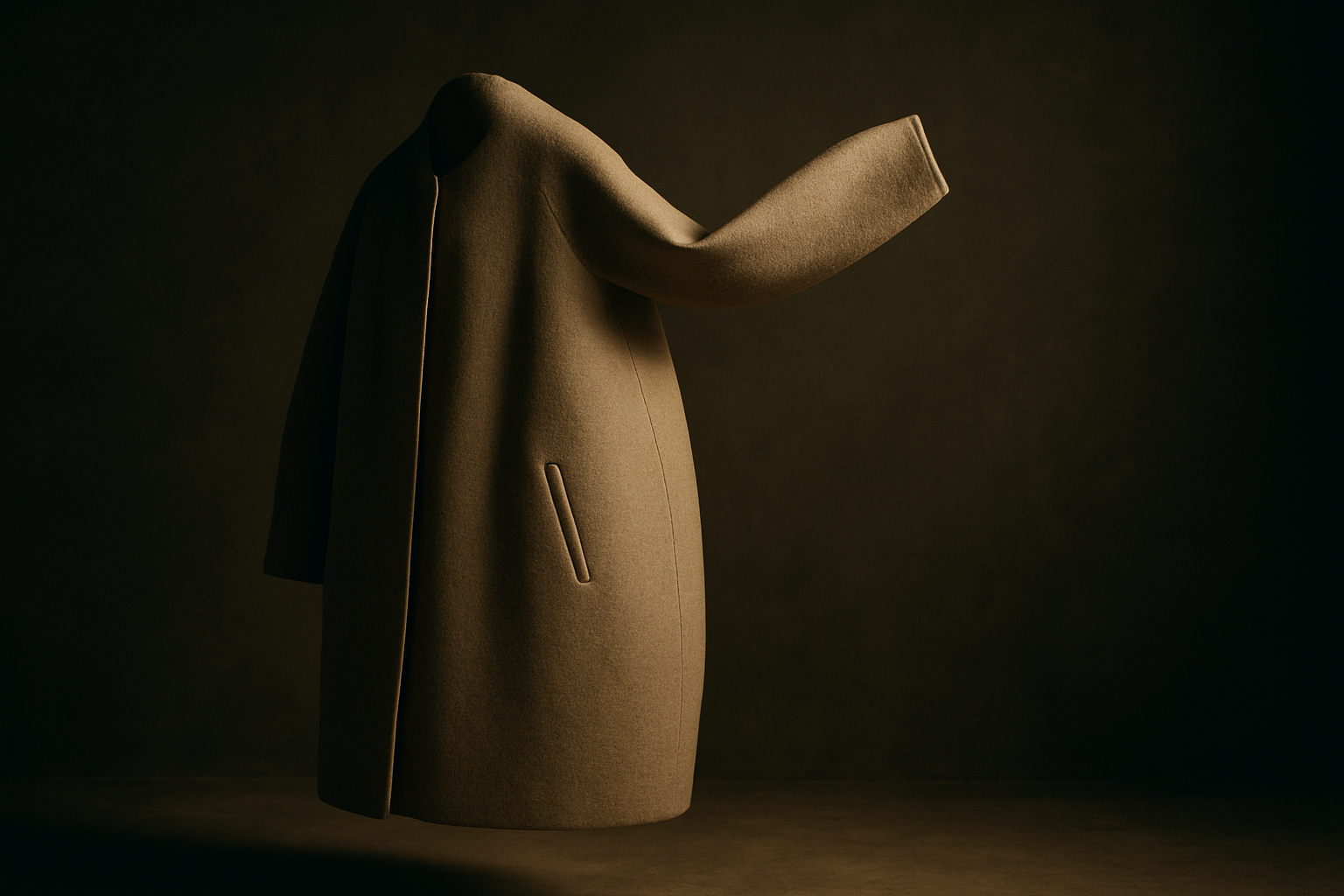
The sleeve on the 1951 barrel coat weighs nothing. Hold the garment up and the wool feels closer to paper than cloth, but the silhouette holds — rounded at the shoulder, narrowed at the hem, structured without a single visible seam doing the work. Cristóbal Balenciaga built that coat by removing construction, not adding it. He made the fabric do what most couturiers asked boning and padding to accomplish. That approach — sculpture through subtraction — is the through-line in a house that has spent seventy years saying different things in different registers, but always from the same foundational grammar.
Balenciaga doesn't revise itself gently. It lurches. And each lurch has clarified what the name actually protects.
Cristóbal: the architect who sewed
Cristóbal Balenciaga opened his Paris atelier in 1937, already forty-two and already certain. He'd run three successful houses in Spain — San Sebastián, Madrid, Barcelona — and arrived in Paris with a technical vocabulary most couturiers spent decades assembling. He could cut, fit, and finish a garment himself. He didn't sketch and hand off. He built.
That mattered because his work wasn't about decoration. It was about form that moved. The balloon jacket, the baby doll dress, the four-sided pyramid coat: these weren't whimsical. They were studies in how much ease a body could carry before the garment stopped reading as clothing and started reading as sculpture. Balenciaga worked in that margin. He gave his clients volume that hovered an inch off the skin, never touching but never collapsing. The effect was monastic and modern at once.
He also worked slowly. One dress could take ten fittings. The atelier kept a three-month production lead for private clients, longer for the more complicated pieces. By the late fifties, as ready-to-wear started eroding couture's economic logic, Balenciaga didn't bend. He kept the fittings, kept the lead times, kept the prices high. In 1968, he closed the house entirely. He was seventy-three. He told his staff the morning of, gave them severance, and walked out. No succession plan. No archive strategy. No licensing.
The house stayed shuttered until 1986.
Ghesquière: the modernist who remembered
Nicolas Ghesquière took over Balenciaga in 1997, twenty-nine years old and mostly unknown outside a brief stint at Jean Paul Gaultier. The house had been through two creative directors since reopening and hadn't landed. Ghesquière landed.
His first collection for spring 1998 was quiet — narrow trousers, slim jackets, a lot of black — but by fall 2000 he'd found the lever. He took Cristóbal's volumes and made them angular. The softness went hard. Shoulders became exaggerated, hips got cut away, and the silhouette turned geometric in a way that felt more Tokyo than Paris. He used technical fabrics — neoprene, bonded jersey, rubberised cotton — and mixed them with lace or broderie anglaise, so a single look could read as both armoured and delicate.
The accessories clarified the vision. The Lariat bag in 2001, then the City bag in 2003: both had that same taut, unpadded structure Ghesquière was putting into the clothes. The City especially — with its thin leather, long fringe, and flat shape — became the bag for a specific kind of dresser. Not minimalist, not maximalist. Something in between, something that wanted edge without costume.
Ghesquière stayed until 2012. Fifteen years. That's long for a contemporary creative director, and the tenure let him build a sustained argument. By the end, Balenciaga meant something legible again: sharp, modern, intellectual, feminine but not soft. The house had a constituency. It also had tension with Kering, which had acquired it in 2001. Ghesquière wanted more control over pace and licensing. Kering wanted growth. He left, and six months later Kering hired Demna Gvasalia.
Demna: the strategist who exploded it
Demna arrived in 2015 from Vetements, the Zurich-via-Paris collective that had spent two years making oversized hoodies and DHL T-shirts feel like the only honest response to fashion's self-seriousness. He brought that energy to Balenciaga, but he also brought something Vetements didn't have: an industrial infrastructure and a surname people recognised.
His first collection, spring 2016, had the oversized blazers and the deconstructed denim, but it also had couture references — a cocoon coat that quoted Cristóbal's 1950s volumes, a sculptural black gown that could've been pulled from the archive. Demna wasn't rejecting the house's history. He was using it as material. He put Cristóbal's shapes into nylon and fleece. He turned the City bag into the Triangle Duffle, a slouchy tote that looked like sportswear but cost €1,800. He made Balenciaga's logo huge and put it on everything — hats, bags, shoes, knitwear — at a moment when most luxury houses were still pretending logos didn't sell.
They sold. Balenciaga's revenue tripled between 2016 and 2021. The Triple S sneaker, released in 2017, became the reference point for the entire ugly-shoe trend. The Speed Trainer — a knit sock with a sole — moved hundreds of thousands of units. Demna turned Balenciaga into a brand that could do €2,000 tailoring and €500 hoodies in the same collection, and both felt coherent.
But coherence isn't stability. In late 2022, two ad campaigns — one featuring children holding bags styled to look like bondage gear, another with documents referencing child abuse law in the background — went public. The backlash was immediate. Balenciaga pulled the campaigns, apologised, sued the production company, then dropped the lawsuit. Demna issued a statement. Kering issued a statement. For six months, the house went quiet.
Demna stayed. The collections since have been more restrained — less provocation, more craft. Fall 2023 leaned into tailoring. Spring 2024 had quieter colours, softer shapes, less logo. Whether that's a recalibration or a retreat depends on how you read the room. Either way, Balenciaga remains one of Kering's largest revenue drivers, and Demna remains in place.
What the house protects
Balenciaga has never been a house that asks permission. Cristóbal didn't ask if couture could survive without compromise. Ghesquière didn't ask if modernism could be commercial. Demna didn't ask if luxury could absorb streetwear's entire visual language and still charge couture prices. Each of them pushed past the question and built the answer in cloth.
What they share isn't aesthetic. It's a willingness to let the work be difficult. Cristóbal's volumes required ten fittings because ease is hard to engineer. Ghesquière's sharp tailoring required new construction methods because bonded neoprene doesn't behave like wool. Demna's oversized shapes require precise grading because a sleeve that's too big by two centimetres reads as wrong, not intentional.
The house's reputation has survived because the technique has. You can argue about whether Demna's logo hoodies belong in the same lineage as Cristóbal's barrel coat, but you can't argue that both required someone to solve a structural problem most designers wouldn't bother with. That's what Balenciaga protects: not a look, but a standard.
There's a photo from the 1968 closure. Cristóbal stands in the atelier, hands in pockets, surrounded by dress forms. The forms are draped in muslin, mid-fitting. He's looking at one of them — not at the camera, not at his staff, just at the form. The muslin has pins in it. He left it unfinished.