The trench coat sits in the Imperial War Museum, collar stiff, belt buckled
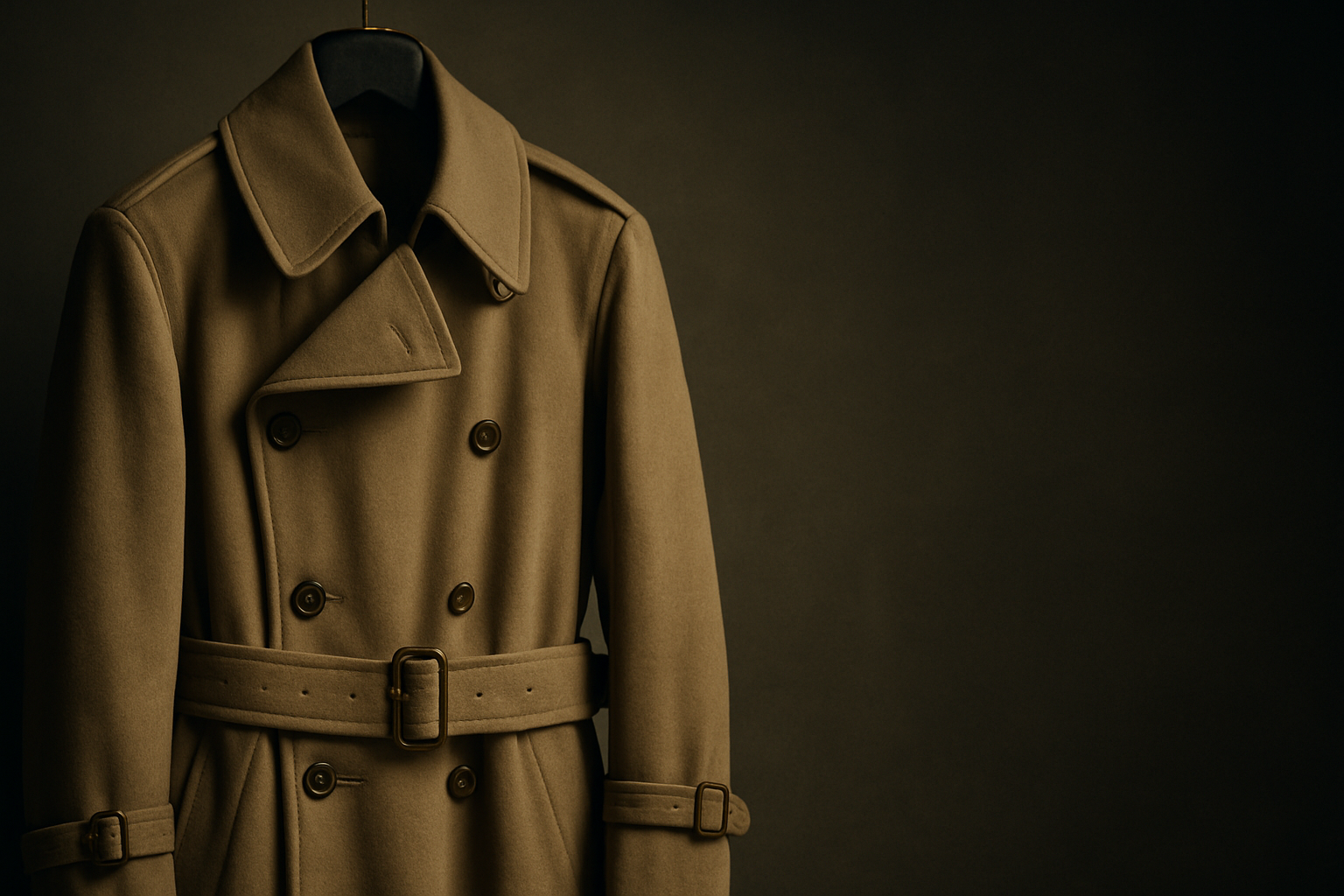
The trench coat sits in the Imperial War Museum, collar stiff, belt buckled. It is beige. It is wool gabardine. It is dated 1918 and labelled with the maker's name: Burberry. The garment does not look like fashion. It looks like function that outlasted its original purpose and became something else.
That transformation is the story of the house.
1856–1914: Gabardine and the Officer Class
Thomas Burberry opened his draper's shop in Basingstoke in 1856. He was twenty-one. By 1879 he had patented gabardine, a tightly woven cotton twill that repelled water without the rubber coating that made other weatherproof cloth stiff and airless. The weave was the innovation. Warp threads were waterproofed before weaving; the fabric breathed.
Burberry supplied the British Army during the Boer War. Officers ordered coats. The design was practical: epaulettes for rank insignia, D-rings for equipment, a storm flap across the chest. The garment was called a trench coat because that is where it was worn. By the end of the First World War, over 500,000 had been issued.
The coat entered civilian life still carrying its military silhouette. Burberry did not soften it. The house understood that authority could be borrowed and worn. Explorers took the gabardine to the poles—Shackleton and Scott both ordered pieces for their Antarctic expeditions. The fabric's reputation was built on endurance, not elegance.
The check appeared later, in the 1920s, as a lining. Camel, red, black, white. It was visible only when the coat was open or the fabric folded back. For decades it remained an interior detail.
1997–2006: Democratisation and Dilution
By the late 1990s, Burberry was in trouble. The trench coat had become a reference point, not a sales driver. The house had licensed its name widely—umbrellas, luggage, dog collars—and the check had migrated from lining to surface. It appeared on everything. Visibility became ubiquity.
Rose Marie Bravo arrived as CEO in 1997 from Saks Fifth Avenue. She hired Christopher Bailey, then a young designer from Gucci, as design director in 2001. The project was rehabilitation. Burberry needed to be desirable again, which meant it needed to be controlled.
Bailey understood that the house's strength was not in decoration but in the coat itself. He kept the trench and built around it. The runway shows in the early 2000s featured lean tailoring, military references stripped of their original context, and the check used sparingly—a scarf, a lining, a trim. The aesthetic was English but not nostalgic. It looked forward by looking inward.
The advertising was equally deliberate. Burberry cast British actors and musicians—Emma Watson, Eddie Redmayne, Cara Delevingne—and shot them in soft, overcast light that recalled British weather without romanticising it. The campaigns were not about luxury as aspiration. They were about luxury as familiarity made newly exclusive.
The strategy worked. Revenue grew from £225 million in 1997 to over £1 billion by 2006. The house went public. Bailey became chief creative officer, then CEO. Burberry was no longer a heritage brand in decline. It was a commercial success with a clear visual language.
But success created its own problem. The check, reintroduced as a mark of identity, became overexposed again. It appeared on counterfeit goods across Europe and became associated with a specific British subculture—football fans, working-class youth—that luxury consumers wanted distance from. By the mid-2000s, some UK pubs banned patrons wearing visible Burberry check. The house had control of its image in advertising but not in the street.
Bailey responded by pulling back. The check nearly disappeared from the runway between 2005 and 2010. The focus shifted to fabrication: bonded cotton, rubberised gabardine, lightweight trenches that packed into their own pockets. Burberry invested in digital infrastructure early—live-streamed shows, direct e-commerce, social media presence—and became the fashion industry's model for technological adoption.
The work was effective. The brand stabilised. But the question of what Burberry was, beyond the trench and the check, remained open.
2018–Present: Riccardo Tisci and the Search for Modernity
Riccardo Tisci was announced as chief creative officer in March 2018. He had spent twelve years at Givenchy, where he built a gothic, romantic vocabulary that felt distant from Burberry's pragmatic English codes. The appointment was unexpected.
Tisci arrived with a clear intention: to make Burberry feel contemporary without erasing its archive. He introduced a new logo and monogram, designed by Peter Saville, that replaced the equestrian knight with interlocking T and B letters. The typeface was sans-serif, the monogram geometric. It was a deliberate break.
The first collections leaned into streetwear: oversized hoodies, logo-heavy pieces, nylon bags with chain straps. The trench coat appeared but often deconstructed—sleeves removed, hems unfinished, proportions exaggerated. Tisci was testing how far the house could move from its centre.
The work was uneven. Some pieces felt like genuine evolution—a trench in bonded technical fabric, a tailored coat with an asymmetric closure. Others felt like borrowing: the logos, the sneakers, the collaborations with streetwear-adjacent names. Burberry was reaching for a younger customer but not always with conviction.
By 2021, Tisci had recalibrated. The collections became quieter. The monogram receded. Tailoring returned, sharper and more architectural than Bailey's soft English cuts. The trench coat reappeared in its classic form, shown alongside leather trousers and sleek knitwear. The vocabulary was not streetwear or heritage. It was something in between—modern luxury that acknowledged the archive without living inside it.
The challenge for Tisci, and for Burberry, is that the house's identity is tied to a garment designed for a specific historical moment. The trench coat is not neutral. It carries military history, class associations, British imperial memory. That weight can be an asset or a limit.
Tisci has chosen to carry it. His recent collections show the trench not as a relic but as a structure—a set of proportions and details that can be reinterpreted without losing their original logic. A trench in black leather. A trench with the sleeves detached and worn separately. A trench cropped above the knee. The experiments are formal, not conceptual.
What Remains
Burberry does not have the singular vision of a house built around one designer's aesthetic. It has a product—a very good one—and a century of context. The work now is to decide what that context means.
The trench coat in the Imperial War Museum is behind glass. It is preserved, which means it is also fixed. The coats on the Burberry runway are not. They move, they sell, they are worn on the street and in advertising and by people who do not think about fashion history when they fasten the belt.
That distance between the archive and the present is where the house lives. Not in one or the other, but in the space between.