The trench coat was invented for war, not for fashion
The trench coat was invented for war, not for fashion. Thomas Burberry patented gabardine in 1879—a tight-weave cotton that could breathe and shed water without the weight of rubberised canvas. By 1914, the British War Office had commissioned half a million coats. Officers wore them in the trenches. The garment's name came from the place it was worn, not the other way around.
That origin is important. Burberry did not start as a luxury house. It started as a problem solved.
1856–1955: Function, Then Status
Thomas Burberry opened his first shop in Basingstoke in 1856. He was twenty-one. The business was outfitting—practical clothing for farmers, sportsmen, people who worked outdoors. Gabardine changed the equation. It was technical before the word meant anything in fashion. The fabric was tight enough to block wind and rain but woven loose enough to let moisture escape. Burberry used it for everything: coats, jackets, motoring wear, expedition gear.
Ernest Shackleton took gabardine to the Antarctic in 1914. Roald Amundsen wore it to the South Pole in 1911. The fabric performed, and performance built the reputation. By the time the trench coat entered civilian life after the First World War, it carried two things: utility and the residue of heroism. That combination—function made elegant, then made symbolic—became the house's template.
The check appeared in the 1920s, as a lining. It was not meant to be seen. Camel, red, black, and white in a grid—a signature that stayed hidden unless you opened the coat. That restraint lasted until the 1960s, when the check moved to the outside: scarves, umbrellas, luggage. By then, Burberry had stores in Paris and New York. The lining had become the logo.
1997–2008: Rehabilitation and Riccardo Tisci's Inheritance
By the late 1990s, Burberry was in trouble. The check had been counterfeited into ubiquity. It appeared on baseball caps, bikinis, dog collars—contexts that diluted the house into shorthand for a certain kind of aspiration, then into parody. The brand was visible everywhere and desired nowhere that mattered.
Rose Marie Bravo arrived in 1997 from Saks Fifth Avenue. She hired Christopher Bailey in 2001. Bailey had worked under Donna Karan and at Gucci under Tom Ford, and he understood that Burberry's problem was not the trench coat. The trench coat was still perfect. The problem was everything else.
Bailey cleaned the line. He pulled the check back—not entirely, but enough that it stopped shouting. He recentred the trench, shooting it on Kate Moss in 2001, then on a rotation of British actors and musicians who carried a specific kind of cool: Eddie Redmayne, Cara Delevingne, Romeo Beckham. The campaigns were not about heritage in the abstract. They were about youth and a version of Britishness that felt current, not nostalgic.
The runway collections under Bailey moved between two poles. One was the archive: trench coats reworked in lace, in shearling, in metallic nylon. The other was a kind of pastoral romanticism—ruffled blouses, long skirts, looks that referenced the English countryside without cosplaying it. The work was not radical. It was rehabilitative. By the time Bailey was named chief creative officer in 2009, Burberry had moved from troubled heritage brand to a house that understood how to monetise its past without being trapped by it.
Bailey's tenure lasted until 2018. Seventeen years. That is long enough to establish a visual language and long enough for that language to calcify. Toward the end, the collections felt like variations on a theme that had been stated too many times. The trench coat in python. The trench coat as a dress. The trench coat deconstructed and reassembled with the check now digital, now pixelated, now a print instead of a weave. Burberry was profitable and consistent, and consistency had become the limitation.
2018–Present: Riccardo Tisci and Daniel Lee
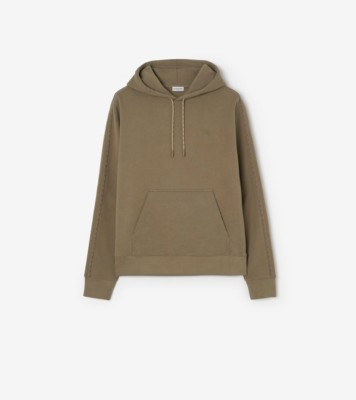
Riccardo Tisci arrived in 2018 from Givenchy, where he had spent twelve years building a dark, romantic, heavily embellished vocabulary. His first move at Burberry was to redesign the logo. Out went the equestrian knight, in came a sans-serif monogram by Peter Saville—two interlocking T and B letterforms that felt more 1908 than 2018, which was the point. Tisci also introduced a new logo: "BURBERRY LONDON ENGLAND" in all caps, set in a bold sans. It appeared on T-shirts, hoodies, nylon bags—items that sat at a lower price point than the trench and were aimed at a younger customer.
The collections were a harder sell. Tisci brought his Givenchy instincts: corsetry, sheer panels, chain details, a kind of after-dark glamour that felt at odds with Burberry's daylight heritage. There were moments—a shearfed coat with an exaggerated collar, a trench reconstructed in bonded leather—but the overall vision never cohered. The house felt split between two incompatible ideas: accessible logo-driven streetwear and high-concept eveningwear that had little to do with what Burberry had been or could be.
Tisci left in 2022. Daniel Lee, formerly of Bottega Veneta, was named creative director that October. His first collection for Burberry appeared in February 2023.
Lee's approach is different. He is interested in the coat, but not as an icon to be remixed. He is interested in it as an object with a specific construction—the sleeve head, the storm flap, the way the belt sits at the waist. His debut collection included trench coats, but also sculptural outerwear in waxed cotton and shearling, tailored separates with a clean shoulder line, and bags that felt like logical extensions of the house's utility-first past. The Knight bag, the Rocking Horse, the Shield tote—each named for something concrete, not abstract.
Lee has also pulled the check back again. It appears, but quietly: as a lining, as a scarf, as a detail rather than a statement. The logo T-shirts remain, but they are not the lead image. The lead image is the coat.
Where the House Stands
Burberry is not in crisis. It is also not inevitable. The trench coat is still in production, still cut the same way, still performing the function it was designed for in 1914. That is rare. Most houses do not have a single garment that has remained both unchanged and relevant for over a century.
The question is not whether Burberry can survive. It is whether it can define itself as something other than the custodian of one perfect coat. Daniel Lee's work suggests a possible answer: return to the material, the construction, the problem solved. Make the coat again, but also make the things that sit next to the coat. Not as supporting players, but as equals.
There is a photograph from 1955. A woman stands on a London street in a Burberry trench, belted tight, collar up against the rain. She is not a model. She is someone on her way somewhere, and the coat is doing what it was made to do. That is the image to hold. Not the check, not the logo, not the campaign. The coat, in the rain, still working.