The white cotton Tabi boot sits on a plinth at Dover Street Market like a question no one asked
The white cotton Tabi boot sits on a plinth at Dover Street Market like a question no one asked. Split toe, flat sole, anonymous stitching. It costs £575 and looks like something a stagehand would wear in Kyoto, circa 1910. It is also one of the most copied silhouettes in contemporary fashion, which tells you everything and nothing about Maison Margiela.
If you're new to the house, start here: Margiela doesn't explain itself. It never has. The Belgian designer who founded it in 1988 gave almost no interviews, showed his face in exactly zero photographs, and left the brand in 2009 without fanfare. What remains is a body of work that prizes anonymity, deconstruction, and a kind of conceptual rigour that can feel, depending on your mood, either thrilling or exhausting.
The founding logic
Martin Margiela trained under Jean Paul Gaultier, showed his first collection in a derelict playground in the 20th arrondissement, and built a house around four principles he never quite articulated but demonstrated relentlessly. One: garments should reveal their construction. Two: luxury is a set of gestures, not a price point. Three: the wearer completes the work. Four: anonymity protects the idea.
This wasn't theory. It was practice. Early collections featured linings worn as outerwear, seams exposed and raw, garments sized to hang rather than fit. Margiela used house codes instead of logos—four white stitches on a fabric label, often left blank. Runway invitations arrived as photocopies. Models wore identical brown wigs or had their faces obscured. The studio referred to itself in the first-person plural. No individual took credit.
The Tabi boot debuted in that first 1989 collection. Margiela had seen the traditional Japanese sock in a book and translated it into footwear. The split toe disrupted the silhouette of every trouser it touched. It also made walking feel strange for the first fifteen minutes, which was possibly the point. You don't forget a Tabi. Your body has to negotiate it.
What to know before you buy
Maison Margiela today operates under John Galliano, who took the creative helm in 2014 and has since steered the house through a second act that honours the archive while building something unmistakably his own. Galliano's Margiela is more theatrical, more ornamental, less austere. The Artisanal collections—haute couture in all but name—feature garments that look like they've been excavated, reassembled, lived in by someone else first. His ready-to-wear is quieter but no less conceptual.
If you're starting a Margiela wardrobe, you're navigating two overlapping territories. The first is the archive vocabulary: Tabi boots, the Replica sneaker, the Memory Of garment-dye pieces, the oversized blazers with exaggerated proportions. These are house signatures, reissued and reworked season after season. The second is Galliano's vision, which skews more decorative and often more expensive. An Artisanal jacket can run north of £8,000. A Replica sneaker starts at £350.
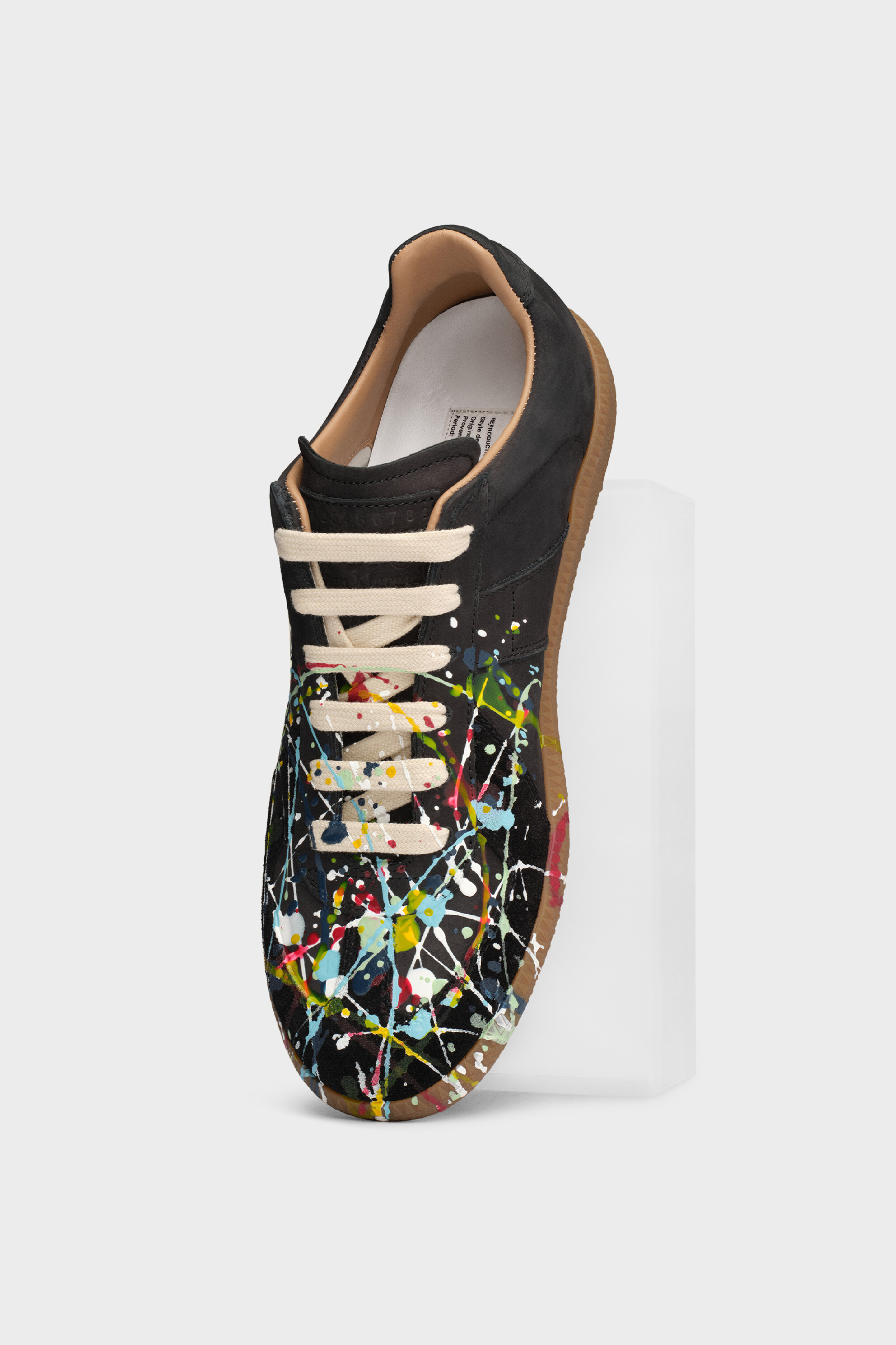
The Replica line is the most accessible entry point. Launched in the early 2000s, Replica reproduces vintage footwear and garments Margiela sourced from flea markets and military surplus stores. Each piece comes with a fabric label that lists the original garment's details: German Army Trainer, Austrian hiking boot, Italian sport shoe. The shoes are made in Italy, the construction is solid, and the price sits in the middle tier of luxury footwear. You're paying for craft, not logo.
The Tabi remains the house's most recognisable piece. It comes in boots, flats, heels, sneakers, and mules. Leather, suede, patent, canvas. Prices start around £400 for a canvas flat and climb to £900 for a leather knee-high. They are not comfortable in the way a Common Projects sneaker is comfortable. They are comfortable in the way a well-cut jacket is comfortable—once your body adjusts to the logic of the thing.
Garment-dye knitwear and shirting make up the Memory Of line, which takes new garments and treats them to look sun-faded, worn, imperfect. A cotton poplin shirt runs £350. A wool crewneck jumper sits around £500. The effect is subtle but unmistakable: the clothes feel like they've already lived a season or two, which makes them easier to wear immediately. No breaking-in period. No anxiety about the first stain.
The tailoring is harder to parse. Margiela's oversized blazers and deconstructed coats don't follow Savile Row logic. The shoulder sits wide, sometimes dropped. The sleeves run long. The chest is roomy. You size down, usually, but even then the fit is loose, architectural, designed to frame the body rather than follow it. A wool blazer starts at £1,200. A cashmere overcoat can reach £3,500. These are not beginner pieces unless you already know how you dress.
Where the house stands now
Galliano's Margiela has become a fixture on red carpets, which would have horrified the original studio. Celebrities wear the Artisanal pieces—bias-cut gowns that look like they've been through a fire, reassembled corsetry, sculptural headpieces. The house's Instagram account has 4.6 million followers. Margiela is, improbably, both cult and mainstream.
This hasn't diluted the work. Galliano's collections remain conceptually dense, technically ambitious, and often difficult to wear outside of a very specific context. The ready-to-wear is more wearable but still demands something from you—a willingness to look slightly off, slightly undone, slightly like you've arrived from a decade that hasn't happened yet.
The house still uses the four white stitches. The labels are still blank. The studio still refers to itself as 'we'. Galliano has never appeared at the end of a Margiela show. The anonymity persists, even as the work grows louder.
If you're buying your first piece, buy the Tabi. Not because it's the most practical—it isn't—but because it's the clearest distillation of what Margiela does. It takes a familiar object, shifts it slightly, and makes you reconsider everything you thought you knew about how a shoe should work. You'll either return it within a week or wear it until the sole separates from the upper. There's no middle ground.
The Replica sneaker is the safer choice. It looks like a sneaker, fits like a sneaker, works with denim and wool trousers and everything in between. But it won't teach you anything about the house. The Tabi will. It'll also make you walk differently, which is possibly the point of all of this.