The white label has four stitches at each corner
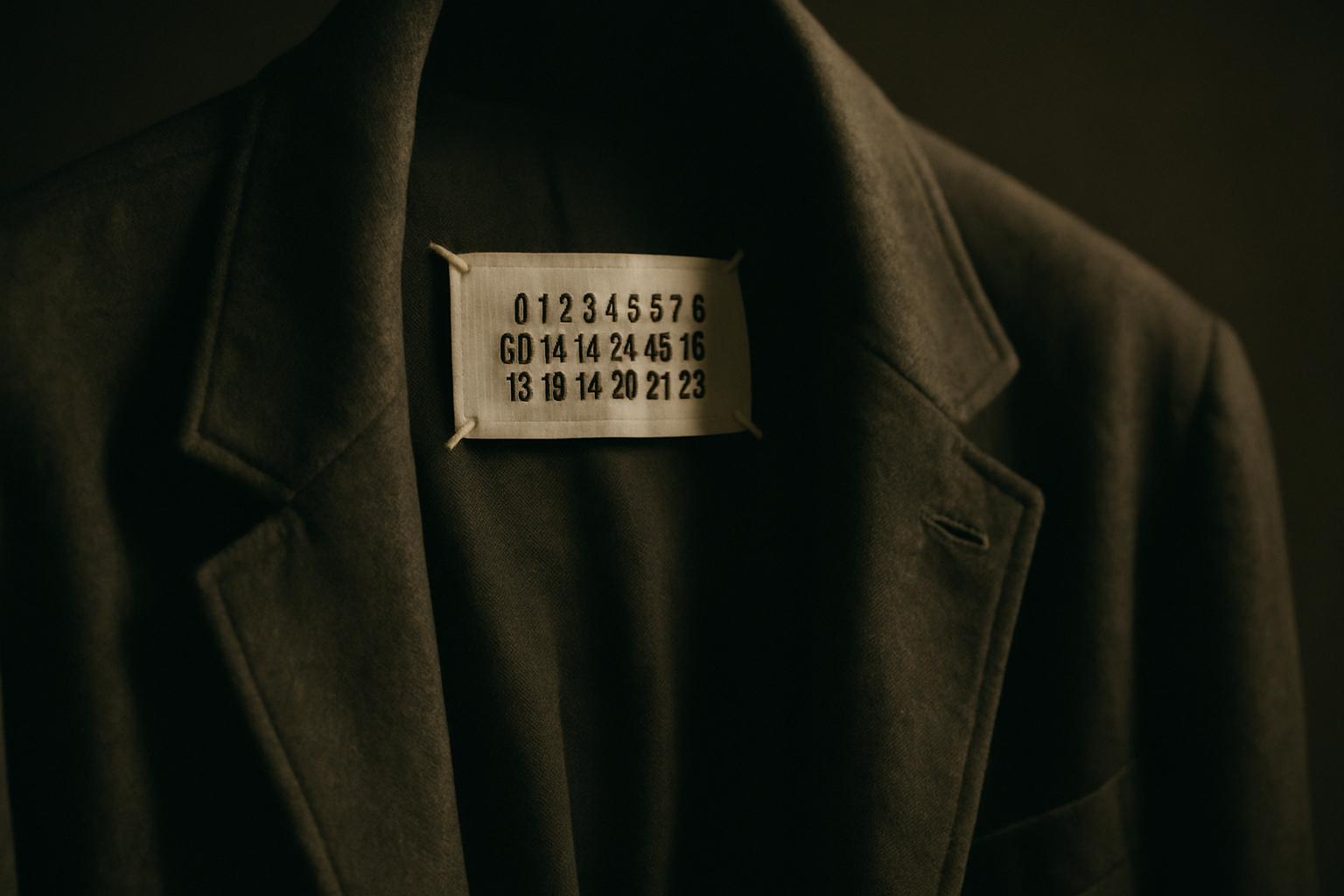
The white label has four stitches at each corner. The numbers are printed in a circle: 0, 1, 10, 14, 22. One number is circled in black marker. That is the line. The label is blank otherwise. No name. The garment speaks, or it does not.
Martin Margiela founded the house in Paris in 1988 with Jenny Meirens. He had worked under Jean Paul Gaultier. He knew how to cut. What he proposed was different: fashion as a system that could be examined, dismantled, shown for what it was. The first collection opened with a white cotton shirt. The seams were on the outside. The stitching was visible. So was the process.
Early shows were not held in salons. Spring 1989 took place in a children's playground in the 20th arrondissement. Models walked on gravel and tanbark. Autumn 1989 was shown in a Salvation Army depot in the 18th. The location was part of the statement. Fashion did not need gilt chairs and chandeliers. It needed a surface to walk on and people willing to look.
The Tabi boot appeared in that first collection. Margiela had seen the split-toe shape in Tokyo years before. The boot references a fifteenth-century Japanese sock. It is not subtle. The cleft bisects the foot at the big toe. Forty years later, it remains in the permanent collection. That is not nostalgia. It is architectural.
The anonymous years
Margiela did not take a bow. He did not give interviews on camera. He did not appear in photographs. The house communicated by fax. Statements came from the collective, not the individual. This was not shyness. It was method.
The garments carried the argument. Autumn 1990 featured a waistcoat made from a vintage dress, the original print and darts still visible. Spring 1991 included a jacket constructed from a leather military belt, buckles intact. These were not samples or sketches. They were sold in the collection. The technique was called 'Artisanal'—line 0 on the label. Each piece was unique. Each piece showed its own history.
The house also worked with deadstock and industrial materials. Autumn 1997 introduced a sweater made from socks, seamed together at the cuffs and toes. The texture was deliberate. So was the reference to making do, to garments as assemblage rather than luxury. Margiela sold at Dover Street Market and high-end boutiques, but the work consistently asked what luxury was for, and whether it required newness.
In 1997, the house began its collaboration with Hermès. Margiela was appointed to design the women's ready-to-wear line. He stayed until 2003. The work was quiet. He brought his approach to proportion and negative space, but he did not bring the deconstruction. Hermès did not need its seams exposed. The partnership was proof that the same hand could do both: avant-garde interrogation and restrained elegance. They are not opposites. They require the same understanding of structure.
Margiela left his own house in 2009. The departure was announced by press release. No explanation, no farewell collection. The atelier continued. The label remained blank.
The interregnum
For five years, the house operated without a named creative director. The team worked from Margiela's codes: the Tabi, the Artisanal line, the oversized blazer, the exposed seam, the garment remade from another garment. Collections were credited to the maison's design team. They were competent. They lacked a centre.
This is not unusual. Many houses survive their founders by becoming museums of themselves. They reproduce the gestures. They do not ask new questions. Maison Margiela during this period was careful. It protected the archive. It did not risk the archive by adding to it.
John Galliano was appointed creative director in October 2014. The choice was not obvious. Galliano had been dismissed from Dior in 2011 after a widely reported incident in Paris. His return to fashion was contested. Some in the industry argued that talent outweighed conduct. Others did not.
Galliano's first Artisanal collection for Margiela appeared in January 2015. It opened with a coat in pale powder blue, the shoulders exaggerated, the sleeves wrapped in tulle and ribbon like a mummy or a ballerina. The silhouette was his. The technique—layering, wrapping, exposing the construction—was Margiela's. The collection asked whether one designer could inhabit the codes of another without erasing them.
The Galliano era
Galliano's work at Margiela is not deconstruction. It is accumulation. He takes the house's vocabulary—the Tabi, the blank label, the repurposed garment—and builds on it until it becomes theater. His Artisanal shows are spectacle. Models walk slowly. The clothes are layered to the point of architecture. A jacket is also a cape, a corset, a sculpture. The body is still there, but it is mediated by fabric, volume, history.
The Spring 2016 Artisanal collection featured a series of looks built around vintage garments pulled apart and resewn. A 1950s dress became a bodice with the skirt reconstructed as a train. A men's suit was sliced and layered over a gown. The technique was Margiela's Artisanal line. The drama was Galliano's. He does not make quiet clothes.
His ready-to-wear collections are more restrained, but they carry the same interest in proportion and transformation. Autumn 2018 introduced the 'Glam Slam' bag, a quilted shoulder style that compresses flat when empty. The shape references both Margiela's interest in industrial materials and Galliano's interest in texture. It became a commercial success. The house needed that.
Galliano has also leaned into the Tabi as a signature. The boot now appears in patent leather, denim, satin, metallics. There are Tabi sneakers, Tabi mules, Tabi pumps. The split toe has become a logo, which is precisely what Margiela avoided. But it is also what keeps the house legible in a market where legibility is currency.
The tension is real. Margiela built a house that refused spectacle, refused the designer's face, refused the idea that fashion needed to announce itself. Galliano is a designer who works in spectacle. His shows are events. His references are operatic: Marchesa Casati, the Ballets Russes, Leigh Bowery, the London club scene of the 1980s. He does not disappear into the work. The work is inseparable from his return, his rehabilitation, his presence.
Some argue that Galliano has saved the house by making it commercially viable. Others argue that he has turned it into something it was not meant to be. Both are true.
What remains
The atelier still produces the Artisanal line. Each piece is still unique. The construction is still visible. The white label still has four stitches at each corner. The number is still circled in marker.
Margiela's work was a proposal: fashion could be intelligent, self-aware, skeptical of its own mythology. Galliano's work is a counter-proposal: fashion is mythology, and mythology requires a storyteller. The house now holds both. It is not a resolution. It is a conversation between two ideas about what a garment should do.
The Tabi boot is still in production. The split toe still divides the foot. People still stop on the street to look at it. That is the work of a shape that does not compromise. Forty years is not a long time for a building. It is a long time for a boot.