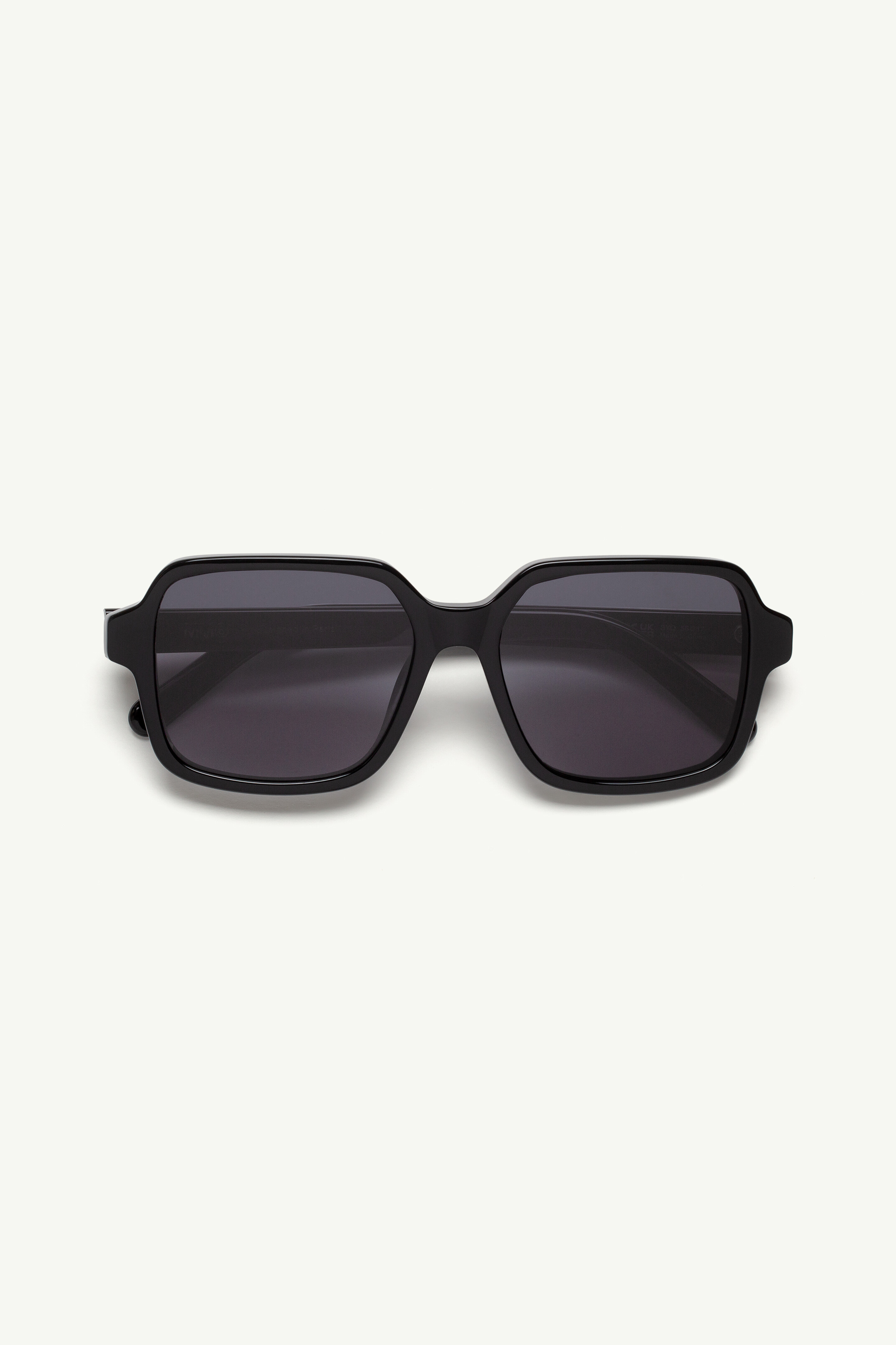
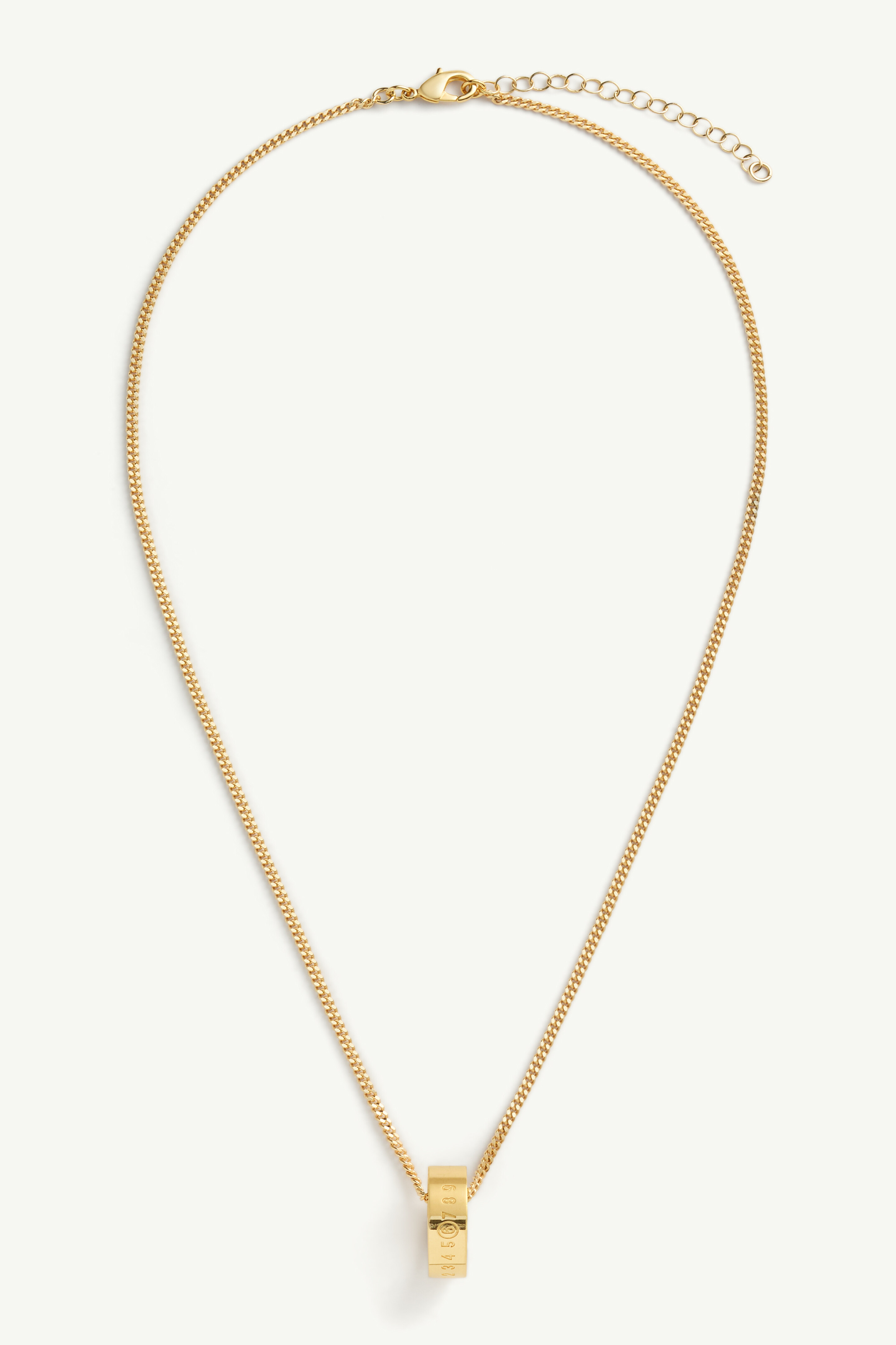
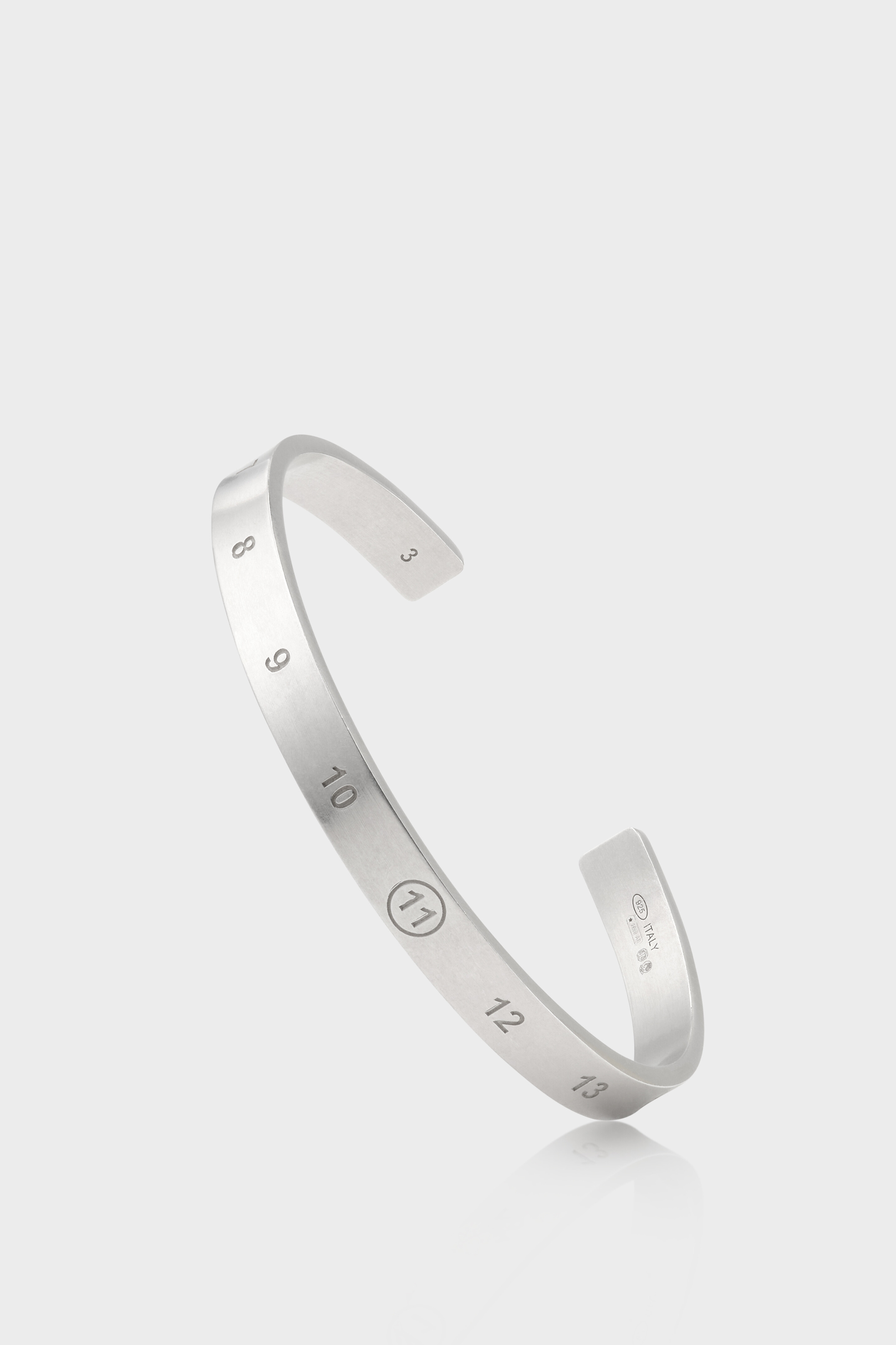
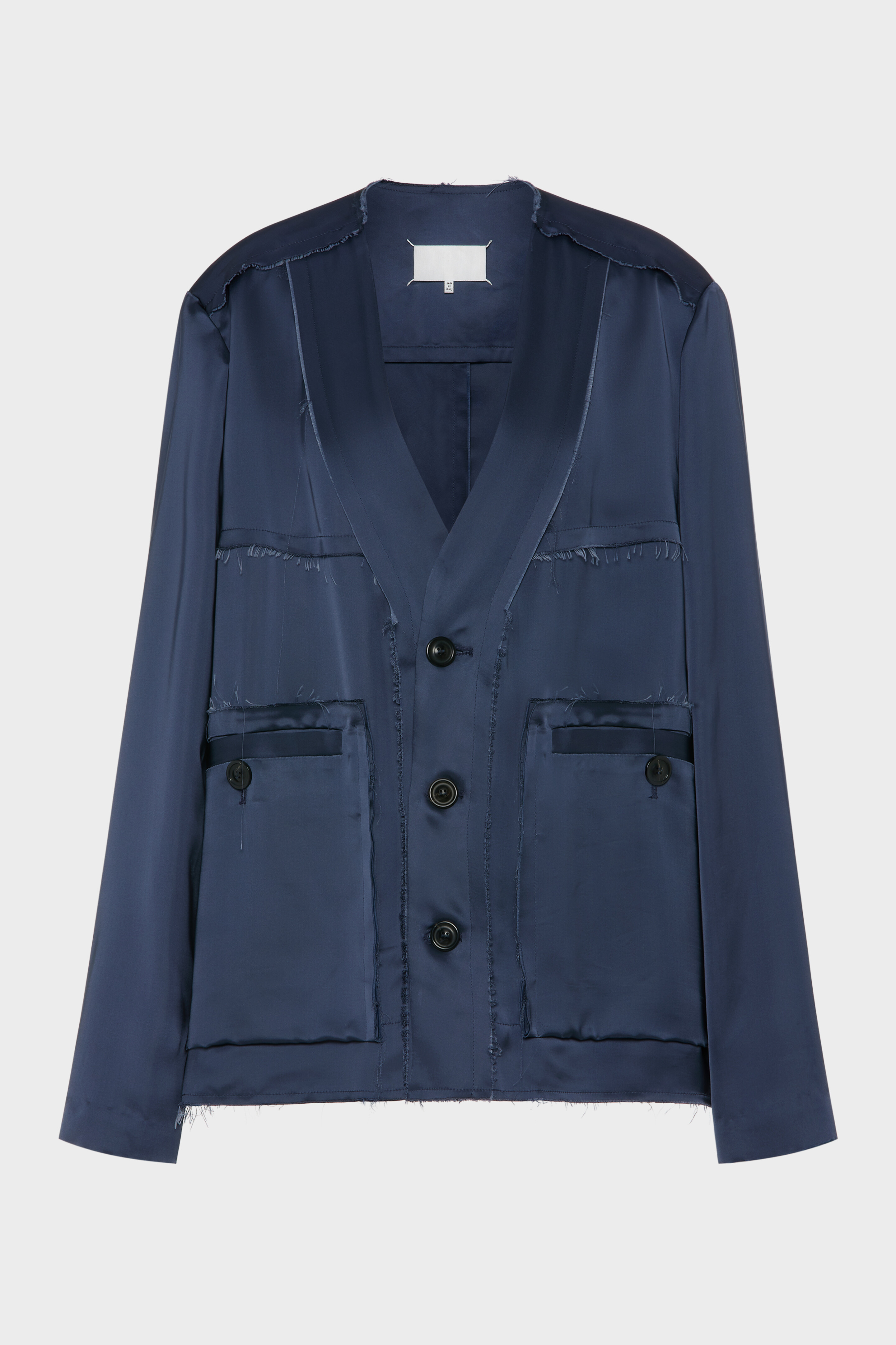
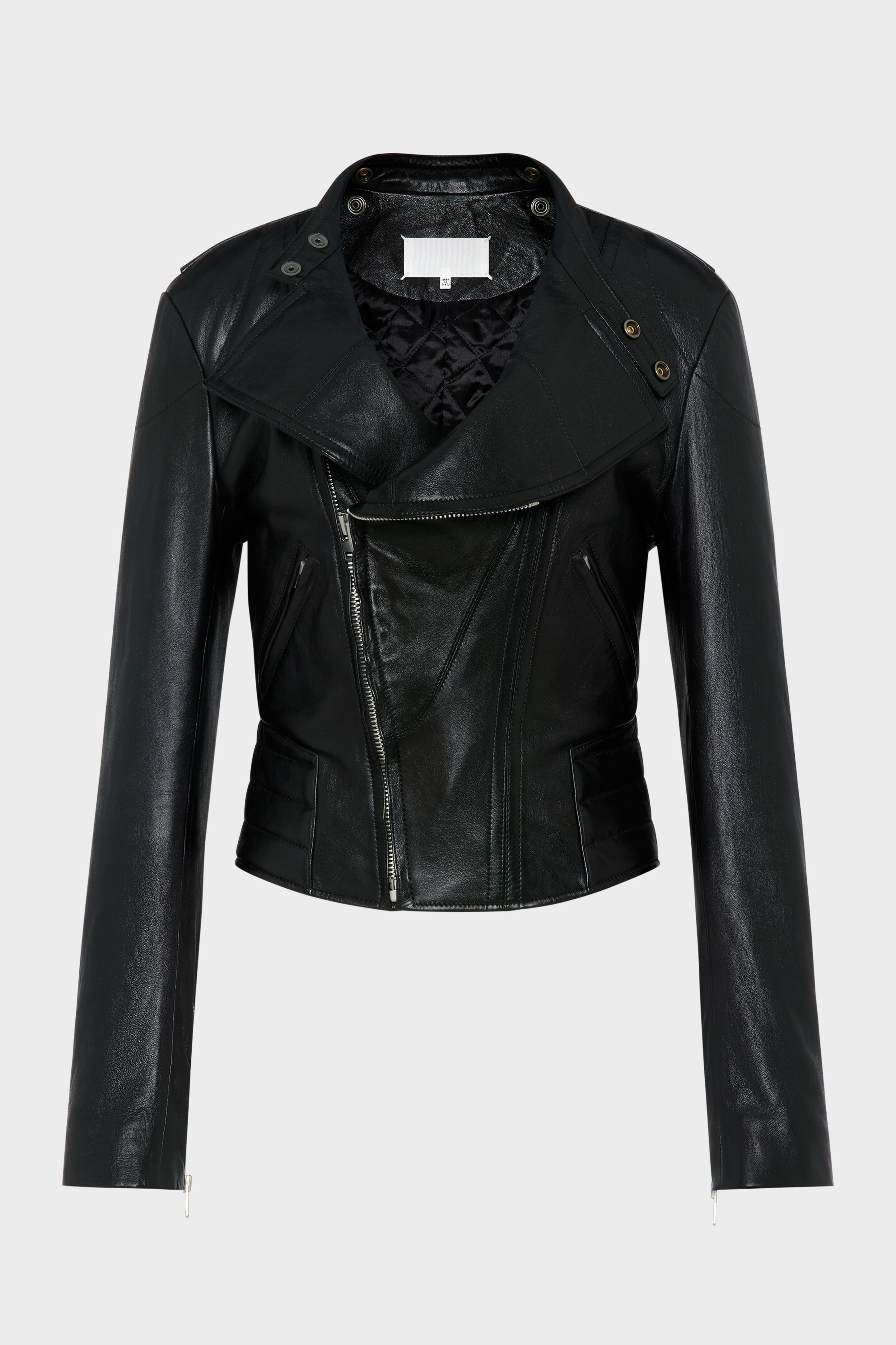
The white label has four stitches at each corner
The white label has four stitches at each corner. The garment number is handwritten in a circle. The label itself is blank — no logo, no name. This is the signature of a house that spent its first decade refusing to put its name on anything.
Maison Margiela opened in 1988 with a spring collection shown in a children's playground in the 20th arrondissement. Martin Margiela, who had left Gaultier's studio the year before, presented clothes that looked like they had been made from other clothes. Sleeves were reattached at odd angles. Linings became exteriors. A waistcoat was a deconstructed trench. The models wore Tabi boots — split-toe, borrowed from Japanese workers — and walked on gravel.
The press did not know what to make of it. Some thought it was poverty. Others saw a manifesto. Margiela gave no interviews, appeared in no photographs, and issued statements only through fax. The atelier was in a former garage in the 11th. The shows continued in non-fashion spaces: empty lots, Metro stations, a Salvation Army depot. In 1997, the house staged a show in which every garment was a reproduction of a previous season's piece, sewn in grey fabric and sprayed with mould and bacteria. The collection was left to decay over four weeks, then shown.
This was not rebellion for its own sake. It was a deliberate dismantling of fashion's mythologies — the cult of the designer, the newness imperative, the idea that a garment's value came from its logo rather than its construction. Margiela's work in those years read as both critique and craft. The Tabi became a house signature not because it was eccentric but because it was structurally coherent. The cleft toe changed the balance of the foot. It required the wearer to walk differently.
The Replica era and the question of authorship
In 1994, Margiela introduced a line called Replica. Each piece reproduced a found garment — a German army trainer, a French deck shoe, an American painter's smock — with forensic accuracy. The originals were often military surplus or workwear, things designed for function rather than fashion. Margiela's versions were identical in cut and material, but made new and sold at a luxury price point.
The line troubled the usual logic. If the design was not original, what were you buying? The house's answer was that you were buying the act of preservation. Replica garments carried a label that listed the original item's country, decade, and type. A 1950s Austrian army trainer. A 1970s Italian deck shoe. The label acknowledged the source, then offered the garment again, removed from its context but retaining its form.
This approach extended across the maison's output. The Autumn-Winter 1996 collection featured garments made from vintage clothes, cut apart and reassembled. A coat might contain pieces of five different coats. The stitching was visible, the seams exposed. In 1999, the house showed a collection in which every piece was oversized, as if made for a body twice the wearer's dimensions. The silhouette was not about proportion. It was about the space between cloth and skin.
Martin Margiela left the house in 2009. He had been absent from fittings for several years, working through his team. The departure was announced in a single-line statement. No retrospective, no farewell collection. The atelier continued without him, designing under the collective name of the house. For five years, Maison Margiela operated with no credited creative director — a structure almost without precedent in luxury fashion.
Galliano and the Artisanal line
John Galliano was appointed creative director in 2014. The choice seemed, at first, contradictory. Galliano's work at Dior had been theatrical, romantic, built on historical pastiche and narrative excess. Margiela's language was reductive, conceptual, concerned with the garment as object rather than story.
But Galliano understood the house's grammar. His first collection for Margiela, shown in January 2015, opened with a series of coats that appeared to be disintegrating. The hems were unfinished. The linings hung loose. On closer inspection, the fraying was deliberate — edges had been carefully distressed, threads pulled one by one. The technique was couture-level, applied to the appearance of ruin.
Galliano's work at Margiela has centred on the Artisanal line, the house's couture-adjacent offering. These are one-off pieces, shown twice a year, never produced for retail. A jacket might be made from a deconstructed 18th-century frock coat, its brocade panels reassembled over a modern shoulder. A gown could be constructed entirely from gloves, each finger stitched to the next. The Artisanal collections read as both homage and expansion. They take Margiela's foundational ideas — deconstruction, transformation, the refusal of newness — and push them toward spectacle.
The Tabi has remained. Galliano has produced it in patent leather, in denim, in thigh-high silhouettes that approach fetish wear. The split toe is unchanged. The boot still announces itself before the wearer enters the room. In recent seasons, the house has introduced Tabi pumps, Tabi loafers, Tabi ballet flats. The line now includes over sixty variations. This is not dilution. It is the same structural idea, tested across every possible application.
What holds
Maison Margiela is now owned by OTB Group, which also holds Diesel and Viktor & Rolf. The house operates boutiques in eighteen countries. The Replica line includes sneakers that sell in the four figures. The white label is still blank, still hand-stitched, but it now appears on products that move through the same retail channels as every other luxury brand.
The contradiction is the point. A house founded on anonymity now has a creative director whose name is as recognisable as the maison's. A label that rejected logos now produces logo-stamped card holders and phone cases. The Artisanal collections, which exist outside commerce, fund a ready-to-wear line that is entirely commercial.
What remains consistent is the treatment of the garment itself. A Margiela coat, whether from 1991 or 2024, is still constructed with exposed seams. The stitching is still visible. The process is still part of the product. Galliano's Artisanal pieces are more baroque than Martin Margiela's early work, but they share a method: take an existing object, dismantle it, rebuild it into something that holds both its original form and its transformation.
There is a photograph from the Spring-Summer 1996 show. A model wears a dress that is also a doll's dress, scaled up to human proportions. The fabric is stiff, the silhouette cartoonish. She stands in an empty Metro station, fluorescent light overhead. No audience is visible. The image could be documentation or performance or both. That ambiguity — between garment and concept, between fashion and art, between the thing and the idea of the thing — is what the house has carried forward. Thirty-six years later, the white label still has no name on it. You know what it is anyway.