The white thread is still there
The white thread is still there. Four stitches, loose at the back seam, trailing a centimetre or so beyond the garment's edge. It marks nothing. It secures nothing. It simply announces that this piece was made by hand, that someone finished the seam and left the thread long on purpose. Most buyers snip it off within a week. Some keep it for years.
That thread — the fil blanc — might be Maison Margiela's quietest signature. Not the Tabi boot, not the deconstructed blazer, not the label stitched to the outside like a hospital tag. Just four white stitches that say: we made this, and we're not hiding the fact.
It's easy to miss. The house has built a vocabulary so widely copied that its actual codes have become invisible. Everyone knows the split-toe boot. Fewer people notice the way Margiela numbers its collections zero through twenty-three, each line a distinct proposition rather than a seasonal drop. Fewer still register the refusal to photograph a face in campaign imagery, or the fact that the runway used to end with models walking backwards out of the room.
These aren't affectations. They're structure. And they predate the logo T-shirt by two decades.
A house built on refusal
Martin Margiela opened the maison in 1988 with Jenny Meirens, showing his first collection in a disused playground in the 20th arrondissement. The models wore flats. The clothes were deconstructed in the literal sense: linings exposed, seams unfinished, armholes dropped to show how a sleeve attached. He wasn't making a point about deconstruction as theory. He was showing you how the garment worked.
The first collection included a waistcoat made from a military sock, sleeves fashioned from glove leather, and a series of coats that looked like they'd been turned inside out because they had been. Margiela was interested in the space between the body and the cloth, and in making that space visible. He lined jackets in silk so fine you could see the canvas beneath. He left pocket bags hanging. He used trompe-l'œil prints of wrinkled fabric on flat jersey, collapsing the difference between real and represented.
The white label came later, in 1989. Four blank cotton rectangles stitched to the outside of the garment, meant to be written on by the retailer. No logo, no name. The house didn't give interviews. Margiela himself never appeared for a bow. Press materials listed him as 'the design team'. His face was not photographed for publication until after he left the maison in 2009.
This wasn't shyness. It was method. If the designer's biography became the story, the clothes became secondary. Margiela wanted the work to speak first.
The codes that didn't travel
The Tabi travelled. The boot, based on a fifteenth-century Japanese sock, appeared in the debut collection and hasn't left. It's been done in patent, in canvas, in shearling, in metallics. It is, at this point, legible from across a street.
But the Tabi was never meant to be the only signature. Margiela built a system of recurring gestures, most of which require you to handle the garment or see it on a body in motion. The oversized tailoring, for instance, wasn't about volume for its own sake. It was about proportion — specifically, the way an XXL men's blazer falls on a woman's frame, creating new lines at the waist and shoulder that a fitted cut never would.
The maison used this principle everywhere. Sweaters were sized four steps too large and belted at the hip. Trousers pooled at the ankle not because hems were left unfinished, but because they were cut for a body ten centimetres taller. The fit was always deliberate, never accidental, and it required the wearer to understand that 'correct' sizing was irrelevant.
Then there's the matter of replica garments. From 1994 onward, Margiela produced a line — Collection 0 — that reproduced vintage pieces stitch for stitch. A 1950s lab coat. A 1960s denim jacket. A 1970s anorak. These weren't inspired-by pieces. They were exact copies, down to the original fabric weight and button placement, made in the same factories that produced the house's main line. Each came with a blank label and no indication of what it was replicating. You had to know.
The gesture was arch and sincere at once. It said: good design doesn't expire. It also said: we can make this better than the original, and we won't tell you which is which.
Collection 0 still exists. It's still numbered zero. Almost no one outside the house talks about it.
Galliano's Margiela
John Galliano took over as creative director in 2014, arriving from a decade-long exile after his dismissal from Dior. The appointment looked, on paper, like a mismatch. Galliano's work had always been maximal, narrative-driven, soaked in historical reference and theatrical gesture. Margiela's vocabulary was reductive, anonymous, focused on the garment rather than the story around it.
But Galliano understood something crucial: Margiela's codes were techniques, not aesthetics. The house had never dictated a look. It had built a method — deconstruction, reconstruction, exposure of process, refusal of authorship — and that method could absorb almost anything.
His first collection, shown in January 2015, opened with a coat that appeared to be held together by masking tape. It wasn't tape. It was leather, cut and stitched to look like tape, then treated to mimic the matte finish and slight translucency of the real thing. The gesture was pure Margiela: trompe-l'œil as construction, the fake made more precise than the original. But the silhouette — a wrapped, kimono-sleeved coat over a body-con knit dress — was pure Galliano.
He's kept the white thread. He's kept the blank label. He's kept the numerical system and the refusal to shoot faces in campaigns. But he's also brought back the corset, the bias cut, the idea that a garment can tell a story about the body wearing it. His Margiela is louder than Martin's, more concerned with spectacle, less interested in disappearing. The spring 2025 couture show featured dresses that looked like they'd been dipped in plaster and left to dry on the body. The effect was arresting, unsettling, and nothing like the 1990s work. But the principle — expose the process, make the construction visible — was identical.
What remains
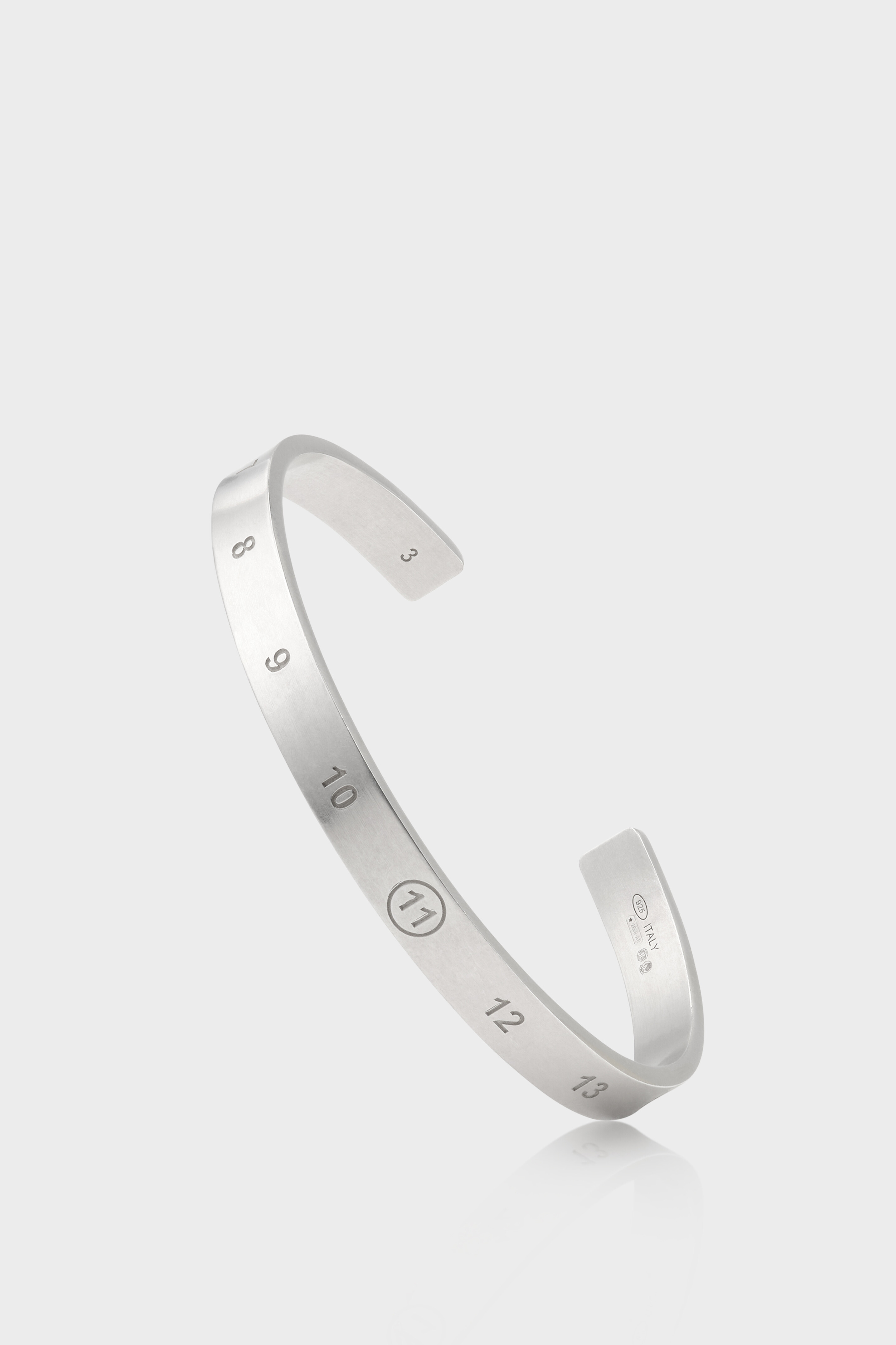
The maison still numbers its lines. Artisanal is 0. Womenswear is 1. Menswear is 10. Accessories is 11. The system is arbitrary and total, a taxonomy that makes sense only to people inside it. It's also still in place, thirty-six years on.
The white thread is still there, too. Not on every piece — it's technically part of the artisanal and mainline collections, not the diffusion or licensed goods — but on enough garments that you can find it if you're looking. Most people aren't looking. The house has become famous for other things: the Tabi, the couture spectacle, the Galliano comeback narrative. The quiet codes, the ones that require you to turn a jacket inside out or check the label placement or notice that a hem is unfinished on purpose, those have receded.
But they're still there. A few seasons ago, a friend bought a Margiela blazer from the men's line. Charcoal wool, single-breasted, nothing remarkable from the front. When he tried it on, the sleeves were four centimetres too long and the shoulder sat an inch past his natural line. He assumed he'd grabbed the wrong size. Then he noticed the white stitches at the back seam, still trailing loose, and understood. The fit was correct. He just had to learn how to wear it.