There is a nylon backpack in the permanent collection of the Museum of Modern Art in New York
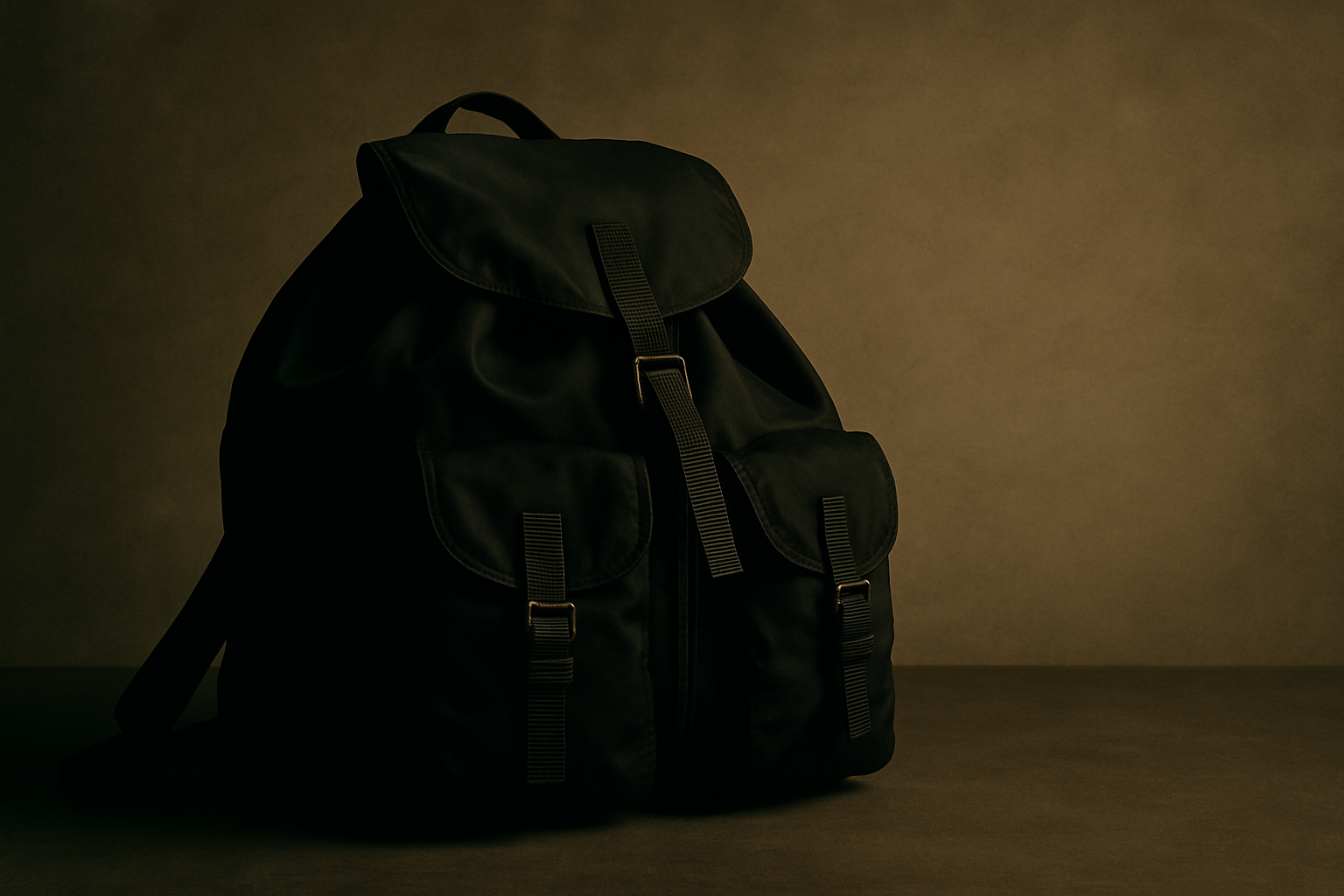
There is a nylon backpack in the permanent collection of the Museum of Modern Art in New York. Black, triangular logo, industrial webbing. Prada, 1984. One might walk past it — many do — but its presence there is not decorative. It marks the moment a Milanese leather-goods house looked at parachute cloth and decided that luxury need not announce itself in gold hardware and embossed hides.
That instinct, to question the terms luxury set for itself, runs through the house's 110-odd years. Not consistently, not without contradiction, but with enough force that Prada remains one of the few maisons whose archive feels like an argument rather than a greatest-hits reel.
Fratelli Prada, or: the leather years
Mario Prada opened a shop in the Galleria Vittorio Emanuele II in 1913. Fratelli Prada — Prada Brothers — sold English steamer trunks, handbags in walrus and crocodile, objects calibrated to the tastes of the Milanese bourgeoisie. Fine work, traditional in the way Milan understood tradition: well-made, discreet, expensive. The house supplied the Italian royal family. One imagines invoices on cream laid paper.
Mario's daughter Luisa took over in the late 1950s. She kept the atelier small, the materials luxe in the conventional sense. Prada remained what it had been: a competent producer of leather goods for a clientele that knew what it wanted and did not require persuasion. There are houses that thrive in this register for generations. Prada might have been one of them.
Instead, in 1978, Luisa handed the business to her daughter. Miuccia Prada had a doctorate in political science, five years in the Italian Communist Party, training in mime. She was not, by any measure one might apply in 1978, an obvious candidate to run a leather-goods atelier.
Pocone, or: the nylon years
The backpack entered production in 1984. Pocone — a heavy-duty nylon used in military tarpaulins — replaced calfskin. The shape was utilitarian, almost aggressively so. No logo save the small enamelled triangle, which in those years felt less like branding than like a quality-control stamp on industrial equipment.
It sold poorly at first. Then it didn't. By the late 1980s, that nylon bag had become the house's signature, which is to say it had become a problem Prada would spend the next decade solving. How does one build a luxury house on a fabric that costs less per metre than the lining in a conventional handbag?
The answer, worked out across the early 1990s, was to make luxury a question of ideas rather than materials. Miuccia Prada's first ready-to-wear collection arrived in 1988: brown, grey, black, shapes that refused the decade's taste for opulence. The silhouette was severe. The fabrics were often synthetic. Vogue, at the time, did not quite know what to do with it.
But by 1996, when the house opened its Rem Koolhaas-designed flagship in SoHo — all waxed zebrawood and translucent resin, a space that felt more like a gallery than a boutique — the terms had shifted. Prada had made intellectualism fashionable, or at least saleable. The nylon backpack, by then, retailed for $450. The fabric still cost pennies per metre. The margin was in the proposition.
Raf, or: the double-signature years
Miuccia Prada announced in 2020 that she would share creative direction with Raf Simons. Not a succession — a partnership. Two designers, equal billing, collections conceived in tandem. The fashion press, which loves a narrative of singular genius, did not quite know how to frame it.
The first co-signed collection appeared in September 2020, shown digitally due to the pandemic. It opened with a grey coat, oversized, worn over a pencil skirt. Then a bomber jacket in technical poplin, then a shearling anorak over a slip dress. The references pinballed: Simons' minimalist rigour, Prada's taste for dissonance, a shared interest in the uniform as a site of meaning.
What emerged was not a compromise but a syntax. Simons brought a certain romanticism — he has always been drawn to youth, to subcultures, to the idea that fashion might express something urgent — and Prada tempered it with her instinct for the perverse. A collection might open with austere suiting, then veer into cartoonish proportions, then land on something so quietly elegant it felt like an apology for the previous 40 looks.
The collaboration has now produced eight collections. They do not feel like Miuccia Prada's solo work, nor like Raf Simons'. They feel, instead, like two people working out in real time what luxury might mean to someone who came of age after the 2008 financial crisis, after Instagram, after the idea that a logo could be worth more than the object it adorned.
The house, now
Prada reported revenue of €4.2 billion in 2023. The Miu Miu brand — Miuccia's second line, launched in 1993 as a space for the ideas too playful or too strange for the main house — has become a commercial engine in its own right. The micro mini skirt from Miu Miu's spring 2022 collection generated enough demand that the house could not keep it in stock for six months. One can buy a nylon backpack, still, though the current iteration features Saffiano leather trim and retails for $1,850.
The house has not resolved the contradiction between its intellectual positioning and its commercial scale. One suspects it has no interest in doing so. A Prada show remains one of the few places in fashion where the front row might include a Booker Prize-winning novelist, a contemporary artist whose work sells for seven figures, and a 22-year-old whose TikTok account has 18 million followers. Whether that constitutes vision or opportunism depends, in the end, on whether one believes fashion can hold multiple ideas at once.
Miuccia Prada gave an interview in 2014 in which she said, "I always wanted to be different. I wanted to be not bourgeois." She was sitting, at the time, in the Prada headquarters in Milan, a building clad in gold leaf, designed by Koolhaas. The interviewer did not press the point.
But the contradiction is the point. A house that began by selling crocodile luggage to the Milanese elite, that made its name on industrial nylon, that now shows collections conceived by two designers who approach fashion from opposite ends of the same question — this is not a house that has changed direction. It is a house that has made instability its organizing principle.
There is a photograph from the spring 2021 show, the second Prada-Simons collaboration. A model walks a runway lined with hand-painted murals, wearing a boxy jacket in pale blue poplin over a skirt that stops mid-thigh. The jacket has epaulettes. The skirt has an asymmetric hem. Behind her, one of the murals shows a woman in profile, face turned away, expression unreadable. The model's face, by contrast, is blank in the way fashion models' faces are blank: a surface on which one might project almost anything. She is wearing flat sandals. She is not smiling. She looks, if one had to choose a word, unconvinced.