There is a photograph, dated 1967, of Jacqueline Kennedy in a white lace dress stepping off a yacht in Capri
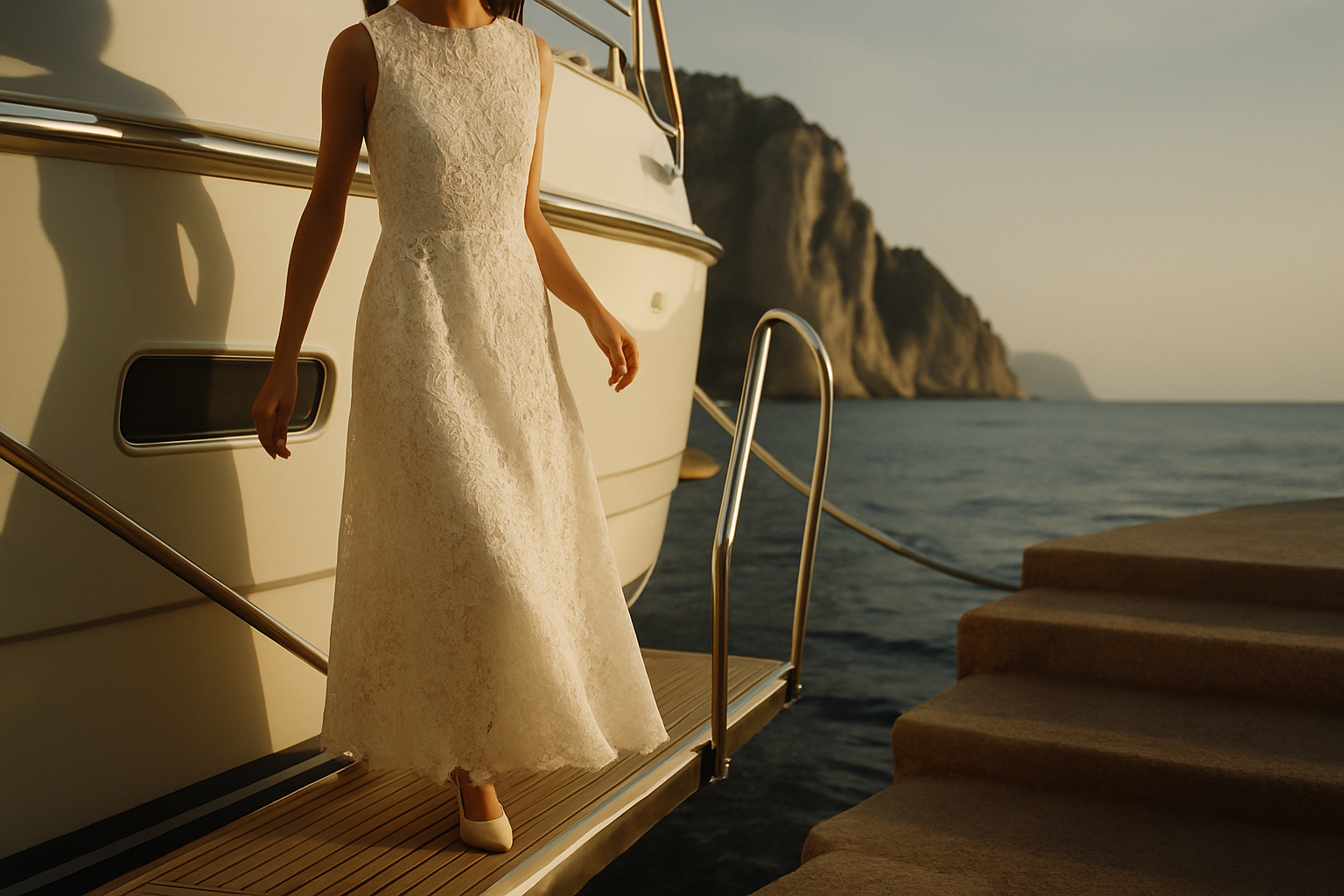
There is a photograph, dated 1967, of Jacqueline Kennedy in a white lace dress stepping off a yacht in Capri. The dress is Valentino. It appears in every retrospective of the house, always with the same caption: the beginning of everything. That is only half true. The beginning was a decade earlier, in a rented atelier on Via Condotti, with two seamstresses and a client list that did not yet include anyone who mattered. What the photograph marks is the moment when Valentino Garavani understood that his work would not simply dress women—it would enter the record.
He opened the house in 1960, twenty-eight years old, trained under Jean Dessès and Guy Laroche but fundamentally Roman in outlook. His first collection showed in the Pitti Palace in Florence. The silhouette was clean, the palette restrained, the tailoring exact. Italian fashion at the time was still working to distinguish itself from Paris, and Valentino's approach—couture construction with a lighter hand, dresses that moved without announcing themselves—was both a declaration and a hedge. He was not trying to out-French the French. He was building a vocabulary that would make sense in Rome, which meant understanding that elegance and spectacle were not the same thing.
The white dress on the yacht changed the terms. It was not the first piece Valentino made for Kennedy, but it was the one that fixed his name to a particular vision: restrained opulence, if such a thing exists. The lace was Valenciennes, the cut was simple, the effect was indelible. Valentino recognised that his client base—titled Europeans, American socialites, women whose lives were conducted in public—required clothes that photographed as well as they wore. This was not about trends. It was about building a uniform for a specific class at a specific moment, one that understood its own visibility.
The Red Era
By 1968, Valentino had introduced the shade that would become his signature. Rosso Valentino is not scarlet, not crimson, not vermillion. It sits somewhere between arterial and theatrical, a red that photographs darker than it appears in person and appears more saturated than any fabric has a right to be. The decision to claim a colour as intellectual property was audacious in the way only mid-century couture could manage. Yves Saint Laurent had his tuxedo, Balenciaga had his sleeve, Valentino had red.
The house's work through the seventies and eighties leaned into this. Evening gowns in silk faille, day dresses in wool crêpe, all in variants of that red or in white so stark it read as red's opposite. The construction was consistently excellent—Valentino had learned from Laroche how to set a sleeve, and he never forgot—but the house's real skill was in understanding proportion. A Valentino gown from 1978 does not look like a Valentino gown from 1985, but both share a particular relationship between bodice and skirt, between what is fitted and what is allowed to move.
This was also the era when Valentino became a name that meant something beyond the workroom. The house dressed Elizabeth Taylor, dressed Diana Vreeland, dressed women who understood that what they wore would be studied. The clothes were not neutral. They announced. But they announced in a register that felt, if not understated, then at least controlled. Valentino was building an archive, piece by piece, and he knew it.
The business grew accordingly. Licensing deals, ready-to-wear, fragrance, accessories. By the nineties, Valentino was no longer a couture house that happened to make other things—it was a brand with a couture division. The distinction matters. The work remained meticulous, but the context had shifted. A red gown on a runway in 1995 was competing not just with other couture houses but with the entire apparatus of fashion as spectacle. Valentino adapted. The silhouettes became more overtly romantic, more layered, more conscious of their own drama. The house was still making beautiful clothes, but it was also making an argument about what beautiful clothes should look like, and that argument was increasingly nostalgic.
Piccioli's Decade
When Pierpaolo Piccioli took sole creative control in 2016—after eight years as co-creative director with Maria Grazia Chiuri—the house had been without its founder for nearly a decade. Valentino himself had retired in 2008, and the intervening years under a series of creative directors had produced work that was competent but unmoored. Piccioli's first solo collection for Spring 2017 was a recalibration. He kept the red, kept the volume, but stripped out the historical reference. The silhouettes were simpler, the palette broader, the whole approach less concerned with what a Valentino dress was supposed to look like.
His tenure became defined by a kind of radical inclusivity that felt, at first, like a departure. Casting expanded. Colours multiplied. The haute couture collections, in particular, began to feel less like exercises in technique and more like arguments about who couture was for. A fuchsia cape over wide trousers. A yellow gown with a train that required two assistants. These were not clothes for women who lunched. They were clothes for women who wanted to be seen wanting to be seen.
Piccioli's work was technically assured—he had been at the house since 1999 and understood its language—but his real contribution was tonal. He made Valentino feel present tense. The house's archive was still there, still referenced, but it was no longer the point. The point was a kind of joyful maximalism that felt, paradoxically, more modern than the minimalism that had dominated the previous decade. By the time he showed his final collection in March 2024, Piccioli had spent nearly a quarter-century at Valentino and eight years as its sole creative voice. The house he left behind was solvent, visible, and in need of a new argument.
What Remains
Alessandro Michele's appointment in April 2024 was both surprising and inevitable. Surprising because his work at Gucci had been so entirely his own, so specific to that house's needs, that it was difficult to imagine it translating elsewhere. Inevitable because Valentino, like Gucci before Michele, needed someone who could generate a point of view loud enough to be heard over the noise.
His first collection, shown in September 2024, was a thesis statement. The silhouettes were softer than Piccioli's, more layered, more concerned with texture than with colour. The palette was muted—cream, grey, navy, with red appearing only twice. The casting was eclectic. The whole thing felt like Michele was attempting to locate some version of Valentino that predated the red era, some quieter iteration of the house that had existed in theory but never quite in practice.
Whether this works remains to be seen. Valentino's strength has always been its clarity—a clear colour, a clear silhouette, a clear sense of who it was dressing and why. Michele's Gucci succeeded because it replaced one kind of clarity with another. At Valentino, he is attempting something more difficult: to honour the archive while building something new, to reference the red without being defined by it, to make clothes that feel like Valentino without looking like Valentino.
There is a dress in the house's archive, circa 1982, in red silk faille with a fitted bodice and a skirt that falls in one unbroken line from waist to floor. It is not the most elaborate piece Valentino ever made, not the most photographed, not the one that appears in retrospectives. But it is the one that makes the argument most clearly: that a dress can be a single idea, executed without compromise, and that the idea is enough. Whether Michele, or whoever follows him, can articulate an idea that clear is the question the house now faces. The red is still there. The atelier is still there. What remains to be determined is what, exactly, they are in service of.