There is a photograph from 1954 in which Gabrielle Chanel is pinning a sleeve
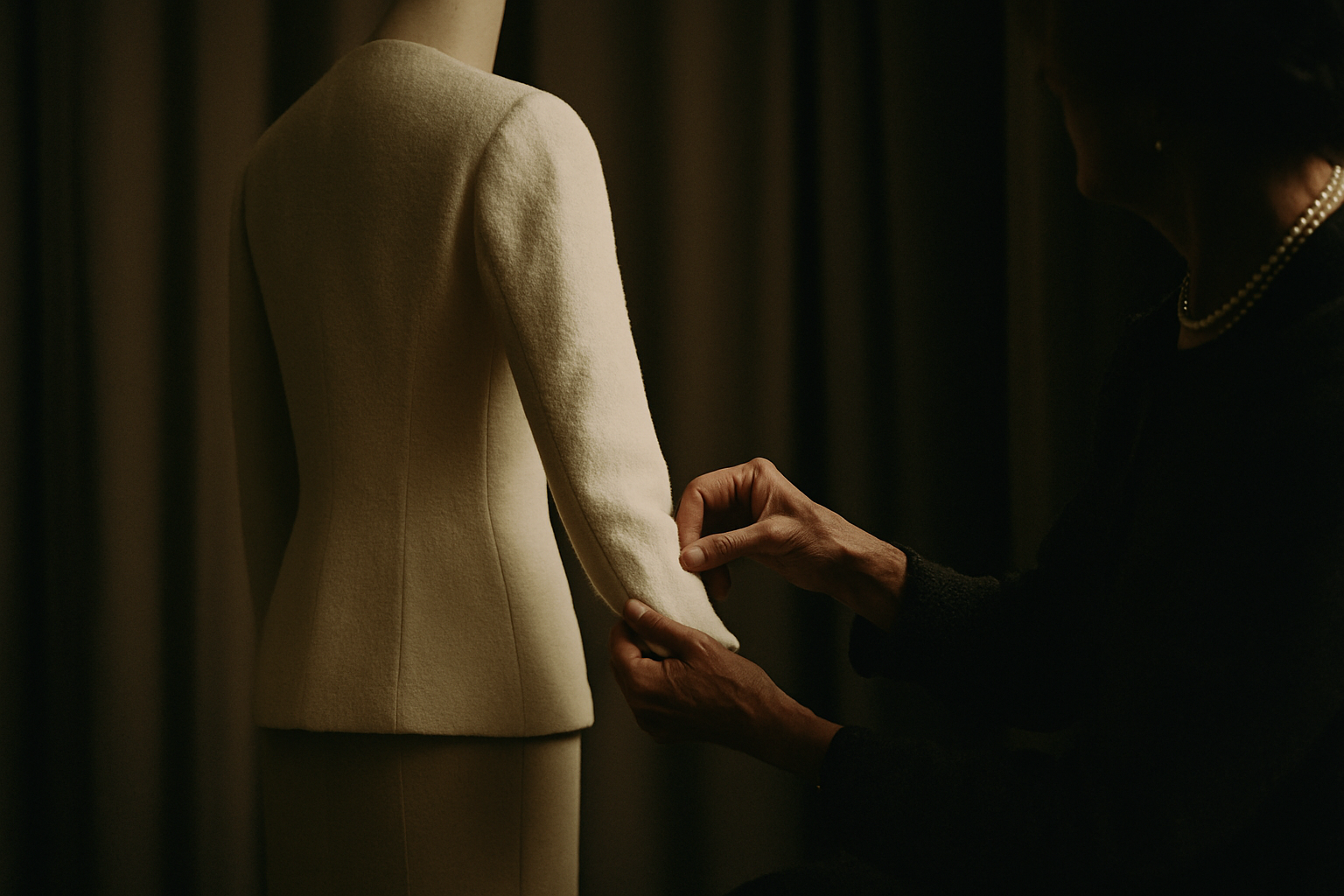
There is a photograph from 1954 in which Gabrielle Chanel is pinning a sleeve. She is seventy-one. The model stands very still. Chanel's hands are quick. The sleeve is wool jersey, and it will move when the woman moves, which is the point. This is not an atelier where clothes are built to photograph well on a statue. Chanel returned from exile that year, after fifteen years away, and staged a comeback collection the French press called a failure. American buyers disagreed. They ordered two hundred pieces.
What they recognised was a grammar that had never really left. Ease. Function. A refusal to treat women as decorative problems to be solved with boning and padding. Chanel had spent the 1920s stripping fashion down to what moved, and the 1950s proved the idea was durable.
The founding proposition
Gabrielle Chanel opened a hat shop in 1910, then a boutique in Deauville in 1913, then another in Biarritz in 1915. By 1920 she was designing clothes in Paris and the thesis was already clear: sportswear fabrications, clean lines, borrowed details from menswear. The little black dress arrived in 1926. Vogue called it "Chanel's Ford"—democratic, practical, destined to be everywhere.
The silhouette was radical because it wasn't. No corset. No fuss. Jersey, which had been underwear fabric, became daywear. Tweed, which had been Scottish countryside cloth, became suiting. Chanel made costume jewellery worth wearing and put women in sailor trousers on the Riviera. Her own wardrobe was a demonstration: she wore what she sold, and she moved freely in it.
The fragrance came in 1921. Chanel No. 5 was aldehydic, abstract, not named after a flower. Ernest Beaux had presented her with numbered samples. She chose the fifth. The bottle was a laboratory flask rendered in glass, rectangular and plain. It is still the most recognisable perfume bottle in the world, which suggests that legibility has commercial value.
By 1939, Chanel employed four thousand people. Then the war came. She closed the couture house, kept the fragrance business, and spent the Occupation in the Ritz with a German officer. The details are contested and unpleasant. In 1945 she went to Switzerland. She stayed there until 1954.
The return and the suit
The 1954 collection was shown on February 5th. The French critics were unkind. Chanel's shapes looked plain next to Dior's New Look, which had spent seven years teaching women to wear structure again. But American department stores saw something else: a suit that worked. Boxy jacket, soft shoulders, braid trim, patch pockets. A skirt that didn't fight the knee. The whole thing was cut to let a woman sit in a taxi, reach for a coat check, cross her legs at lunch.
Chanel refined the suit through the 1950s and into the 1960s. The formula: lightweight tweed, usually from Scotland. Chain weights sewn into the jacket hem so it wouldn't ride up. Silk lining in a contrasting colour, often printed. Four pockets. The effect was structure without stiffness, polish without fuss. It became the uniform of a particular kind of woman—one who had things to do and no interest in dressing as though she didn't.
The quilted handbag arrived in February 1955, hence 2.55 as its model name. The chain strap was borrowed from military kit. The burgundy lining was meant to recall the uniforms at the orphanage where Chanel spent part of her childhood. These origin stories are tidier than life usually is, but the bag itself was practical: hands-free, soft enough to compress, structured enough to hold its shape. It has been in production, with minor tweaks, for sixty-nine years.
Chanel died in 1971. She was eighty-seven, still working, still living at the Ritz. The house continued under a series of designers who kept the codes intact but didn't push them anywhere new. The suit remained. The quilted bag remained. The interlocking Cs remained. For a decade and a half, Chanel was a house with a very clear past and no obvious future.
Lagerfeld and the archive as engine
Karl Lagerfeld arrived in 1983. He had been at Chloé, Fendi, his own label. He understood that Chanel's vocabulary was not a constraint but a toolkit. The suit could be tweaked—hemlines shortened, shoulders broadened, fabrics mixed with denim or leather. The quilted bag could be reissued in new sizes and leathers. The camellia, the pearls, the chains: all of it could be played with, as long as the grammar held.
Lagerfeld's shows became spectacles. He built a supermarket inside the Grand Palais. He built a rocket ship. He built an iceberg. The clothes were often quieter than the sets, which was part of the strategy. Chanel under Lagerfeld was both archive and novelty, a house that could reference itself endlessly without seeming stuck. He produced eight collections a year for thirty-six years.
The business grew. Chanel is private, so revenue figures are partial, but by 2017 the house was reporting over $9 billion in sales. The suit, the 2.55, the Boy bag, the espadrilles, the tweeds: all of it was still selling, often to customers who had not been born when Gabrielle Chanel died. Lagerfeld had made the archive contemporary by treating it as raw material rather than scripture.
He died in February 2019. Virginie Viard, who had worked beside him for thirty years, was named creative director. The appointment was logical but not obvious. Viard had spent decades in the studio, not in front of cameras.
Viard and the question of now
Viard's Chanel is quieter. The sets are smaller. The tweeds are softer. The silhouettes are looser. There are fewer logos, fewer statement pieces, more clothes that resemble what women might actually wear on a Wednesday. This has been read, variously, as restraint, as timidity, as a return to Gabrielle Chanel's original pragmatism.
The collections reference the archive but do not perform it. A recent show featured cardigans over slip dresses, flat sandals, unstructured blazers. The tweeds were there, but they were lighter, less armoured. The critique from some corners has been that the clothes lack a clear point of view. The defence is that the point of view is clarity itself—Chanel as ease rather than spectacle.
The question facing the house now is whether ease is enough. Chanel remains one of the most profitable luxury brands in the world, but the fashion conversation has moved toward designers with a sharper thesis: Chemena Kamali at Chloé, Matthieu Blazy at Bottega Veneta, Jonathan Anderson at Loewe. These are designers who treat the archive as one reference among many, not the central subject. Viard is working within a narrower frame.
Chanel has always been a house that returns to itself. Gabrielle Chanel built a vocabulary in the 1920s, left, and came back to find it still worked. Lagerfeld spent thirty-six years remixing that vocabulary. Viard is now testing whether the vocabulary can hold without the remixing.
The house is still in Paris, still private, still showing eight collections a year. The ateliers are still staffed by petites mains who know how to set a sleeve in jersey, how to weight a hem, how to line a tweed jacket so it moves. There is a version of the future in which that knowledge is enough. There is another version in which it isn't.
For now, the suit is still in production. The 2.55 is still on arms in every city where there is money to spend on a handbag. And somewhere in the Chanel archive, there is probably still that photograph from 1954: Gabrielle Chanel, seventy-one, pinning a sleeve, refusing to treat fashion as anything other than a problem of movement.