There is a photograph from 1978 that captures the thing before anyone had a name for it
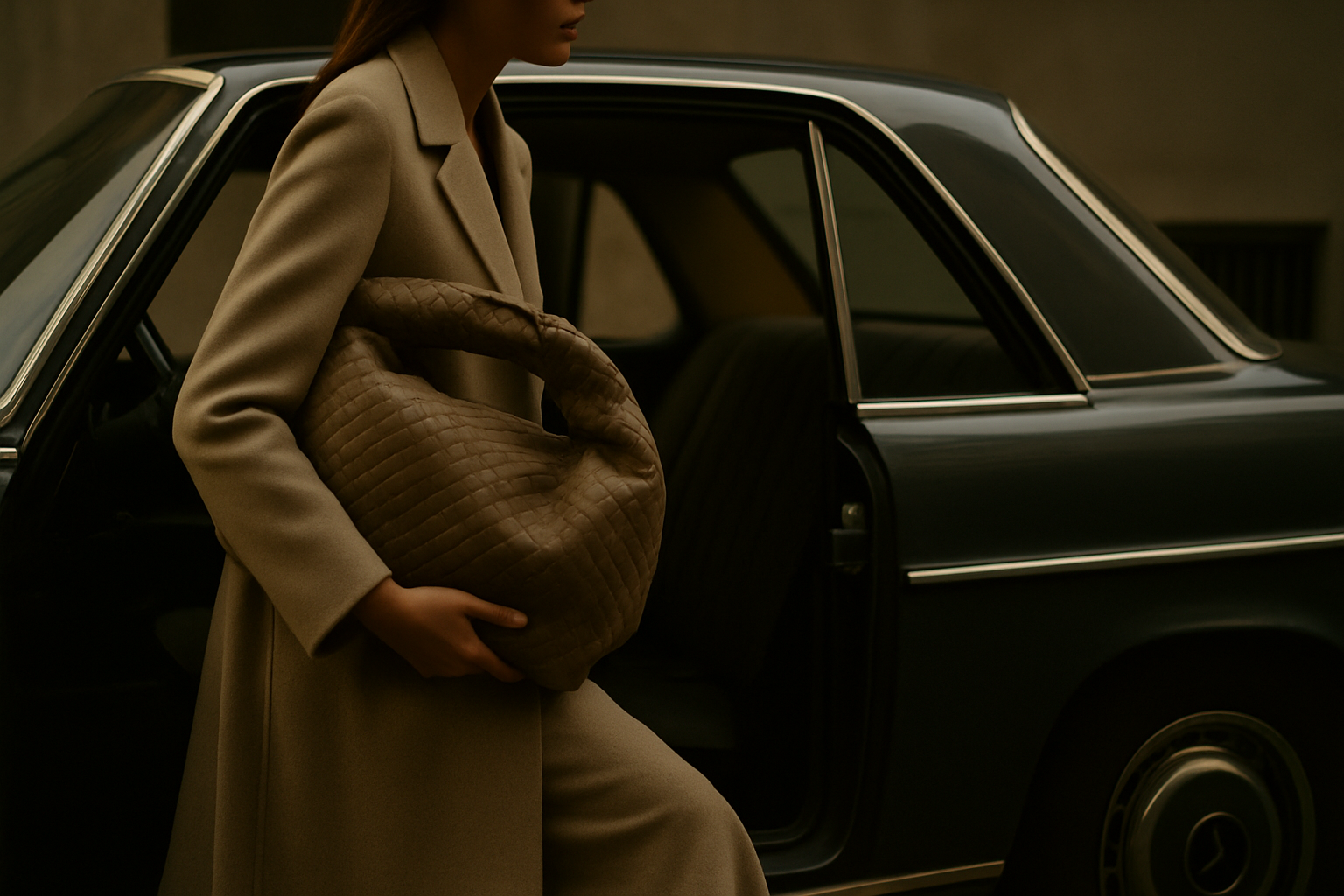
There is a photograph from 1978 that captures the thing before anyone had a name for it. A woman in Milan, stepping out of a car, holds a soft leather bag with no hardware, no logo, no clasp. The bag folds under her arm like cloth. It is, by every measure of the time, invisible. Within five years, that invisibility became the most legible status symbol in Europe.
Bottega Veneta has always worked this way. The house makes objects that whisper, then watches the whisper travel.
The Founding Intention
Michele Taddei and Renzo Zengiaro opened a leather goods workshop in Vicenza in 1966. The location mattered. Vicenza had tanneries, artisans who could execute intrecciato — the woven leather technique that would become the house signature — without fuss. Taddei and Zengiaro were not designers in the couture sense. They were producers who understood material and had access to craftsmen who could make a seam disappear.
The first bags were sold to American department stores under other labels. Bottega Veneta did not stamp its name on the outside of anything. The intrecciato itself was the mark: eight strips of nappa leather, woven tight, creating a surface that flexed without creasing. It was a structural solution that happened to be beautiful. The technique made the leather stronger and removed the need for lining in many pieces. Practical, then decorative.
By the mid-seventies, the house had its own label and a client base that understood the proposition. These were women who had stopped carrying monograms. The Bottega bag was the antimatter to logomania, which made it, perversely, more visible in certain rooms. An intrecciato Veneta hobo in bitter chocolate nappa became the handbag equivalent of a whispered recommendation. You either knew, or you didn't.
The advertising was minimal. The house opened a handful of boutiques in Europe and the U.S. but relied on word of mouth and the kind of editorial placement that didn't require a press release. By 1980, Bottega Veneta had become the brand for people who claimed not to care about brands. The irony was lost on no one, least of all the house, which leaned into it.
The Tomas Maier Rebuild
When Tomas Maier arrived in 2001, Bottega Veneta was in receivership. Gucci Group had acquired the house two years earlier and found a name with equity but no coherent product line. The intrecciato had been licensed into oblivion. There were Bottega Veneta keychains, Bottega Veneta golf bags, Bottega Veneta luggage sets that looked like they belonged in a different century. Maier's job was to make the house mean something again.
He started by throwing things out. The licenses were killed. The product range was cut by two thirds. Maier kept the intrecciato and the Veneta hobo and built everything else from there. He reintroduced the Cabat, a large tote with no internal structure, woven entirely by hand. It took a single artisan two days to complete one bag. Maier priced it accordingly and refused to make more than the atelier could produce. Scarcity, but the real kind.
The clothes came later, and they were quieter than the bags. Maier worked in cashmere, in bonded nappa, in duchesse satin that didn't announce itself. The silhouettes were simple to the point of severity: a slim trouser, a collarless jacket, a dress that skimmed rather than clung. The palette was earth, rust, forest, stone. Bottega Veneta became the house for people who wanted to spend a great deal of money looking like they hadn't thought about it.
Maier's tenure lasted 17 years. By the time he left in 2018, Bottega Veneta was generating over a billion euros in annual revenue and had become the reference point for an entire aesthetic register. Quiet luxury, stealth wealth, old money — the terms multiplied, but they all pointed back to the same place. Maier had taken a bankrupt leather goods workshop and turned it into the house that defined restraint.
The Daniel Lee Rupture
Daniel Lee did not continue the conversation. He ended it and started a new one.
Lee arrived in 2018, aged 32, from Celine, where he had worked under Phoebe Philo. The assumption was that he would extend the Maier line: more refinement, deeper quiet. Instead, Lee made the Pouch. It was an oversized clutch with a gathered top and no structure, rendered in butter nappa that looked like it might split if you looked at it wrong. It was vulgar in the best sense. The proportions were absurd. It worked.
The Pouch became the handbag of 2019, which meant it became the handbag of Instagram, which meant Bottega Veneta was suddenly visible in a way it had not been since the seventies. Lee followed it with the Padded Cassette, a puffy intrecciato crossbody that looked like a quilted pillow. Then came the Tire boots, chunky lug-sole Chelseas that weighed as much as the bags. Then the square-toe mules, the chain-mail shirts, the neon intrecciato, the collaborations with Tyrone Lebon and Gaetano Pesce.
Lee was not interested in stealth. He was interested in craft at high volume. The intrecciato was still there, but now it came in lime green and covered entire coats. The shapes were exaggerated, the textures extreme. A Bottega Veneta bag under Lee was still woven by hand, but it was also likely to be bright orange and large enough to require two hands. The house became loud, then became inescapable, then became the aesthetic reference point for a different kind of client. Younger, more digital, less invested in the idea of taste as a form of discretion.
Lee left in 2021. The reasons were never made public. By then, Bottega Veneta had doubled its revenue under his tenure and become the most searched luxury brand on Lyst. The house had gone from invisible to viral in three years.
Where It Stands
Matthieu Blazy took over in late 2021. He had been Lee's right hand, which suggested continuity, but Blazy's first collection felt like a correction. The volumes came down. The palette returned to earth. The intrecciato was still there, but now it appeared in trompe-l'oeil denim, in leather that looked like linen, in bags that resembled crumpled paper but were, in fact, meticulously structured nappa. Blazy kept the craft visible but made it strange.
His second collection featured a coat that looked like jeans but was made entirely of leather, each stitch and rivet hand-applied. It took 15 hours to make. It looked, from a distance, like something you could buy for 50 quid in Dalston. Up close, it was a technical marvel. This is where Bottega Veneta is now: making objects that require you to look twice, that reward proximity, that function as status symbols only if you know what you're looking at.
The house has not returned to Maier's quiet. It has not stayed in Lee's volume. Blazy is working somewhere between the two, in a register that acknowledges both the artisan workshop in Vicenza and the TikTok feed. The intrecciato is still woven by hand. The bags still have no logo. But now they come in shapes that look like mistakes until you hold them.
There is a bag in the current collection that appears to be made of folded paper. It is, in fact, calf leather, treated and shaped to hold a crease that will never flatten. It costs more than some people's monthly rent. It looks, from across the room, like something you folded on the Tube. That gap — between what it is and what it looks like — is where Bottega Veneta has always lived.