Tom Ford: a house, in brief
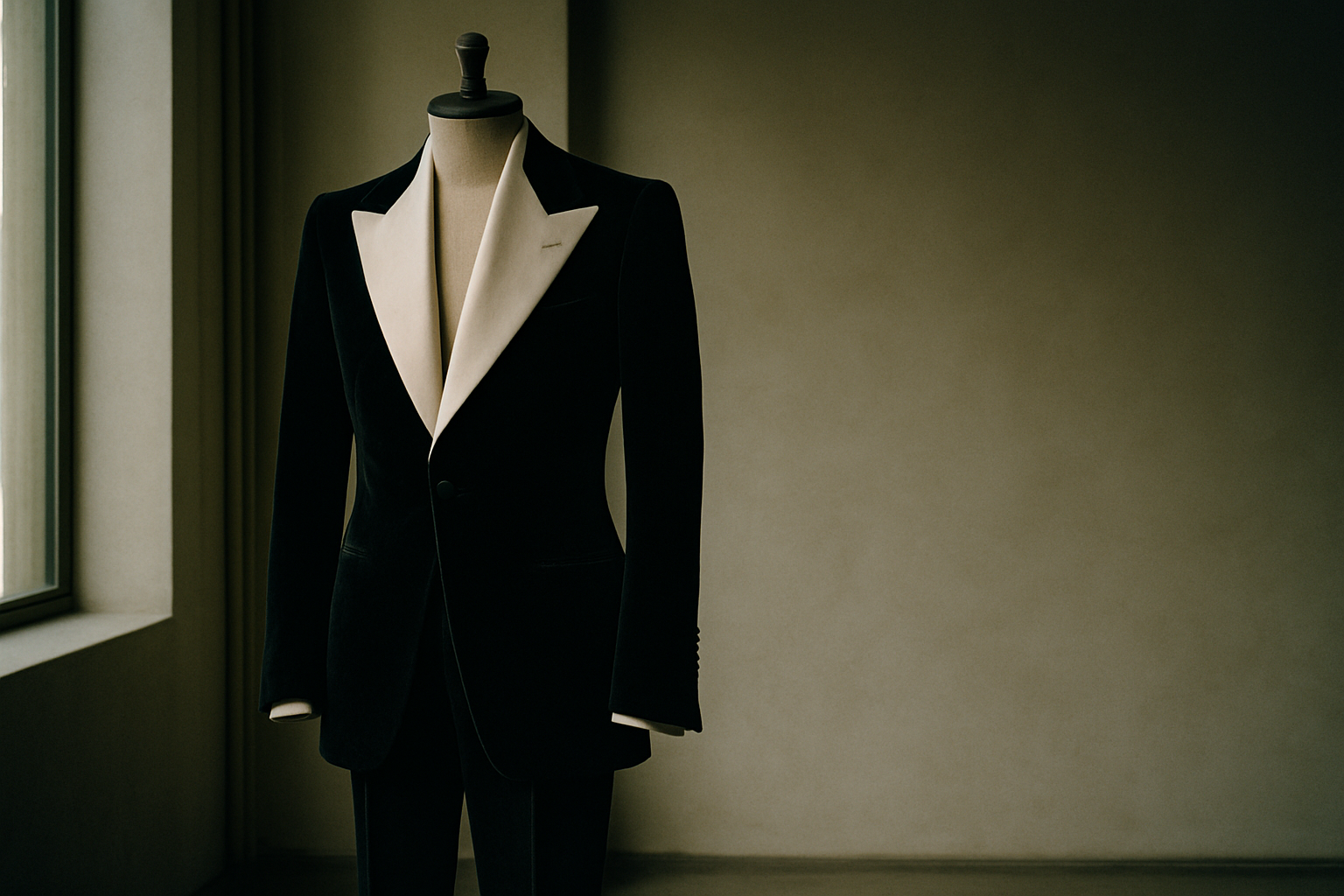
The black velvet suit Ford showed in his final collection for Gucci — Spring 2004, the one with the ivory satin lapels and a trouser leg so narrow the model had to walk like she was crossing a tightrope — sold out before it shipped. Not unusual for that period. What was unusual: it reappeared, identical cut, under the Tom Ford label two seasons later. Same mill, same pattern-cutter, different label. Ford had already started building the exit.
The Gucci Decade and the Myth of Rescue
Tom Ford joined Gucci in 1990 as chief women's ready-to-wear designer when the house was licensing its name to anything with a buckle. By 1994, he was creative director. By 1995, the Gucci loafer was no longer the punchline to a joke about divorced men in Boca Raton.
What Ford did wasn't subtle. He sexed up everything — the advertising, the velvet hipsters, the satin shirts unbuttoned past any reasonable latitude — and he did it at a moment when minimalism had turned so austere that Jil Sander's runway felt like a hospital corridor. The market wanted heat. Ford gave them heat with a credit line.
The numbers: Gucci's sales grew from $230 million in 1994 to $3 billion by 2003. Ford also took on Yves Saint Laurent in 1999, after Gucci Group acquired it, and ran both houses until his departure in 2004. YSL under Ford was divisive in the way only Paris can make divisive — the French press called it vulgar, which in that context meant effective. The rive gauche clients stayed away. The new clients, the ones buying the Mombasa bag and the Opium campaign imagery, didn't care what the rive gauche thought.
Ford's Gucci wasn't about restraint. It was about making desire look like a business plan. And it worked, because Ford understood that luxury in the late nineties wasn't about heritage or craft language. It was about looking like you had a better weekend than anyone else.
The Namesake House and the Problem of Translating Yourself
Tom Ford the brand launched in 2005, backed by Domenico De Sole, who had been Gucci Group's CEO during the Ford years. The first collection was menswear. The first store opened on Madison Avenue in 2007. The first women's ready-to-wear collection came in 2010, shown in New York during a season when most American designers were trying to prove they belonged in Paris.
Ford didn't try to prove anything. He showed at his own store, by appointment, with a guest list that read like a client roster. The clothes — liquid jersey gowns, sharply cut tuxedos, a lot of décolletage — looked like Ford's Gucci work but without the Gucci budget for spectacle. Which was the point. This was a house built for people who already knew what they wanted and were willing to pay for it quietly.
The business model was unusual. Ford kept production small, distribution tight, and relied on his own taste as the primary marketing vehicle. The eyewear and fragrance licenses — handled by Marcolin and Estée Lauder, respectively — did the volume work. Ready-to-wear and accessories stayed rarefied. A Tom Ford suit started at $4,000. A private label tuxedo started at $6,000 and required three fittings. The margins were extraordinary. The press access was minimal.
Ford also directed films — A Single Man in 2009, Nocturnal Animals in 2016 — which shouldn't have worked as brand strategy but did. The films looked like his campaigns, which looked like his stores, which looked like his clothes. It was total aesthetic control in a way that's nearly impossible to maintain once a house scales past a certain point. Ford kept it small enough to maintain it.
By 2022, the house was reportedly generating over $1 billion in annual revenue, most of it from beauty. The fashion side remained exclusive by design. Ford never did e-commerce for ready-to-wear. You had to go to the store, or you didn't get it.
The Estée Lauder Acquisition and What Happens Next
In November 2022, Estée Lauder Companies acquired Tom Ford for $2.8 billion. Ford stayed on as creative director through the end of 2023, then stepped back. The house announced in September 2023 that Haider Ackermann would take over as creative director, effective Spring 2024.
Ackermann is a capable appointment — his tailoring is clean, his sense of colour is specific, and he's worked at a scale that doesn't require a learning curve. But the challenge isn't whether Ackermann can design. The challenge is whether Tom Ford without Tom Ford can hold its position as a house defined entirely by one man's taste.
Ford built the brand as a direct expression of himself — not as a character or a persona, but as a literal translation of how he dressed, where he went, what he found attractive. That's not a strategy you can hand off. It's not a design language or a set of codes. It's a point of view, and points of view don't transfer cleanly.
Estée Lauder's interest is clear: they want to grow the fashion and accessories business using the same infrastructure that made the beauty line so profitable. That means more distribution, probably e-commerce, likely a broader price architecture. It also means the house will have to become something other than what it was — a small, tightly controlled operation that succeeded precisely because it didn't try to be everything to everyone.
Ackermann's first collection for Tom Ford showed in February 2024. The reviews were respectful. The clothes were accomplished. But the question isn't whether the new creative director can make good clothes. The question is whether a house built on one man's specific, unapologetic taste can survive the transition to a more diffuse, more market-driven version of itself.
The Velvet Suit, Again
That black velvet suit from Ford's final Gucci collection — the one that reappeared under his own label — eventually made it into the house archive. Not the Gucci archive. The Tom Ford archive, which Ford kept in a climate-controlled storage unit in Los Angeles. It sat there, along with samples from every collection he'd done under his own name, catalogued by season and fabric weight.
When Ford sold the company, the archive went with it. Estée Lauder now owns every sample, every pattern, every drape Ford ever approved. They own the velvet suit. They own the satin lapels. They own the way the trouser leg narrowed past the point of practical movement. They own all of it, which means they own none of it, because the thing that made those pieces matter wasn't the cut or the cloth. It was the fact that Ford made them for himself first, and sold them second. You can't acquire that. You can only license it for a while, and hope it doesn't dilute in translation.