Versace: a house, in brief
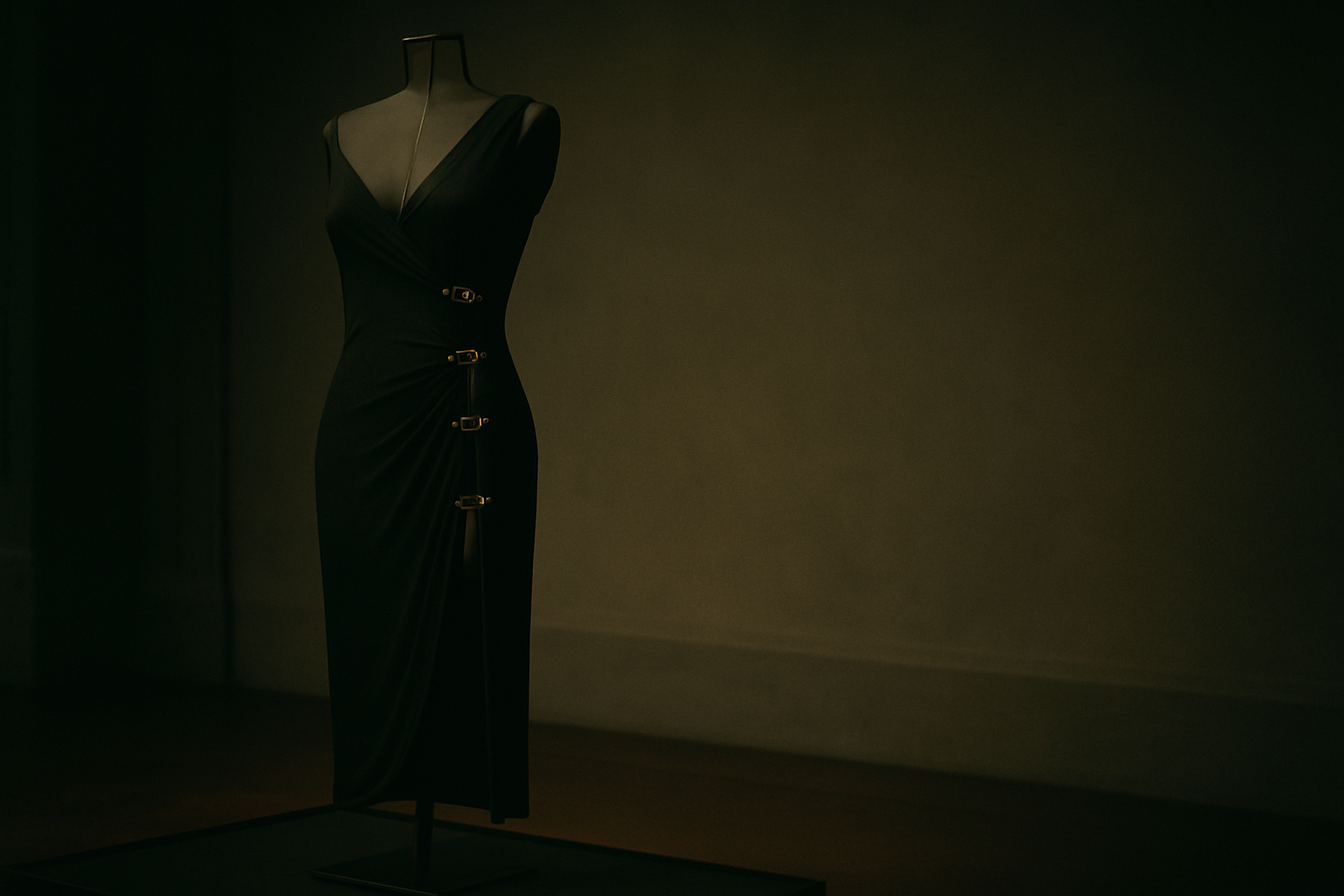
The safety pin dress sits in a vitrine at the V&A, mounted on an armature that cannot quite replicate the body it was made for. Black silk jersey, held together at the hip by gold pins the size of a thumb. One can see, even through museum glass, that the pins are not decorative — they are structural. Remove them and the garment collapses. It was worn once, in 1994, by Elizabeth Hurley on a red carpet, and it has been doing work ever since. Not the work of covering a body, but the work of announcing what Versace was, and in certain respects still is: a house that understood spectacle as a form of engineering.
Founding: via Reggio di Calabria
Gianni Versace opened his atelier in Milan in 1978, though the house's origins lie further south, in Reggio Calabria, where his mother ran a dressmaking shop. He learned construction there — pattern-making, draping, the mechanics of a bodice — but what he brought to Milan was something else. A taste for the baroque. An appetite for reference that ranged from Greek friezes to Warhol prints, often within the same collection. And a conviction, unusual at the time, that fashion could borrow from fine art without apology.
The early work was loud in a way that Milan was not. While Armani was building an empire on the controlled line and the muted palette, Versace was screen-printing Marilyn Monroe onto silk and cutting evening gowns that required both a body and a certain nerve to wear. The Medusa head, adopted as the house logo in 1980, was not subtle. It was a promise: look here and you will be changed, possibly against your will.
By the mid-eighties, Versace had become the preferred couturier of a specific class of celebrity — not the old Hollywood guard, but the supermodels who were themselves becoming famous in a new register. Naomi Campbell, Linda Evangelista, Christy Turlington. He dressed them, befriended them, and deployed them as a kind of living billboard. The runway shows were not presentations but events, choreographed to house music, lit like a nightclub, attended by people who did not typically attend fashion shows. It was, one suspects, the first time a maison had treated pop culture not as a threat to refinement but as a resource.
The construction underneath all that noise was serious. Versace worked in bias-cut silk jersey, a fabric that requires both precision and an understanding of how cloth moves against skin. The metal mesh evening gowns — aluminium discs linked by hand, each one articulated so the garment draped rather than clanked — were a technical feat that took months to produce. But the house did not lead with craft. It led with image, and the image was: more.
The Nineties: Oroton and After
If the eighties were about volume, the nineties were about control. Not restraint — Versace never did restraint — but a kind of calculated excess. The safety pin dress, shown in the Spring 1994 collection, is the most cited example, though it was not the only one. There were the bondage-strap gowns, the vinyl trench coats, the suits cut so sharp they read as armour. Gianni Versace had always understood that fashion was about power, but by the mid-nineties he was making it explicit.
The house also began to license aggressively. Versace Home, Versace fragrances, Versace eyewear. The Medusa head appeared on everything from bath towels to whisky tumblers, and while this was profitable, it also diluted the brand's position. By 1997, when Gianni was murdered outside his Miami Beach villa, Versace was both a creative force and a licensing behemoth, and it was not clear which would survive him.
Donatella Versace, his younger sister, took over as creative director. She had been involved in the house for years — Gianni often credited her with shaping the brand's image — but she had not designed a collection alone. The early work was uncertain. She leaned into what she knew: the gold hardware, the animal prints, the aggressively sexy silhouette. Critics were not kind. The clothes were called garish, retrograde, a pastiche of Gianni's greatest hits without the intellect that had animated them.
But Donatella had something her brother did not, which was a willingness to adapt. By the early 2000s, she was working with younger photographers, casting younger models, and acknowledging that the supermodel era was over. The clothes became, if not quieter, then more considered. She introduced denim, sportswear, a certain streetwise ease that had not been part of the Versace vocabulary before. It did not always work, but it kept the house in motion.
Present: Capri Holdings and the Question of Scale
In 2018, Michael Kors Holdings — since renamed Capri Holdings — acquired Versace for $2.1 billion. The deal was presented as a partnership, though the terms were clear: Versace would remain in Milan, Donatella would stay on as creative director, but the business would now answer to a New York-based conglomerate with a track record of turning heritage brands into accessible luxury.
The collections since have been competent. Donatella continues to mine the archive — the baroque prints, the Medusa, the safety pins reappear each season in slightly altered form — but there is a sense that the house is managing its past rather than building on it. The runway shows are still spectacles, still soundtracked, still closed by a lineup of models in logo-heavy looks. But the context has shifted. What read as transgressive in 1992 reads as nostalgia now, and nostalgia is a difficult place from which to make new work.
That said, there are moments. The Spring 2023 collection included a series of tailored coats in acid green and fuchsia, cut with a precision that recalled Gianni's early suiting. The fabric was wool-silk, substantial, and the construction was clean. No pins, no mesh, no overt reference to the archive. Just a good coat, made well, in a colour that demanded attention. It was a reminder that Versace, at its best, understood that spectacle and craft are not opposites.
The question now is whether the house can sustain both under the pressure of quarterly earnings and the logic of scale. Capri Holdings has invested heavily in expanding Versace's retail footprint, particularly in Asia, and the product mix has shifted accordingly. More handbags, more sneakers, more logo-driven accessories that can be produced at volume. The haute couture line, never a significant revenue stream, has been scaled back. What remains is a brand that is profitable, globally recognized, and in certain respects less distinct than it was a decade ago.
A House, Held
There is a photograph from 1991, taken backstage at the Milan shows. Gianni Versace is adjusting the strap of a gold mesh gown on a model whose name is now lost. His hands are careful, specific. The gown is one of the metal pieces — each disc linked by hand, each seam invisible. It would have taken weeks to make. Donatella stands behind him, watching, one hand on his shoulder. The photograph is not staged. It is simply a record of two people who understood that fashion, however loud, begins with a pair of hands and a length of cloth.
Versace is no longer that house, if it ever purely was. But the gown is still in the archive, and the safety pin dress is still in the vitrine, and both remain legible as objects made with intention. Whether that is enough to carry a maison forward is not a question one can answer from the outside. But it is worth noting, on balance, that the work itself has not disappeared. It has simply been joined by a great deal else.