Versace now: where the house stands
The Medusa head — cast in brass, roughly the size of a euro coin — sits at the centre of every safety pin that closes a Versace garment. One notices it on the Spring 2024 runway, where a black column dress is held together by a dozen of them, marching from neckline to hem. The effect is both structural and decorative, a doubling that has long defined the house. Whether that doubling still holds the same charge is the question hanging over Versace today.
Founding mythology, briefly
Gianni Versace opened his atelier in Milan in 1978, at a moment when Italian fashion was finding its commercial feet but had not yet declared itself aesthetically. He brought with him a vocabulary drawn from Calabrian baroque, from Warhol's silkscreens, from the hard-edged glamour of nightclub dressing. The work was unsubtle by design. Versace understood that luxury, at a certain register, is about being seen — and that being seen requires volume.
The safety pin dress that Elizabeth Hurley wore in 1994 remains the house's most cited object, and for good reason. It was not couture. It was not particularly expensive. But it was legible from across a room, and it photographed with the clarity of a logo. Gianni built an empire on that principle: garments that announced themselves before you had time to look away.
His death in 1997 cleaved the house's history in two. Donatella Versace, his younger sister, assumed creative direction. She had been his muse and collaborator; now she was tasked with translating a singular vision into an ongoing concern. For two decades, she managed it. The work was uneven — sometimes brilliant, often overstated, occasionally incoherent — but it was recognisably Versace. The iconography held.
The sale, and what followed
In 2018, Michael Kors Holdings (since rebranded as Capri Holdings) acquired Versace for $2.12 billion. The deal valued the house at roughly twelve times its annual earnings, a premium that assumed significant growth. Donatella remained as creative director. The atelier stayed in Milan. On paper, little changed.
In practice, the acquisition marked a shift in how Versace understood its own audience. Under independent ownership, the house had operated as a high-margin business with relatively modest scale. It sold to clients who wanted maximum visual impact — celebrities, oligarchs, a certain stripe of European nightlife regular. Capri Holdings, by contrast, needed Versace to grow into a billion-dollar-revenue brand. That required reaching beyond the core customer, into what the industry calls 'accessible luxury': leather goods priced between €800 and €2,500, footwear that telegraphs the logo without requiring a second mortgage.
The financial results have been uneven. Versace's revenue grew modestly in the first two years post-acquisition, then contracted sharply during the pandemic. By fiscal 2023, sales had recovered to roughly $1 billion, but profit margins remained thin. Capri Holdings, which also owns Jimmy Choo and Michael Kors, has publicly expressed frustration with Versace's performance. In earnings calls, executives speak of 'repositioning' and 'brand elevation', phrases that suggest the house has not yet found the balance between its louder heritage and the quieter codes of contemporary luxury.
Donatella's recent collections
The Spring 2024 collection, shown in September, opened with a series of tailored separates in black and white. The silhouettes were sharp — high-waisted trousers, cropped blazers with exaggerated shoulders — but the ornamentation was restrained. No baroque prints. No gold Medusa buttons marching down the placket. Just clean lines and, in a few cases, those safety pins holding a lapel or sleeve in place.
Midway through, the tone shifted. Out came the Versace one expects: a chainmail mini dress in electric pink, a gown with a neckline that plunged past the navel, a leather corset laced so tightly it read as armour. The casting was notable — mostly very young women, several of them new faces, all of them styled with a severity that felt more Milan 1990 than Milan 2023. Donatella was not abandoning the codes; she was insisting on them.
The reviews were mixed. Some critics praised the tailoring, which showed a level of craft that Versace does not always foreground. Others found the collection confused, unable to decide whether it wanted to seduce or to provoke. Both readings are defensible. What one notices, watching the runway footage, is a house trying to speak to two audiences at once: the client who wants a logo-stamped bag and the client who wants a dress that stops conversation. Whether those clients still overlap is unclear.
Where the house stands
Versace occupies an odd position in the current luxury landscape. It is too loud for the minimalist turn that has defined high fashion over the past five years, but not quite niche enough to claim outsider status. It lacks the artisanal mythology of Hermès, the intellectual framing of Prada, the sheer market dominance of Louis Vuitton. What it has, instead, is a back catalogue of images — Naomi Campbell on the Spring 1992 runway, Tupac Shakur in a gold Medusa-print shirt, Jennifer Lopez in that jungle-print Jungle Dress — that continue to circulate and generate cultural capital, even as the house struggles to create new ones.
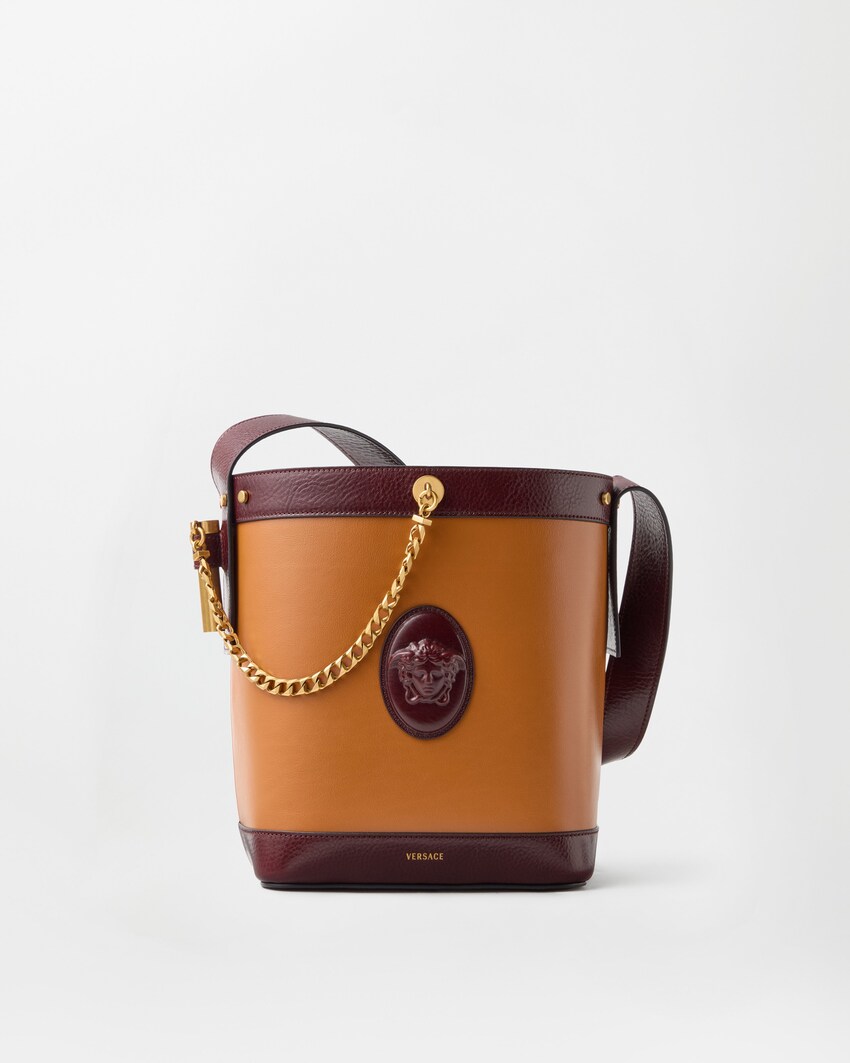
The leather goods, which Capri Holdings has identified as the key growth category, remain a hard sell. The Medusa-head hardware is distinctive, but it does not carry the same weight as a Chanel double-C or a Gucci double-G. The La Medusa bag, introduced in 2022 as the house's answer to the Dior Saddle or the Loewe Puzzle, has not achieved breakout status. Sales are steady, one hears, but not exceptional. The problem may be that Versace's visual language — all that gold, all that maximalism — does not translate easily to the kind of discreet signalling that drives contemporary handbag sales.
And yet. There are moments when the house still manages to assert itself. The Medusa Aevitas platform pump, introduced in 2021, became an unexpected hit. It is an absurd object: a five-and-a-half-inch heel with a chunky platform sole and an oversized Medusa emblem at the vamp. It should not work. But it does, perhaps because it refuses to apologise for itself. That refusal — the sense that Versace will not soften its codes to meet the market halfway — remains the house's strongest asset. Whether it is enough to sustain a billion-dollar business is another question entirely.
One thinks of Gianni's atelier in the early 1990s, when he was dressing every supermodel and half the musicians who mattered. The work was never subtle. But it was coherent. It knew what it wanted to be. Versace today feels less certain, caught between its own mythology and the demands of a parent company that needs it to grow. Donatella, now sixty-eight, continues to design. The safety pins still march down the runway, holding everything in place.