Alexander McQueen is not a house you dip into lightly
Alexander McQueen is not a house you dip into lightly. The silhouettes skew dramatic, the references dense, the construction unapologetic. This is not minimalism. It is not quiet luxury. It is, instead, a vocabulary of sharp tailoring, engineered structure, and a gothic streak that runs through nearly every collection since Lee Alexander McQueen founded the label in 1992. What makes a good first piece is not the loudest one. It is the piece that holds its shape, works across contexts, and carries enough of the house codes—skull motifs, exaggerated shoulders, a certain darkness—without announcing itself from across the room. You want something that feels like McQueen without requiring an explanation. That means prioritising cut and construction over embellishment, and choosing pieces that layer into a wardrobe rather than dominate it. The house has always been about craft: pattern-cutting trained at Anderson & Sheppard, then amplified into something more theatrical. Your first piece should reflect that balance. Something precise enough to wear often, bold enough to justify the name on the label.
Under £500: The Leather Card Holder
The skull card holder is the entry point most people take, and for reason. It is small, functional, and legible as McQueen without tipping into costume. The embossed skull sits flat against grained calfskin, usually black or navy, and the whole thing measures about ten by seven centimetres. You can slip it into a jacket pocket or a jeans back pocket. It holds four cards comfortably, six if you don't mind a bit of bulk.
This is not a transformative object. It will not change how you dress. But it will last. The leather is sturdy, the stitching clean, and the skull motif—repeated across belts, boots, jewellery, and bags—is one of the house's most consistent codes. It reads as McQueen to anyone who knows, and as a well-made card holder to anyone who doesn't. That dual legibility is useful. You can carry it to a meeting or a bar without adjusting your intent.
The price sits around £250, sometimes less during sale periods. For that, you are buying into the house's visual language without committing to a full leather good or a piece of clothing. If you find McQueen's aesthetic is not for you, a card holder is easier to move on from than a £1,200 bag.
£500–£1,500: The Oversized Sneaker
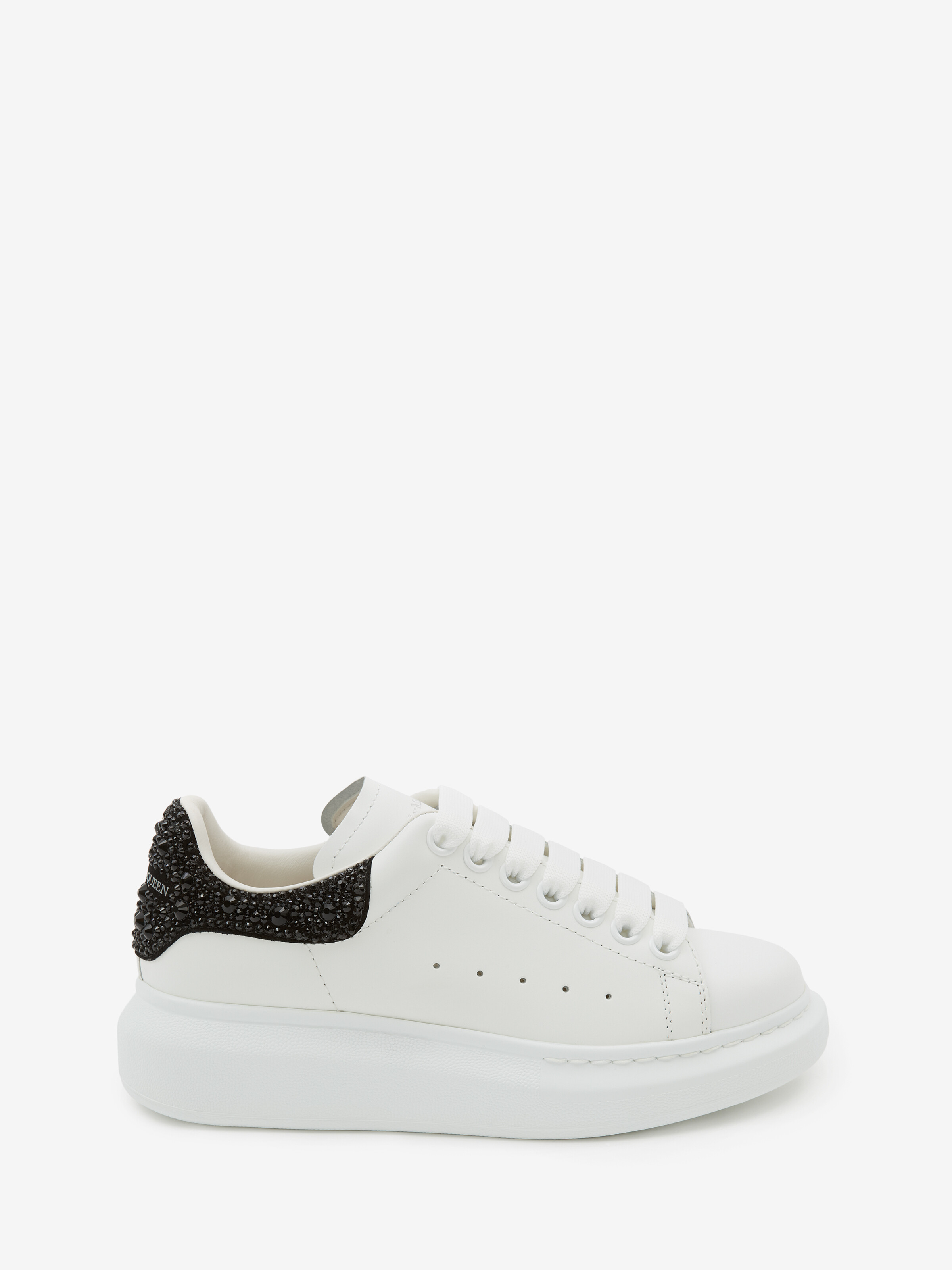
The Oversized sneaker—usually referred to by that exact name—has been in the collection since 2015 and remains one of the house's most commercially successful pieces. It is a chunky, low-top trainer with an exaggerated rubber sole and a thick heel counter. The upper is typically smooth calfskin, white with a contrasting heel tab in black, pink, or metallic. The silhouette is neither minimal nor technical. It is, instead, deliberately bulbous, a reaction against the sleek Stan Smith clones that dominated menswear in the early 2010s.
What makes it work is the construction. The sole is vulcanised rubber, hand-finished and designed to age without disintegrating. The leather is thick enough to hold its shape but soft enough to crease naturally. The laces are flat and wide, the tongue lightly padded. These are not running shoes. They are not even walking shoes, strictly speaking. They are a shaped object that happens to go on your feet.
They work best with cropped trousers or tapered denim, where the volume of the sole can sit in proportion to the rest of the outfit. Wearing them with wide trousers tends to muddy the line. The sneaker needs space to register as intentional bulk, not accidental weight.
Expect to pay around £350 to £450, depending on material. Seasonal versions with embroidered uppers or metallic finishes push closer to £600, but the core white leather model is the one to start with. It is the most versatile and the least likely to date.
Over £1,500: The Single-Breasted Tailored Jacket
If you are spending over £1,500, buy tailoring. McQueen's jackets are where the house's technical training shows most clearly. The shoulder is structured but not stiff, with a slight peak that extends the line without veering into 1980s excess. The chest is cut close, the waist suppressed, and the skirt flares just enough to balance the upper body. This is not a soft, deconstructed jacket. It is a shaped garment, built on a canvas interlining and designed to impose a silhouette rather than drape around one.
The single-breasted jacket—usually a two-button, notch lapel—is the most wearable. It comes in wool suiting, typically a mid-weight worsted around 10 to 11oz, and occasionally in a wool-mohair blend for spring. The fabric is smooth, holds a press well, and does not pill. The lining is viscose, sometimes printed with a skull or floral motif, depending on the season.
The fit is slim but not restrictive. If you are used to Italian tailoring, this will feel more controlled. If you are used to British bespoke, it will feel looser. The sleeve is set high, the armhole slightly smaller than a standard ready-to-wear jacket, which gives more freedom through the shoulder when you move.
Prices start around £1,800 and climb depending on fabric and detailing. A plain black wool jacket will cost less than a Prince of Wales check with contrast stitching. Both will last. McQueen tailoring is built to be worn hard, not preserved.
Pair it with the Oversized sneakers if you want to lean into the house's high-low tension, or with a plain leather derby if you prefer to let the jacket do the work. Either way, the jacket is the piece that justifies the rest.
Care and Longevity
McQueen pieces are not delicate, but they do require attention. The leather goods benefit from occasional conditioning—a neutral cream once or twice a year will keep the grain from drying out. The sneakers can be wiped down with a damp cloth; avoid machine washing, which will separate the sole from the upper. The tailoring should be dry-cleaned sparingly, once or twice a season at most. Hang it on a shaped wooden hanger, and brush the fabric after each wear to lift dust and prevent matting.
The house uses solid construction methods—Goodyear welting on boots, full canvas in jackets, reinforced stitching on bags. These are not fragile objects. They will age, and they should. A McQueen piece that looks untouched after two years has not been worn enough.