Bottega Veneta doesn't do logos
Bottega Veneta doesn't do logos. It did once—briefly, in the nineties—but the house pulled back, and that restraint became the brand. What remains is craft you can feel: intrecciato weave so tight it reads as texture rather than technique, leather that breaks in instead of breaking down, and a design language built on structure rather than ornament. The result is a wardrobe that doesn't announce itself in the first three seconds but holds up under scrutiny for the next three years.
The challenge with a first Bottega piece is that the house makes entering easy and choosing hard. The accessories line runs deep—bags, shoes, small leather goods, all executed with the same material rigour—but not everything ages the same way, and not every silhouette survives a creative director handover. What works: pieces tied to the house's technical backbone rather than seasonal storytelling. Intrecciato isn't going anywhere. Neither is the maison's preference for matte calf and soft construction. A first purchase should lean into those constants.
Three budgets below. Each assumes you're after something that improves with handling and doesn't become dated the moment the next collection preview drops.
Under €500: The Zip-Around Wallet
Bottega's continental wallet in intrecciato nappa calf sits at €430. It's long enough to hold a passport, structured enough not to collapse in a tote, and woven tightly enough that the leather won't separate at the seams after two years of daily friction. Most wallets this size feel like compromises—too flat to be useful, too bulky to be elegant. This one finds the width.
The intrecciato here isn't decorative. It's structural. Each strip of calf is woven under tension, which distributes stress across the entire surface instead of concentrating it at a few stitched seams. That's why a five-year-old Bottega wallet still closes flush while most stitched leather goods start gaping at the edges.
Colour matters more at this price point than it does higher up. Black and espresso both soften into a matte patina that reads as intentional. The seasonal brights—acid green, cobalt, burnt orange—fade unevenly and date fast. If you're buying your first piece in this category, you want something that improves as it darkens, not something that announces which season you bought it in.
The zip-around also works as a test. If the hand-feel doesn't justify the price after six months of use, Bottega probably isn't your house. If it does, you've learned what €400 worth of vacchetta calf should feel like, and you won't overpay for lesser materials elsewhere.
€800–€1,200: The Small Arco Tote
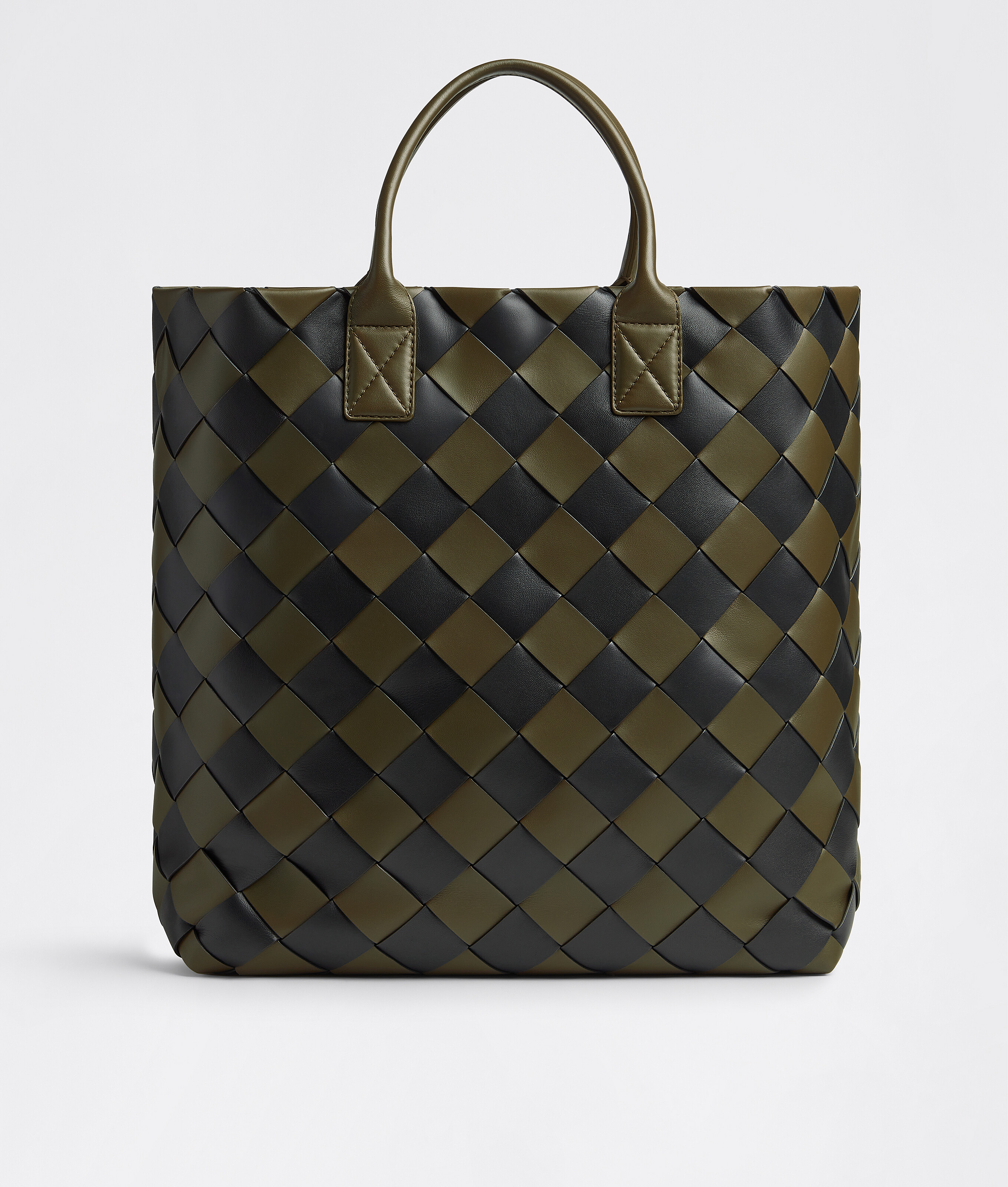
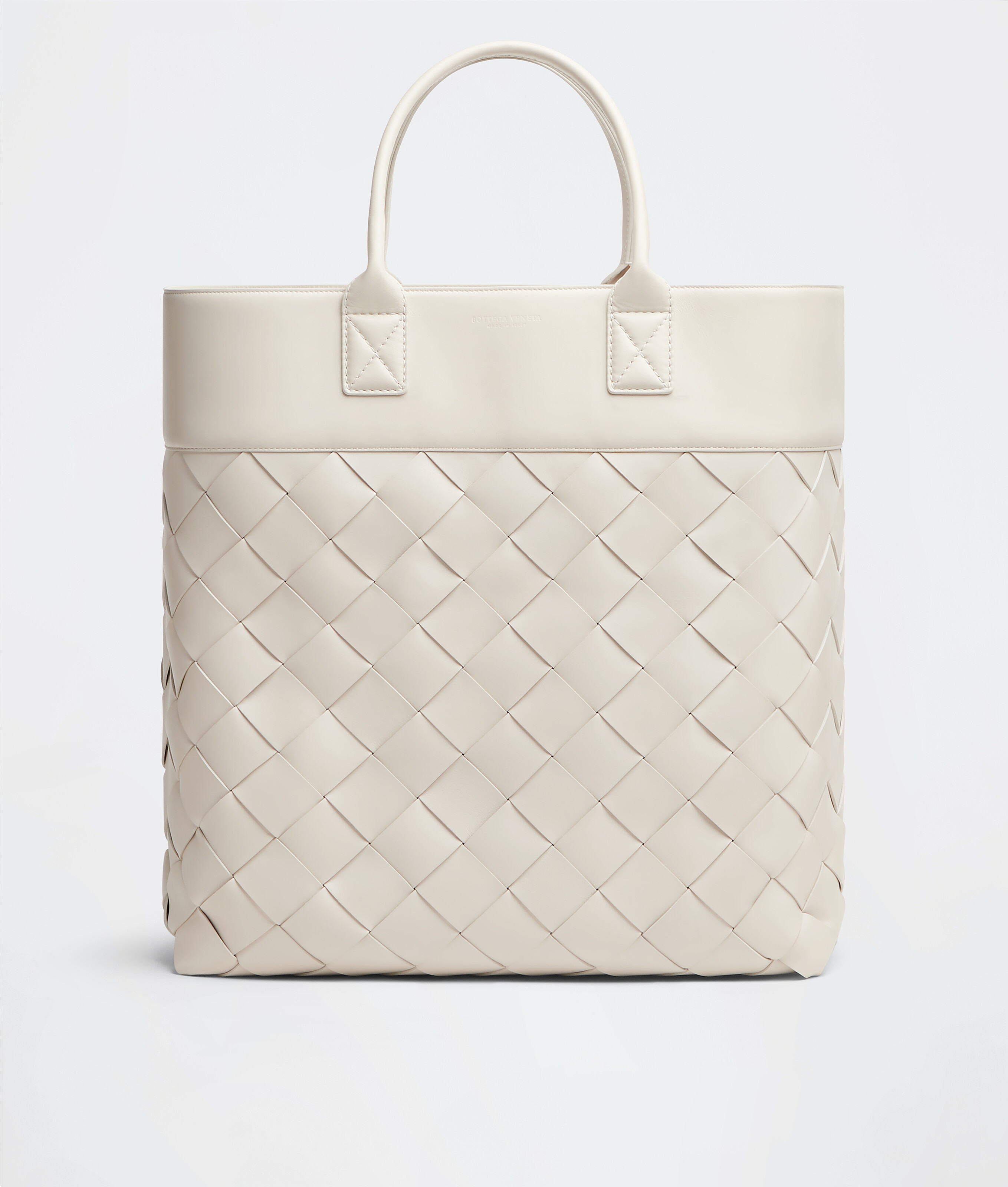
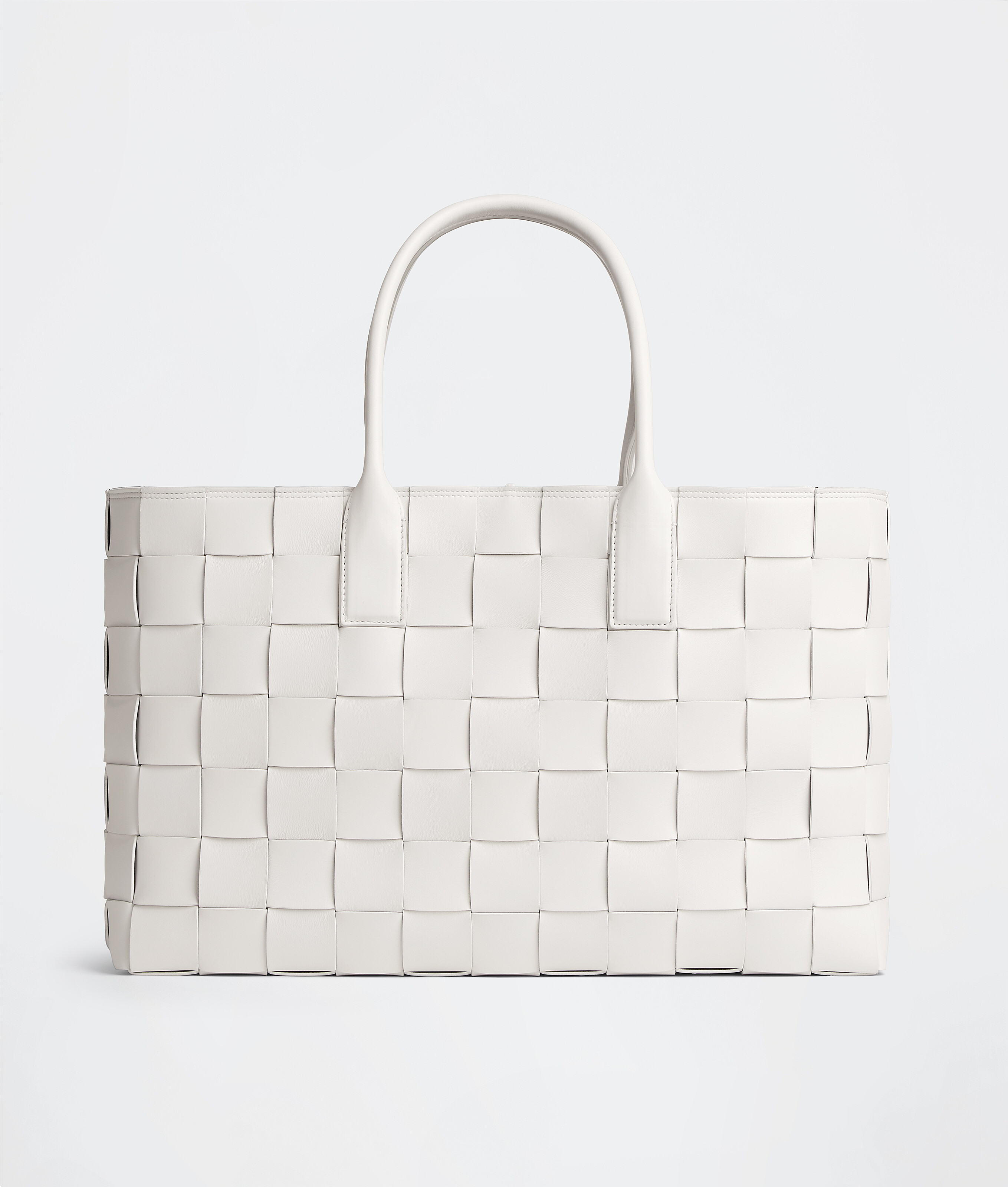
The Mini Arco sits at €1,100 and remains one of the few Bottega bags that hasn't been creatively redirected every eighteen months. Introduced under Tomas Maier, it survived the Daniel Lee era and continues under Matthieu Blazy, which suggests the design is tied to something structural rather than seasonal.
The bag is a half-moon tote with an arched top handle and a flat base wide enough to stay upright when you set it down. No feet, no hardware, no logo plate. The only detail is the way the intrecciato weave tightens as it approaches the handle, creating a gathered effect without actual gathering. It's a joinery trick—tension doing the work of embellishment.
What makes it a good first bag: it's a shape that works across contexts without requiring you to own six other bags to cover the gaps. Fits a 13-inch laptop flat, or a change of shoes and a small pouch. Soft enough to compress when half-empty, structured enough not to sag when full. The double handle drop is short enough for hand-carry, long enough to tuck under an arm when you need both hands free.
The Mini Arco also introduces you to how Bottega handles scale. The bag isn't trying to be compact. It's small relative to the full-size Arco, but it still takes up space, and that's intentional. The house designs for proportion, not for trend-driven miniaturisation. If you're used to logo bags or anything with chain straps, this will feel like a recalibration. It should.
Colour: same logic as the wallet, but with more room to move. Fondente, a dark chocolate-brown, wears in beautifully. Parakeet, a grassy green that was part of the Lee-era palette, is still available in some stockists and hasn't aged out yet. Avoid anything described as 'seasonal pop' unless you're already three bags deep and treating this as a accent piece.
€2,500–€3,500: The Intrecciato Lug Chelsea Boot
Bottega's Intrecciato Lug Chelsea in woven calf runs €2,690. It's the house's most technically complete product and the one that makes the case for why you'd pay this much for footwear in the first place.
The boot is a Chelsea silhouette—elastic side gussets, pull tab, ankle height—but the upper is full intrecciato, which means the entire vamp and quarter are woven from individual calf strips before being lasted. Most woven leather goods are flat panels stitched into shape. These are woven three-dimensionally, so the tension follows the curve of the foot. The result is a boot that flexes at the ball without creasing at the throat, which is rare in structured footwear.
The lug sole is Bottega's own mould, deeper than a dress sole but not as aggressive as a commando tread. It works on wet marble, which is the actual test for any sole in Milan between October and March. The sole is stitched and glued, which means a cobbler can replace it without dismantling the upper. Most boots at this price are cemented, which makes them disposable after two resoles.
These take about two weeks to break in. The woven calf doesn't stretch the way smooth leather does—it softens, but it doesn't give. If they're tight across the instep in the store, they'll stay tight. Size accordingly.
The boot also clarifies what Bottega does better than most houses: it builds complexity into the construction, not the decoration. There's no visible branding, no contrast stitching, no hardware. The intrecciato is the design, and the design is the reason the boot costs €2,690. You're paying for labour and material science, not for a logo hit.
On Care and Longevity
Bottega's intrecciato doesn't need much. Wipe with a dry cloth after exposure to rain. Condition once a season with a neutral cream—nothing with silicone, which clogs the weave. Don't store in dust bags for months at a time; the leather needs air circulation or it dries out.
The house offers a repair service for intrecciato goods, though turnaround is slow and pricing isn't published upfront. A rewoven panel on a bag runs somewhere between €150 and €400 depending on size. Most damage is at the corners or handle join, both of which can be reinforced before they split. Better to send it in early than wait until the weave unravels past the point of repair.