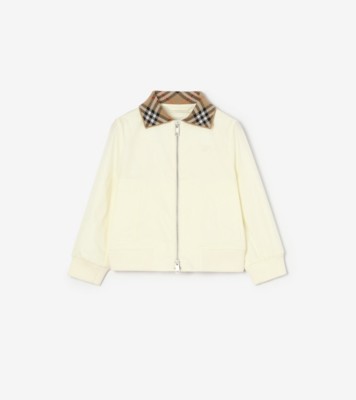
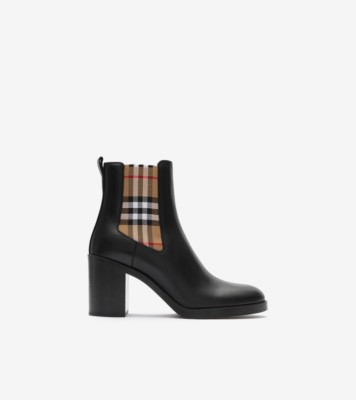
Burberry has been making clothes in England since 1856
Burberry has been making clothes in England since 1856. That longevity means something — not prestige for its own sake, but proof that certain things hold. The trench coat didn't arrive fully formed. It was refined across decades, worn by pilots and officers and then by people who just needed a coat that worked. That's the through-line: utility first, then the mythology around it.
The question for a first piece isn't what's most iconic. It's what you'll actually wear. A trench is the obvious entry, but if you live somewhere that rains twice a year, it's ornamental. A scarf makes sense if you run cold. A bag works if you need one. The right piece is the one that solves a problem you already have, and happens to be made by people who've been solving it for a century and a half.
Burberry's range splits cleanly: archive-inspired pieces that pull from the house's own past, and contemporary cuts that lean into what Daniel Lee has been building since he took over in 2022. Both matter. The former gives you the trench, the check, the gabardine. The latter gives you proportion and a kind of relaxed formality that doesn't announce itself. Start with what you need. The rest can wait.
Under £500: The Check Cashmere Scarf
The house check — that camel, red, black, and white grid — has been in production since the 1920s. It started as a trench lining. By the sixties it was outerwear. By the nineties it was everything, sometimes to its detriment. Burberry pulled back, recalibrated, and now the check works best where it started: as a detail, not a billboard.
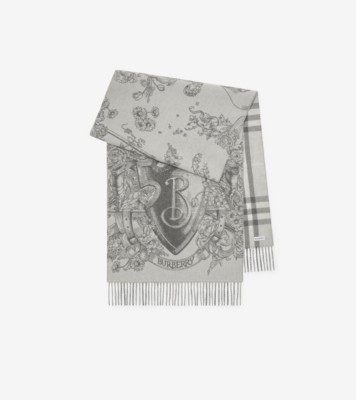
The cashmere scarf in house check runs around £450. It's not small — 168cm x 30cm, enough to wrap twice or knot once and let it fall. The cashmere is light, not bulky. It sits flat under a coat collar. You can wear it to a dinner or on a plane or over a T-shirt in October when the heating hasn't kicked in yet. It doesn't solve every cold-weather problem, but it solves enough of them.
Cashmere quality is about fibre length and ply. Burberry's sits in the mid-to-upper range: soft without being fragile, structured enough that it won't pill in the first month. This isn't the kind of scarf you baby. You wear it, you hand-wash it once a season, you let it dry flat. It improves as it gets older — the hand softens, the drape relaxes.
If the house check feels like too much, Burberry makes the same scarf in solid camel, navy, or black. The construction is identical. You lose the reference, but you gain flexibility. Either way, it's the lowest-cost entry into the house's material language, and one that doesn't require you to rethink how you dress.
£1,000–£2,000: The Knight Bag
Burberry's leather goods have had a complicated decade. The house tried several directions — logo-forward, then minimal, then somewhere in between. Lee's arrival steadied things. The Knight bag, introduced in his first full collection, is the clearest articulation of that steadying: a soft, unstructured shoulder bag with a single buckle closure and a shape that doesn't fight the body.
The medium Knight in grainy leather sits around £1,790. It's not a structured tote. It's not a slouch hobo either. It holds its form when empty but softens under weight. The single strap adjusts long enough to crossbody or short enough to tuck under your arm. The buckle is functional — it actually closes the bag — which is rarer than it should be.
The leather is pebbled calfskin, drum-dyed, with a slight texture that hides scratches. This is a bag meant for daily use, not special occasions. It fits a laptop, a sweater, a book, the debris of a normal day. The interior is suede-lined, with one zip pocket. No logo lining, no unnecessary compartments. The only visible branding is a small embossed crest on the back.
Colour matters here. The house's signature knight blue — a deep, greyish navy — works across seasons and doesn't read as either corporate or casual. Black is black. Tan develops a patina faster but shows wear in a way some people want and others don't. The blue splits the difference.
This is the bag that makes sense if you've been carrying nylon or canvas and want to shift into leather without performing that shift. It's quiet. It's not trying to announce what you paid for it.
£2,000+: The Heritage Trench Coat
The trench is the reason Burberry still exists. Thomas Burberry invented gabardine in 1879 — a tightly woven cotton that's waterproof without being coated. The British Army commissioned trench coats during the First World War. Officers wore them in the field, then kept wearing them after. By the time Bogart put one on in Casablanca, the garment had already passed from military issue to civilian uniform.
Burberry's Heritage Trench, in mid-length, runs around £2,090. The cut hasn't changed much since the 1950s: a straight silhouette, raglan sleeves, a storm shield across the right shoulder, a throat latch, a belt that most people knot instead of buckle. The gabardine is still made in Yorkshire, still woven tight enough to bead water without a membrane.
The fit is generous through the shoulders and chest — this is a coat built to layer over a suit jacket. If you're between sizes, take the smaller one. The length matters more than people think. The short version (to mid-thigh) works if you're under 5'8" or prefer a cropped proportion. The mid-length (just above the knee) is the most versatile. The long version is a commitment, and it's the right one if you live somewhere that actually rains.
The honey beige is the original, and it's still the one that works hardest. It's not quite tan, not quite khaki. It reads as neutral until you put it next to something else beige, and then you see the warmth. Black trenches exist, but they lose some of the coat's history. Navy works if you already own too much beige.
This isn't a coat you wear every day unless you live in London or Seattle. But when you need it, nothing else does what it does. It's formal enough for a wedding, practical enough for a commute, specific enough that people clock it without you saying anything.
A Note on Longevity
Burberry's construction is solid in the upper ranges, less consistent in the diffusion lines. The Heritage Trench is fully canvassed and will last decades if you treat it correctly. The Knight bag's leather is durable, but the strap hardware will loosen after a few years of heavy use — take it to a cobbler, don't wait until it breaks. The cashmere scarf is hand-wash only; dry cleaning weakens the fibre over time.
Store the trench on a wide wooden hanger, never folded. If it gets soaked, let it dry at room temperature away from heat. The gabardine will stiffen as it dries — that's normal. For the bag, condition the leather once a year with a neutral cream. For the scarf, a gentle wool wash and a flat dry is enough.
None of these pieces require precious care. They require consistent care. There's a difference. Do the small things regularly, and they'll outlast the trends that come after them.