Burberry occupies a strange position in the luxury landscape
Burberry occupies a strange position in the luxury landscape. It's a house people know before they know fashion — the check, the trench, the association with rain and British restraint. That familiarity can work against it. You see too much of something and stop seeing it at all.
But the archive is deep, and the craft is real. Burberry has been making outerwear since 1856, and that kind of institutional knowledge doesn't evaporate just because a logo gets overexposed. The question isn't whether Burberry makes good clothing. It does. The question is what to buy first, and how to buy it in a way that acknowledges both the house's strengths and your actual life.
A first Burberry piece should do a few things. It should reference the archive without being a costume. It should work across contexts — the kind of thing that moves from a work meeting to a dinner without requiring a full change. And it should be the kind of garment that gets better as it ages, not worse. Burberry's tailoring and outerwear meet that standard. Some of the accessories do too. The logo-heavy stuff, less so.
What follows are three entry points, scaled to three budgets. Each represents a different way into the house, but all three share a logic: buy the thing Burberry has been making longest, or the thing that borrows most directly from that lineage.
Under $500: The Check Cashmere Scarf
This is the obvious choice, which doesn't make it the wrong one. Burberry's check cashmere scarf has been in production, in some form, since the 1920s. It's not revolutionary. It's not trying to be.
What it is: 168 grams of cashmere in a 30-by-168-centimetre rectangle, woven in Scotland, finished with a whipstitch edge. The check itself — stone, black, red, camel — comes from the gabardine lining Burberry used in its trench coats starting in the 1920s. It became outerwear in the Sixties, when the house started making it available as a standalone pattern. You're buying a piece of house code that predates most of the people wearing it.
The weight matters here. A lot of cashmere scarves are too thin to do much, or so thick they add bulk under a coat. Burberry's sits in between. You can wear it as a layer in November or as the primary insulation in April. It doesn't slip off your neck. It doesn't pill after a season if you treat it correctly.
The check reads differently depending on what you pair it with. Over a black wool coat, it's a signature move — visible, referential, the kind of thing people clock from across the street. Over a navy peacoat or a grey topcoat, it's quieter. The pattern breaks up the monotony without competing for attention. You can also knot it at the throat, French-style, and let the ends hang inside your coat. That works if you want the warmth without the announcement.
It's $490. You'll wear it for a decade if you hand-wash it once a season and store it flat with cedar. That comes out to $49 a year, which is less than you'd spend on a wool-blend scarf that pills by February.
$1,000–$1,500: The Kensington Heritage Trench (Short)
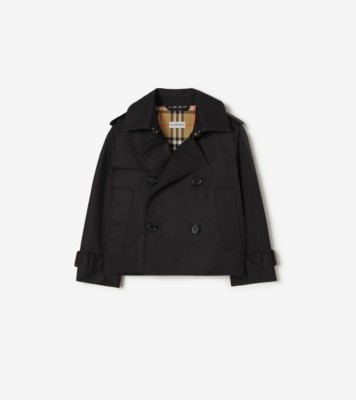
If you're buying Burberry, you should probably buy the trench. Not eventually — first. This is what the house does better than anyone else, and it's been doing it since Thomas Burberry patented gabardine in 1879. The Kensington is the entry-level silhouette, which is a misleading term because there's nothing entry-level about the construction.
The fabric is cotton gabardine, tightly woven and weather-resistant without any synthetic coating. It's the same cloth Burberry supplied to British officers in the First World War, minus the epaulettes and D-rings that came from military specs. The modern version keeps the gun flap, the storm shield, and the belt — details that have a function even if most people wearing this aren't crossing a trench in Flanders.
The short version hits mid-thigh, which is the right length if you're under six feet or if you spend any time in a car. The long version is more dramatic, but it's also more specific. It asks for a certain kind of day and a certain kind of confidence. The short works more often.
Fit matters with a trench. Burberry cuts these slim through the body, which looks clean but doesn't leave much room for layering. If you're planning to wear this over a blazer or a heavy knit, size up. The sleeves should hit your wrist bone when your arms are at your sides. The shoulder seam should sit right at the edge of your shoulder, not halfway down your arm.
Colour: go with honey or black. Honey is the house colour, and it works as a neutral in a way that navy or grey sometimes don't. Black is sharper, more urban, less referential. Both age well. Both hide the occasional coffee stain better than stone.
The Kensington starts at $1,390, depending on the season and the retailer. You can find it on sale if you're patient, but not often. This is a piece that holds its price because it holds its value. Wear it hard for five years and it'll still look like something worth keeping.
Over $2,000: The Rocking Horse Bag
Burberry's leather goods don't have the same historical weight as the outerwear, but the Rocking Horse is an exception. It launched in 2015, which makes it new by house standards, but the design borrows from the equestrian bags Burberry made in the early 20th century — structured, top-handled, built to take a beating.
The shape is a rounded trapezoid with a curved base and a single top handle. It comes in three sizes; the medium is the most practical. It's big enough for a laptop, a wallet, a book, and the debris that accumulates over the course of a day, but it doesn't look like you're hauling groceries.
The leather is calfskin, drum-dyed and finished with a slight grain. It's not the softest leather Burberry uses, but it's the most durable. The bag doesn't scratch easily, and when it does, the marks blend into the texture rather than standing out as damage. The hardware is brass-toned metal, substantial without being heavy. The closure is a fold-over flap with a rotating lock — secure, but not fussy.
What makes this work as a first bag is versatility. The Rocking Horse doesn't code as evening or day, formal or casual. It's structured enough for a meeting, soft enough for the weekend. You can carry it by the top handle or use the detachable shoulder strap. The strap is long enough to crossbody if you're tall, which most bags in this category aren't.
It's $2,490 in classic calf, more if you go for exotic skins or seasonal colours. Stick with black, dark tan, or oxblood. Those read as intentional, not trendy. And they won't look dated in three years when Burberry moves on to the next archival reference.
Care and Longevity
Burberry's strength is in garments that improve with age, but only if you maintain them correctly. The trench needs to be cleaned once a year by someone who knows how to handle gabardine — no dry cleaner that uses perc, no home washing. The cashmere scarf should be hand-washed in cold water with a pH-neutral detergent, then laid flat to dry. Don't hang it; the weight of the water will stretch the fibres.
The Rocking Horse will develop a patina, which is what you want. Condition the leather twice a year with a cream-based conditioner, not an oil. Oil darkens the leather unevenly. Cream maintains the colour and keeps the surface from drying out.
Store everything in a cool, dry place. Use dust bags for the leather, cedar for the cashmere. Don't leave the trench balled up in the back of your car for three months and expect it to come out looking sharp.
Burberry builds things to last, but lasting requires your participation. Treat these pieces like what they are — investments that pay dividends in utility and presence — and they'll outlive most of what's in your wardrobe.